How to Get Into Ecommerce: A Practical Beginner’s Roadmap
Starting an ecommerce business requires more than a website. Choose the right business model, validate product demand, calculate costs, select a sales channel, and build a reliable selling system.
If you are trying to work out how to get into ecommerce, the hardest part is usually not building a website. It is deciding what to sell, which business model fits your budget, where to sell, how orders will be fulfilled, and how customers will find you after launch.
We have seen beginners lose weeks comparing themes while the important questions are still unanswered. A good ecommerce business starts before the storefront: a real customer problem, demand you can validate, workable unit economics, reliable fulfillment, and enough cash to learn without betting everything on one launch.
Today, we’ll explain the order we use on real ecommerce projects, showing where Shopify, WooCommerce, marketplaces, dropshipping, digital products, product research, fulfillment, ecommerce marketing, and ecommerce SEO fit without turning the process into a textbook.
Let’s begin.
What Does Getting Into Ecommerce Actually Mean?
Ecommerce means selling products or services through digital channels, whether through your own online store, an Amazon marketplace listing, Etsy, social commerce, or several channels together. Whatever the channel, the online business still needs value, payment, fulfillment, and enough margin to operate.
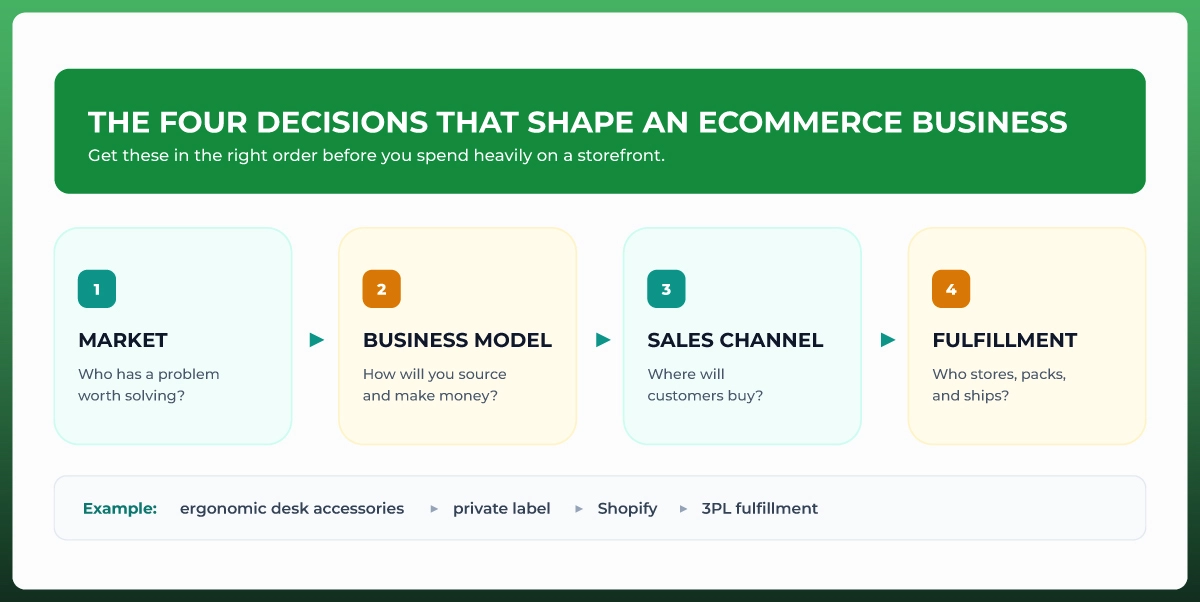
Ecommerce for beginners feels confusing because four decisions get mixed together: who you sell to, how the business makes money, where the transaction happens, and how the order is fulfilled. Shopify, Amazon, and dropshipping sit in different layers.
The easiest way to understand how to get into the ecommerce business is to separate those layers. Choose the market and ecommerce business model first, then the sales channel and fulfillment method. The ecommerce website comes after those decisions, not before them.
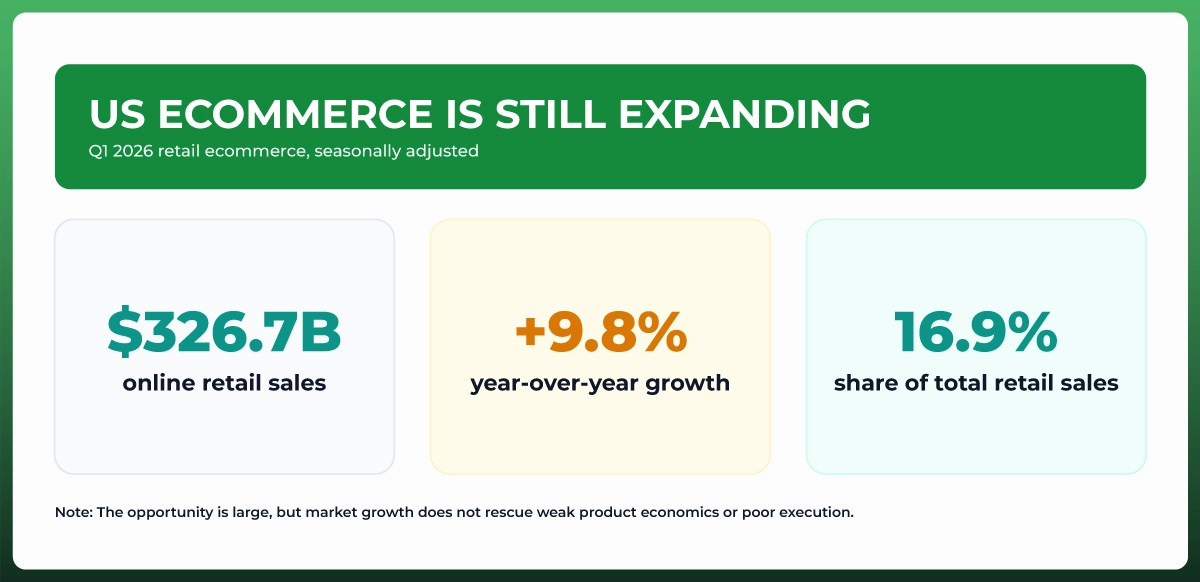
The market is still expanding. The U.S. Census Bureau reported $326.7 billion in seasonally adjusted retail ecommerce sales for Q1 2026, up 9.8% from Q1 2025. Ecommerce represented 16.9% of total U.S. retail sales that quarter. Growth creates room, but it does not make every idea viable.
Is Ecommerce the Right Business for You?
You do not need coding experience, a warehouse, or a business degree to start an ecommerce business. You need patience to research before spending, basic comfort with margins, and the discipline to improve after launch.
Skills You Actually Need at the Beginning
The useful beginner skills are practical rather than technical. Focus on five areas:
Customer research: find problems people already pay to solve.
Basic finance: understand margin, cash flow, and break-even.
Product judgment: compare quality, demand, and differentiation.
Copy and merchandising: explain value clearly without overselling.
Digital tools: work comfortably with your store, analytics, and marketing platforms.
How Much Time Can You Realistically Commit?
A side hustle can work, but sourcing, customer questions, marketing, inventory management, refunds, and supplier communication still need regular attention. Start with a model that fits the hours you can protect each week.
If your schedule is tight, a small catalog or digital products can be easier to manage than an inventory-heavy store. With more time than capital, lean harder on customer research, content, and direct outreach before heavy ad spend.
How Much Risk Can You Afford?
Your risk tolerance should shape the model. Private label and wholesale give more control but tie up cash. Dropshipping and print on demand reduce inventory exposure while giving you less control over fulfillment, quality, and margin.
Protect enough cash for a second test. If the first inventory order, website, and ad campaign consume the whole budget, you cannot correct a bad assumption. Early ecommerce business ideas usually need refinement.
Expectations vs. Reality
Ecommerce is not automatic passive income. Products, acquisition, fulfillment, returns, cash flow, and customer service still need attention. Automation helps later; early involvement shows you where the business is leaking.
Competition is not proof that a niche is dead. It can confirm demand. The real question is whether a defined customer has a better reason to choose you through product fit, positioning, service, convenience, content, or price. That is closer to real ecommerce success than simply finding an uncrowded category.
Choose Your Way Into Ecommerce
Before choosing a platform, decide how the business will make money and who carries the inventory risk. This is where many people researching how to get into ecommerce business make the first expensive mistake: choosing a tool before choosing a model.
Model
Upfront Capital
Inventory Risk
Control
Speed to Launch
Best For
Main Trade-Off
Private label/own brand
Medium to high
High
High
Slower
Long-term brand builders
Inventory and sourcing commitment
Wholesale/reselling
Medium
Medium to high
Medium
Medium
Sellers with supplier access
Less differentiation
Dropshipping
Low to medium
Low
Low to medium
Fast
Product testing and lean starts
Supplier and shipping dependence
Print on demand
Low
Low
Medium
Fast
Creators and niche brands
Lower margin and production control
Handmade/custom
Low to medium
Medium
High
Medium
Skilled makers
Production capacity can limit scale
Digital products
Low
None
High
Fast
Knowledge and creative businesses
Demand and differentiation still matter
Subscription ecommerce
Medium
Medium
High
Medium
Repeat-use categories
Retention and fulfillment discipline
Dropshipping and Print on Demand
Dropshipping can test demand without a large inventory purchase. The trade-off is control: your supplier affects shipping speed, packaging, quality, and returns, so supplier selection matters as much as the product.
If this model is the direction you are considering, our guide on how to start dropshipping on Shopify goes deeper into supplier selection, store setup, legal basics, and the first-sale workflow without repeating that entire process here.
Private Label, Wholesale, and Reselling
Private label gives you stronger product and brand control but requires more cash and sourcing discipline. Wholesale and reselling can launch faster around known demand, although competition often shifts toward price, availability, and marketplace position.
Choose based on budget, supplier access, desired control, and willingness to hold stock. Do not pick private label because it sounds more serious or dropshipping because it sounds easier. Pick the risks you can actually manage.
Decide Where You Will Sell
Your sales channel is separate from your business model. The same product can sell through a website, Amazon, eBay, social commerce, or several channels, each with different trade-offs around traffic, data, fees, branding, and operations.
Your Own Ecommerce Store
An owned store gives you the most control over brand experience, customer relationships, and conversion. Shopify is a strong hosted option for commerce-first beginners, while WooCommerce suits businesses that want more WordPress control.
Wix and BigCommerce can also be strong fits depending on catalog complexity and team skills. Instead of choosing from a logo grid, compare total cost, checkout, payments, integrations, SEO control, inventory needs, and your next two or three years of growth. Our best ecommerce platforms comparison covers that decision in detail.
Online Marketplaces
Marketplaces reduce one major beginner problem: finding an audience from zero. Amazon, eBay, Etsy, and Walmart already have shoppers and checkout infrastructure. In return, you operate inside their fees, policies, rankings, and customer relationship rules.
Amazon says independent sellers account for more than 60% of sales in its store, and U.S. independent sellers averaged more than $375,000 in annual sales there in 2025. That figure shows the scale of the channel, not a realistic beginner earnings promise.
If Amazon is your likely first channel, start with the operational basics rather than branding extras. This Amazon seller account setup guide covers verification, selling plans, tax information, and the mistakes that can delay a new account.
For eBay, the economics and seller workflow are different. A beginner can test demand with smaller quantities and even start by selling products already available at home. Our practical guide on how to sell on eBay explains account setup, sourcing, fees, listings, and fulfillment.
Marketplace vs. Your Own Store
Factor
Own Store
Marketplace
Built-in buyer traffic
Low at launch
High
Brand control
High
Limited to moderate
Customer data
Stronger ownership
Platform controlled
Setup flexibility
High
Rule based
Acquisition burden
Mostly yours
Shared with marketplace discovery
Platform dependence
Lower
Higher
Many strong businesses eventually use both. Your store becomes the brand-owned hub while marketplaces add discovery and volume. The operational challenge is keeping prices, inventory, orders, and product data aligned, which is where structured ecommerce marketplace management becomes valuable as channel count grows.
How to Get Into Ecommerce Step by Step
The practical answer to how to get into ecommerce is not “open a Shopify account.” It is a sequence that reduces risk before you spend heavily, so every build decision has a business reason behind it.
Step 1: Set Your Goal, Budget, and Constraints
Define the goal first. Are you building a full-time company, a second income stream, moving an existing business online, or simply testing a product idea? That answer changes how much inventory, software, and marketing complexity makes sense.
Set three hard limits: the money you can invest safely, the hours you can protect each week, and the amount you can afford to lose while learning. Those constraints filter ideas faster than trend videos.
Step 2: Choose an Ecommerce Business Model
Pick one primary model from the comparison above. Combining private label, wholesale, dropshipping, subscriptions, and arbitrage on the first launch creates unnecessary suppliers, margins, workflows, and customer expectations.
A good ecommerce strategy starts narrow: one defined customer, one main offer, one fulfillment approach, and one or two acquisition channels. Expand after the business proves that customers want what you sell.
Step 3: Find a Market and Customer Problem
Start with the buyer, not a “winning product” spreadsheet. Look for recurring frustrations, desires, routines, or tasks, then study what that audience already buys and complains about in reviews, communities, search suggestions, and competitor pages.
The strongest opportunities are often familiar products with a clearer audience, better bundle, improved sizing, stronger instructions, faster delivery, or more credible offer. Proven demand plus a meaningful reason to switch is usually more useful than novelty alone.
Step 4: Research and Validate Product Demand
Product research should answer three questions: do people buy this type of product, can you reach those buyers, and is there room to compete without destroying margin? Use Google Trends for direction, then validate with marketplace demand, reviews, category pages, and competitor activity.
Treat TikTok, Pinterest, and social trends as idea sources, not proof of a durable market. A viral product can peak before your inventory arrives. For Amazon-specific research, our product research framework explains how demand, competition, reviews, seller count, sourcing, and product economics fit together.
Step 5: Check the Unit Economics Before You Buy Anything
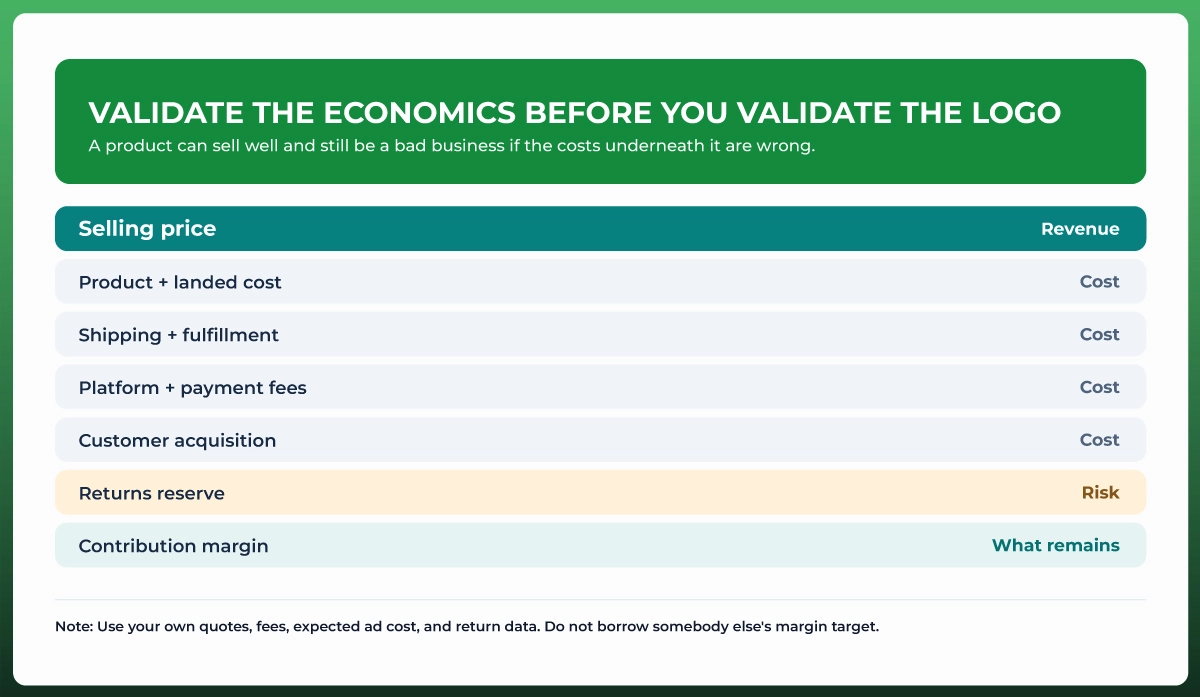
Revenue is not profit. Estimate what remains after product cost, freight, shipping, fulfillment, payment and platform fees, expected returns, discounts, and customer acquisition. If the margin only works when every order goes perfectly, the model is too fragile.
Use supplier quotes and actual platform fees instead of borrowed “ideal margin” rules. For physical products, calculate landed cost rather than factory price. For digital products, include software, payment fees, support, and paid acquisition where relevant.
Step 6: Find and Vet Suppliers or Decide How You Will Fulfill
Whether you use a manufacturer, wholesaler, dropshipping supplier, POD provider, or local maker, vet the operating details before you rely on them:
Minimum order quantity and unit pricing.
Production lead time and shipping speed.
Defect, replacement, and return policy.
Packaging, tracking, and branding options.
Backup supply if the main source fails.
Order samples when a supplier controls physical quality. Inspect the exact item, packaging, dimensions, instructions, and delivery experience the customer will receive. A cheap unit cost is not cheap if defects and delays create refunds.
Step 7: Handle the Business, Financial, and Legal Basics
Business registration, tax obligations, product rules, privacy requirements, and consumer rights vary by country and sometimes by state or province. Do not copy another seller’s setup and assume it applies to you.
Before taking live orders, make sure the basics are covered:
Required business and tax registrations.
Separate, accurate financial records.
Product-specific licenses or restrictions.
Visible shipping, privacy, refund, and return terms.
Step 8: Choose the Ecommerce Platform or Marketplace
Platform selection is easier once requirements are clear. Shopify may fit a small DTC catalog, WooCommerce a content-heavy WordPress business, and a marketplace a seller who values built-in demand over storefront control.
Do not judge an ecommerce platform by subscription price alone. Compare payments, app and transaction costs, inventory, shipping integrations, SEO controls, marketplace connectivity, reporting, and room to grow.
Step 9: Build the Minimum Store You Need to Sell
A first store needs credibility and clarity more than visual complexity. Build clean navigation, strong product pages, accurate photos, clear pricing, shipping expectations, a visible return policy, contact information, and a checkout that works properly on mobile. Those pieces reduce hesitation more than decorative animation. Baymard Institute currently puts the average documented cart abandonment rate at 70.22%, a reminder that getting people to the cart is only part of the job.
If Shopify is the right fit but you do not want the technical setup to become the project, our Shopify website design and development team handles the storefront, checkout, integrations, mobile experience, and conversion.
Step 10: Set Up Payments, Shipping, Returns, and Tracking
Choose a payment gateway that supports your market, currencies, business type, and preferred methods. Then define shipping zones, rates, delivery estimates, tracking, packaging, returns, and the process for lost or damaged orders.
This is where inventory management becomes operational. Decide how stock updates, low-stock alerts, overselling protection, supplier inventory, and marketplace quantities will work before the first campaign creates volume.
Step 11: Test Everything Before Launch
Place a real test order on both mobile and desktop, then check:
Variants, discounts, taxes, and payment.
Shipping rates and delivery messaging.
Confirmation emails and order tracking.
Analytics, contact forms, and refunds.
The same purchase completed by someone who did not build the site.
The goal is not a perfect website. It is a reliable purchase path. Launch when customers can understand the offer, pay confidently, and receive what was promised. Real behavior will tell you what to refine next.
Step 12: Get Your First Customers
Do not launch and wait for traffic. Pair one faster channel, such as paid search, paid social, creators, communities, or outreach, with one compounding channel such as ecommerce SEO, useful content, email, or repeat-customer programs.
Your ecommerce marketing plan should match how the customer discovers the product. A visually demonstrable item may suit short-form video. A high-intent problem may suit Google Search. A considered purchase may need comparison content and email nurturing. Our digital marketing services combine SEO, paid acquisition, and conversion thinking when you need those channels coordinated.
Step 13: Measure, Learn, and Improve
Track a small set of numbers from day one:
Traffic and conversion rate.
Average order value.
Customer acquisition cost.
Gross margin.
Refund or return rate.
Repeat purchase rate.
Use the numbers diagnostically. Low traffic points to acquisition. Healthy traffic with weak add-to-cart activity points to the offer or product page. Strong checkout starts with weak purchases usually signal shipping, trust, payment, errors, or friction.
How Much Does It Cost to Get Into Ecommerce?
There is no honest universal startup number. A downloadable-template business has a different cost structure from a private-label furniture brand. The useful question is what your model must pay for before you can test real demand properly.
Cost Area
Inventory-Light Model
Inventory-Based Brand
Marketplace-First Seller
Product/inventory
Low or none upfront
Often the highest cost
Depends on sourcing model
Platform/marketplace
Store software and apps
Store software and apps
Selling plan, listing and referral fees
Domain/website
Usually needed for owned store
Needed
Optional at first
Samples/quality checks
Still important
Essential
Essential for private label
Shipping/fulfillment
Supplier or POD dependent
Packaging, carrier, 3PL or self-fulfillment
FBA, FBM or marketplace-specific
Marketing
Testing budget required
Testing budget required
Ads may still be needed
Legal/tax/insurance
Varies by location and product
Varies by location and product
Varies by marketplace and business
Cash reserve
Needed for refunds and tools
Needed for reorders and returns
Needed for fees, returns and restocking
Amazon's U.S. Professional selling plan is currently $39.99 per month plus selling fees, while owned-store platforms add subscriptions and sometimes app, payment, or transaction costs. Prices vary by market and plan, so confirm current pricing before budgeting.
The common mistake is overspending on visible polish and underfunding learning. A premium theme, elaborate logo, and huge catalog cannot fix weak demand. Keep budget for samples, another test, customer acquisition, returns, and operational surprises after launch.
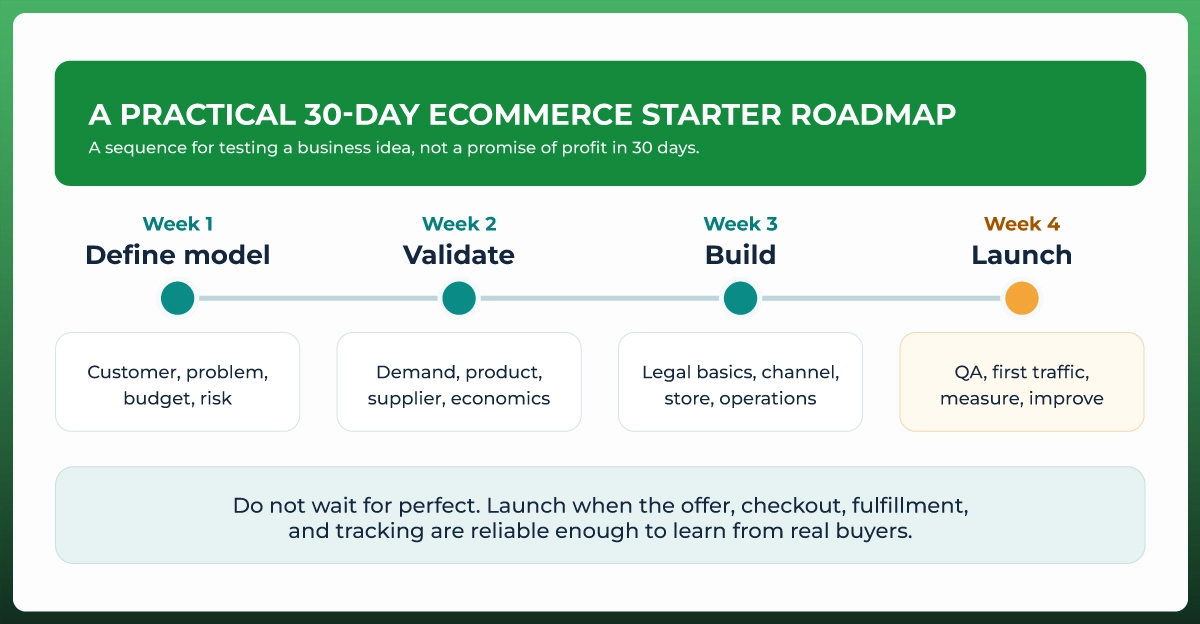
A Practical 30-Day Ecommerce Starter Roadmap
A lean ecommerce startup does not need six months of preparation, but rushing a random product online in a weekend is not a strategy. This 30-day sequence keeps validation ahead of expensive commitments.
Week 1: Define the Model
Choose the customer, problem, business model, budget, target market, and risk limits. Remove ideas that require capital, compliance, or operational complexity you cannot support yet.
Week 2: Validate the Offer
Study demand, competitors, reviews, pricing, suppliers, and economics. Order samples where relevant and identify the assumption most likely to break the idea before you move to design.
Week 3: Build the Selling System
Handle the business basics, choose the channel, create core product pages, configure payment and shipping, write policies, connect analytics, and confirm the fulfillment path from checkout to delivery.
Week 4: Launch and Learn
Run test orders, fix obvious friction, launch to a controlled audience, and start the first acquisition channel. The first objective is not scale. It is learning whether the offer converts and operations survive real orders.
Common Beginner Mistakes That Cost Money
Buying Inventory Before Validation
A supplier discount is not a reason to over-order. Large minimums may improve unit price while increasing total risk. Validate demand, test quality, and understand the sales cycle before locking cash into stock.
Choosing a Platform Before Defining Requirements
People often ask “how do I get into ecommerce” and immediately compare builders. That reverses the process. Platform fit depends on the model, catalog, payments, integrations, technical ability, budget, and channel plan. Define those first.
Copying Competitors Instead of Finding a Customer Gap
Competitor research should reveal patterns and gaps, not give you a store to clone. Read negative reviews, compare bundles and delivery promises, and study positioning. Your advantage needs to solve a customer problem, not imitate a successful homepage.
Confusing Revenue With Profit
A $20,000 sales month means little if product cost, ads, shipping, payment fees, refunds, software, and labor consume the margin. Measure contribution and cash flow, not screenshots. Healthy economics scale better than unprofitable revenue.
Underestimating Returns and Fulfillment
Returns, failed deliveries, damaged items, and support time belong in the business model. Build a reserve into the economics and choose suppliers or fulfillment partners with clear policies. The post-checkout experience can undo a great acquisition campaign.
Trying Every Marketing Channel at Once
Early data becomes noisy when a small budget is split across too many channels. Pick the channels that fit the buying journey, learn them properly, and add another only when you understand what is already working.
When Should You Scale Your Ecommerce Business?
Scale when demand is repeatable, not when one campaign has a good weekend. You should understand what more volume will do to margin, cash, fulfillment, returns, and stock before increasing spend.
Useful signs that the business is ready include:
Consistent sales from the same acquisition channel.
Stable conversion and healthy unit economics.
Reliable suppliers and fulfillment.
Repeat customers or clear retention signals.
Enough cash to reorder without starving operations.
At that point, automation, additional products, new marketplaces, international expansion, and hiring can make sense. If you own a brand and Amazon becomes a serious channel, Amazon Brand Registry can become part of the next stage by adding brand protection and access to stronger listing and advertising tools.
When Professional Ecommerce Help Makes Sense
Doing everything yourself is reasonable when the model is simple and the main objective is learning. Professional help becomes valuable when technical execution delays the business or mistakes around checkout, tracking, integrations, SEO, migration, or marketplace setup can cost more than the service.
It also makes sense when an existing business is moving online, several channels must share inventory, the catalog is complex, or validated demand is growing faster than the team can execute. The goal is to remove a real bottleneck, not outsource decisions you still need to understand.
You do not need a bigger stack. You need a launch plan that fits the business.If your model is validated and you want experienced help turning it into a reliable store and sales system, talk to Ecomgiantz about the right build and channel setup for your next stage.
Frequently Asked Questions
Can I start ecommerce with little money?
Yes, but low capital narrows the options. Digital products, print on demand, reselling, and dropshipping can reduce upfront inventory cost. You still need money or time for validation, software, acquisition, and refunds.
Which ecommerce platform is best for beginners?
There is no single best option. Shopify is a strong commerce-first choice, WooCommerce suits WordPress users who want more control, and Wix works for smaller stores. Marketplaces suit sellers who value built-in traffic.
Do I need to register a business before selling online?
It depends on where you operate, what you sell, your entity type, and platform rules. Some sellers can begin as sole proprietors; others need licenses, tax registrations, or a formal entity. Confirm local requirements before launch.
What is the easiest ecommerce business to start?
The easiest model has the fewest unfamiliar moving parts. Digital products remove shipping, reselling uses known products, and dropshipping reduces inventory risk but adds supplier dependence. Easy to launch does not mean easy to profit from.
How long does it take to make money in ecommerce?
There is no reliable timeline. An existing audience may sell quickly, while a new brand can need months of testing. Measure progress by demand, conversion, margin, and repeatability rather than a promised profit date.
Is ecommerce still profitable in 2026?
Yes. Ecommerce can still be profitable in 2026, but results depend on product economics, acquisition cost, fulfillment, competition, and retention. Market growth does not replace a differentiated offer or disciplined operations.
Should I sell on Amazon or build my own website?
Amazon offers built-in demand and trust but more platform dependence. Your own website gives stronger brand and customer control but requires traffic generation. Many businesses validate demand first, then add channels later.
Final Thoughts
The best approach to online selling is to reduce uncertainty in order: choose a customer and model, validate demand, check the economics, secure fulfillment, build the minimum selling system, and learn from buyers.
If you have been wondering how to get into the ecommerce business, do not wait for a perfect niche or storefront. Start small enough to learn but serious enough to measure whether customers buy under sustainable economics.
That is how to get into ecommerce without treating it like a lottery. Build one workable system, improve what customers and data expose, and scale only when demand, margin, and operations support more volume.
Ecomgiantz Team consists of our in-house experts who share their hands-on experience in ecommerce businesses, websites, marketplaces, etc. We also share the latest updates, insights, and market trends that can be helpful for your online business.