Black Friday Cart Abandonment: What to Fix Before Increasing Ad Spend
Reduce Black Friday cart abandonment by fixing checkout errors, unexpected costs, discount issues, and payment failures. Improve mobile shopping, clarify delivery, and use effective cart recovery strategies.
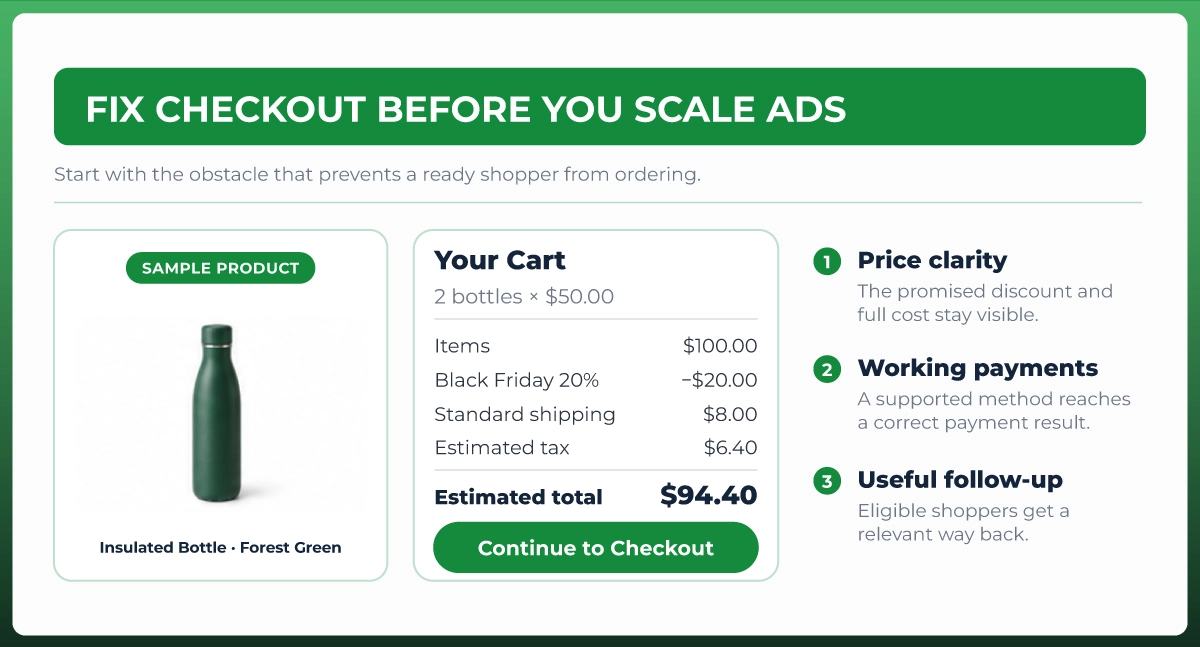
To reduce abandoned carts, your Black Friday strategies should start with working payments, clear costs, reliable discounts, and an easy checkout. You need to fix the obstacle stopping a ready shopper from buying before paying to bring more people into the same broken journey.
US shoppers spent $11.8 billion online on Black Friday 2025. It means you have the chance to give your sales a boost, but your own order completion matters more to get such a result. A busy cart dashboard can hide a discount error or delivery charge that keeps interrupting purchases.
In this article, we’ll explain how you can recover your potential customers who’ve abandoned their carts during Black Friday. You will learn how to convince them and confirm the purchase before time runs out.
Let’s begin.
What Should You Fix First Before Black Friday?
To reduce cart abandonment on Black Friday, start with evidence of blocked purchases. A shopper who cannot pay needs a working payment path. A shopper still comparing products may need more time. Those situations call for different responses.
Priority
First Action
Check Before Scaling Ads
1
Repair checkout and payment failures
A test order reaches the correct confirmation
2
Correct discounts and unexpected totals
The advertised offer matches the payable price
3
Clarify delivery and sale conditions
Shoppers can assess arrival and return options
4
Remove form and mobile friction
Guest purchasing works on relevant devices
5
Verify recovery and measurement
Messages, exclusions, links, and events work
Use this order to investigate Black Friday checkout issues, then adjust it to your store's actual failures. Black Friday checkout optimization should protect completed purchases first. Test meaningful improvements early enough to correct problems before the sale begins.
Understanding how to reduce cart abandonment starts with a basic question: where does your purchase journey stop working? Record the affected device, product, offer, and payment path. Give the person investigating enough detail to reproduce the problem and confirm the repair.
Unexpected Costs Appear During Checkout
A discount loses its appeal when the total changes unexpectedly. Baymard's 2026 abandonment reasons, excluding browsing, include 40% citing high extra costs and 12% being unable to determine the total upfront. These are shopper-reported reasons, not percentages of all abandoned carts.
How to Fix It
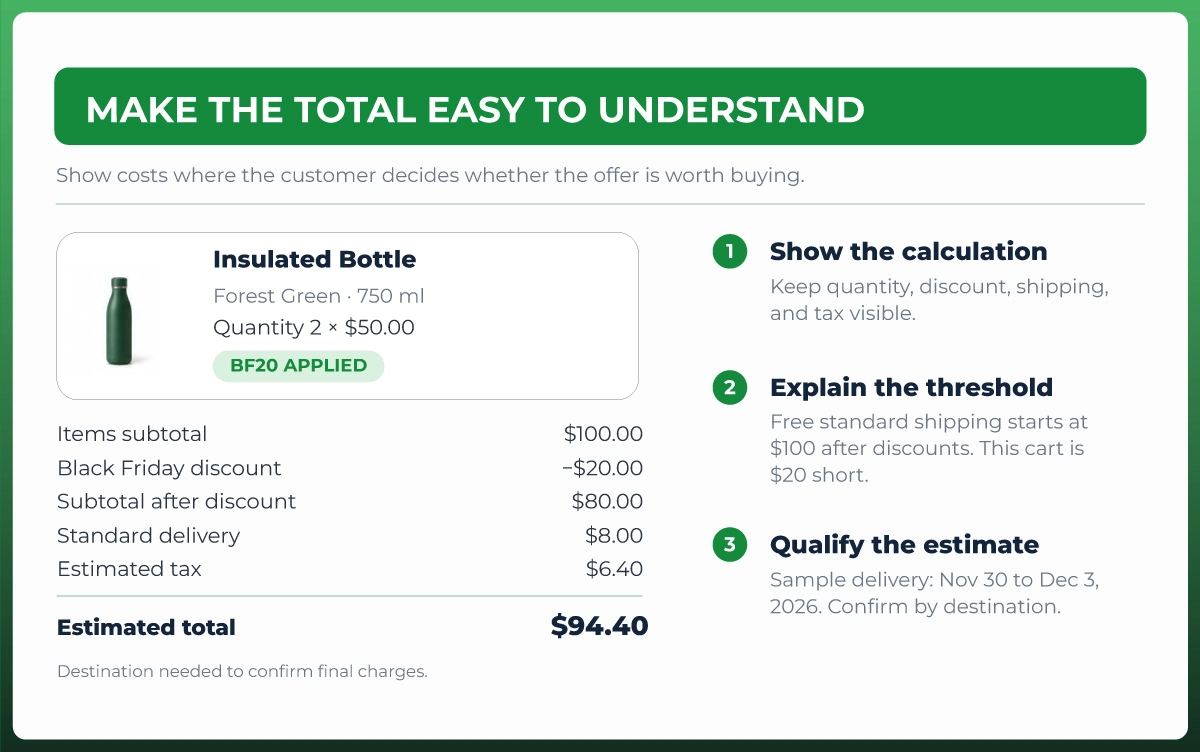
Put shipping estimates and available charges on the product or cart page where possible. Baymard's product-page research supports showing an order-cost estimate near the buying decision. Label estimates clearly and explain which destination or conditions they assume.
Show item prices, quantities, discounts, shipping, and applicable fees separately.
Explain whether free-shipping eligibility uses the subtotal before or after discounts.
Recalculate the total when quantities, variants, or delivery details change.
Black Friday Discount Codes Do Not Work
Imagine advertising 20% off, then making shoppers discover that their chosen color is excluded. Even a technically correct rule can create an avoidable surprise. Make eligibility clear before customers spend time building a cart around the offer.
How to Fix It
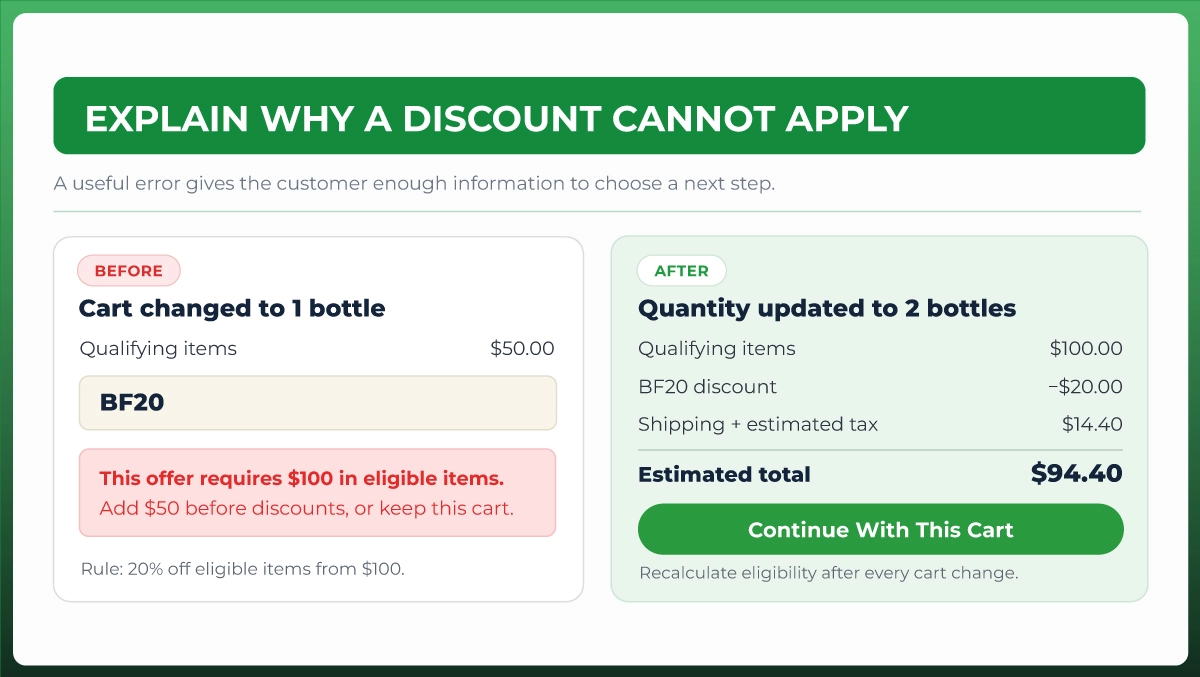
Test the combinations people will actually buy, including discounted products, bundles, gift cards, and different quantities. Check the promotion's start and end settings, currency, minimum spend, and stacking rules. Repeat the test after changing any related app or promotion setting.
State exclusions beside the offer and on relevant product pages.
Use automatic discounts when they fit the promotion.
Replace vague errors with a reason and a useful next step.
Customers Cannot Find Their Preferred Payment Method
A shopper may recognize your product but still hesitate when payment feels unfamiliar. Use your market, device mix, payment reports, and customer questions to choose suitable methods. Displaying every available option can create clutter without addressing what your customers need.
How to Fix It
Stripe's April 2025 payment-method experiment tested more than 50 eligible methods using randomized holdbacks. Dynamically showing at least one additional relevant method beyond cards produced average increases of 7.4% in conversion and 12% in revenue. Those results describe the studied environment, not a promised store uplift.
Check wallet availability on the browsers and devices your customers use.
Confirm relevant regional methods and their eligibility requirements.
Test the full purchase, including any redirect back to your store.
Compare completed orders and payment costs after a change. A popular method in one country may contribute little in another. Keep the options that help your audience complete purchases at an acceptable cost.
Payment Failures Prevent Customers From Completing Orders
Payment choice and payment reliability need separate checks. A gateway error, failed authentication, or broken return redirect can stop someone who already decided to buy. Read the payment event and order record before asking the customer to try again.
How to Fix It
Give support a clear way to distinguish declined, pending, and successful payments. Explain the next action in plain language, preserve entered details where supported, and offer another available method when appropriate. Check existing payment status before encouraging a retry.
Monitor failures by method, device, browser, and customer location.
Test authentication, unsuccessful payments, and return redirects.
Match confirmation emails and order statuses to the actual payment result.
Forced Account Creation and Long Forms Complicate Checkout
First-time shoppers may want one purchase, not another password. In the same Baymard research, 18% cited mandatory account creation and 17% a lengthy or complicated checkout. Its benchmark averages 14.88 form fields, while its usability research shows some flows need only seven or eight.
How to Fix It
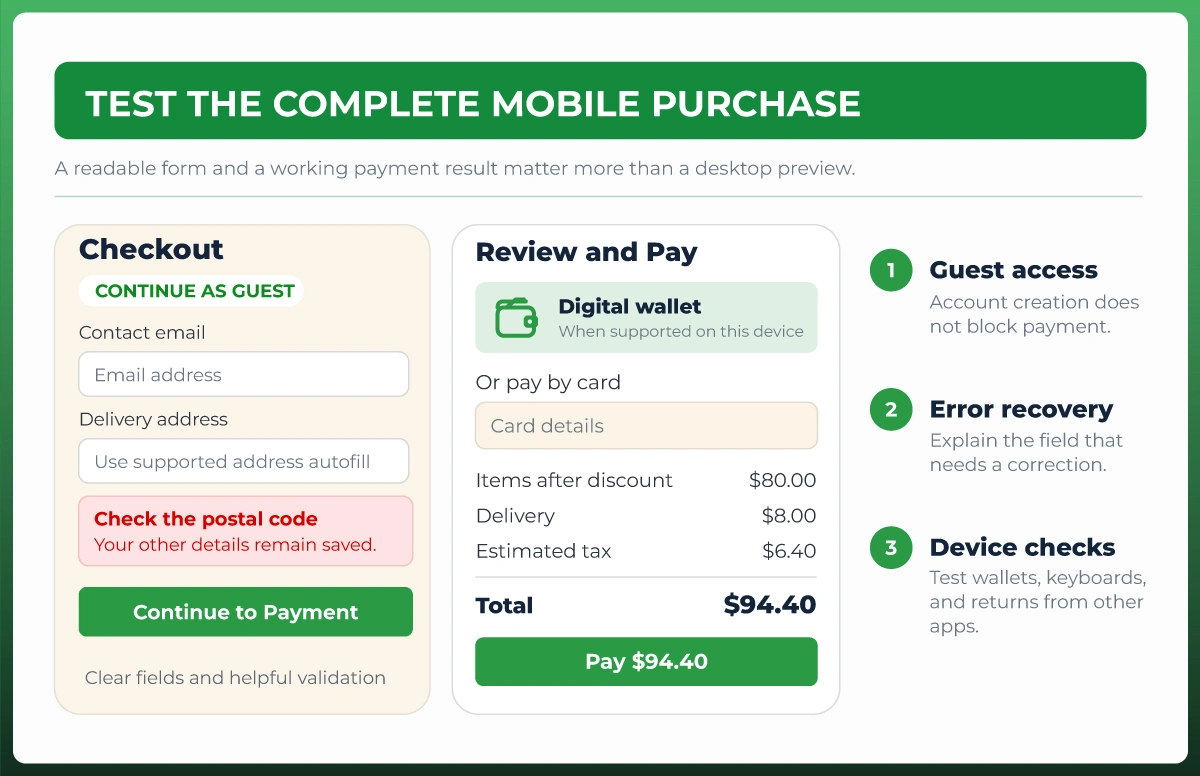
Make guest purchasing visible where supported. Ask whether every required field is necessary for payment, delivery, or a real business requirement. Keep useful autofill, explain optional information, and invite customers to create an account after they have ordered.
Hide secondary address fields until needed where the platform allows it.
Place helpful validation beside the affected field.
Retain completed information after an error.
Mobile Checkout Is Difficult to Complete
Adobe reports that smartphones drove 56.4% of US online holiday spending in November and December 2025. This spending share makes a complete phone test essential. A desktop preview cannot tell you whether a keyboard hides the payment button or an overlay blocks an error.
How to Fix It
Follow a real campaign link on a phone and complete the journey. Review the cart drawer, discount entry, shipping choice, and payment screen. Include these checks in your Shopify website design review when theme elements or app overlays create friction.
Match input types to email, phone, and address fields.
Keep totals and validation readable without zooming.
Check progress after switching apps or returning from a wallet.
Shipping, Delivery, and Return Information Is Unclear
A shopper buying a gift needs to judge whether it will arrive in time. DHL's 2026 Black Friday Trend Report says one in three Black Friday shoppers identify shipping options as their most likely abandonment stage; 81% would abandon without preferred delivery options and 74% without preferred return options.
These are survey responses, not observed checkout abandonment rates. The underlying surveys ran from December 2025 to February 2026. They support making fulfillment choices clear, while your shipping-step data should determine which changes your store needs most.
How to Fix It
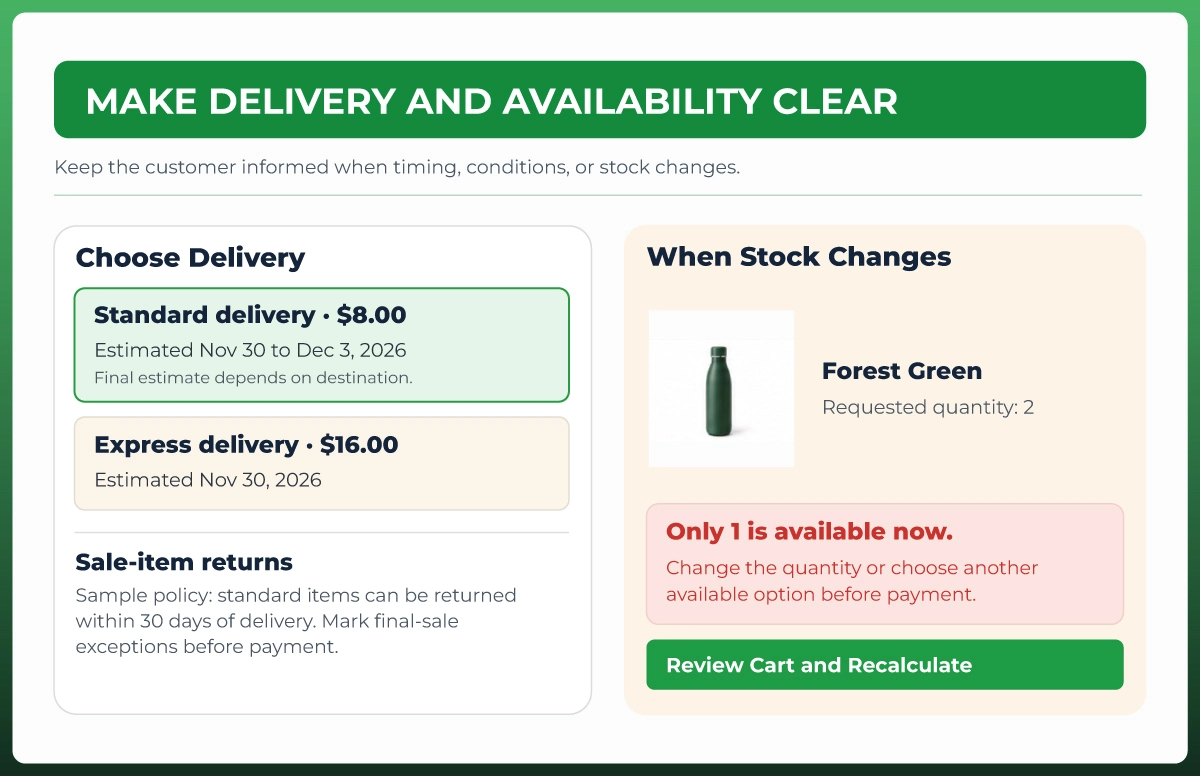
Show realistic arrival estimates alongside shipping prices. Explain destination restrictions, processing time, and relevant holiday cutoffs. Make sale-item return windows and final-sale exclusions easy to find. Update these details when actual fulfillment conditions change.
Customers Do Not Trust the Checkout Experience
An unexpected payment page can make a legitimate purchase feel uncertain. A recognizable provider helps, but the transition still needs to make sense. Explain genuine redirects before customers leave your domain, and keep branding consistent where your checkout provider allows it.
How to Fix It
Use accurate security information and genuine business contact details. Check the payment destination, HTTPS, and the route back to order confirmation. Remove unsupported security claims. Treat these checks as payment-confidence work; keep product and fulfillment explanations in their own sections.
Customers Cannot Find Answers Before Purchasing
Missing information can look like price resistance. A shopper may need a size measurement, compatibility detail, or confirmation that a bundle includes an accessory. Review repeated support questions before assuming that everyone who leaves needs a better discount.
How to Fix It
Answer common questions on the relevant product or cart page. Provide accessible support during the sale and a clear escalation route for automated assistance. Keep responses aligned with live product, promotion, and delivery information so help does not introduce a conflicting promise.
The Store Loads Slowly or Checkout Breaks Under Heavy Traffic
Some failures appear only when several systems must update together. A variant sells out, a discount recalculates, and an order awaits payment confirmation. Black Friday shoppers need a clear outcome even when availability changes while they are checking out.
How to Fix It
Test availability, variant stock, cart quantities, and order confirmations under realistic conditions. Check actual stock-reservation rules and the response when an item becomes unavailable. Include these tests in your BFCM checklist alongside performance monitoring and an incident owner who can investigate failures.
Review unnecessary scripts and cart or payment integrations.
Test common devices, slower connections, and important purchase combinations.
Retest after relevant changes and avoid unverified releases during peak traffic.
Abandoned Carts Receive No Follow-Up
To reduce abandoned carts, Black Friday strategies also need a useful follow-up for shoppers who were interrupted or still deciding. Black Friday abandoned cart strategies should reconnect people with the items and information they need while the offer remains valid.
Klaviyo's October 2026 benchmark report, based on more than 110,000 customers, reports average abandoned-cart email click rates of 6% and revenue per recipient of $6.77. These cross-industry platform benchmarks are not Black Friday recovery rates or forecasts for your store.
Before using these abandoned cart recovery templates, verify recipient eligibility, product availability, prices, recovery links, and purchase exclusions. Set delays against your purchase behavior and the actual sale window. Coordinate email marketing campaigns with recovery messages so the same shopper does not receive overlapping reminders.
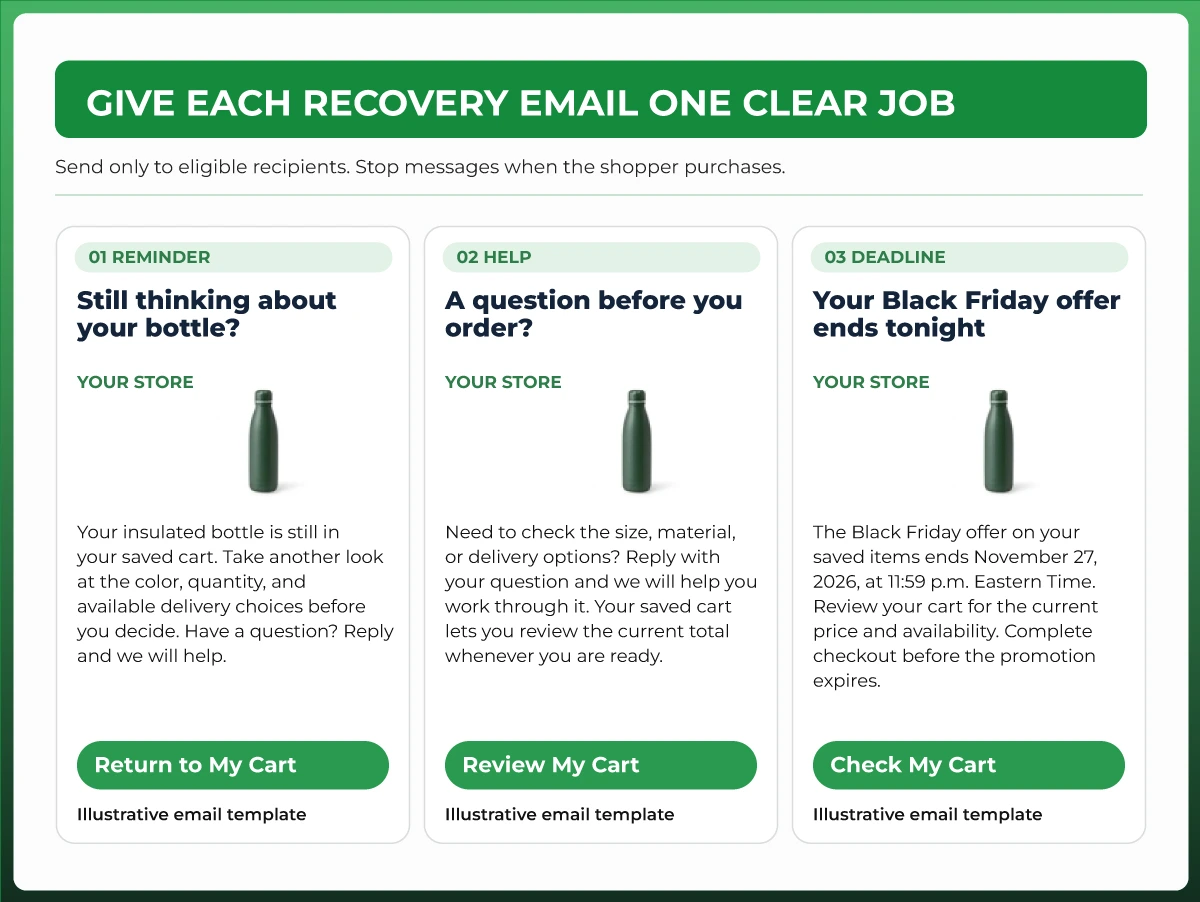
Email 1: Remind Shoppers About Their Saved Items
Subject: Still thinking about your bottle?
Preview: Review your selection and current delivery options.
Your insulated bottle is still in your saved cart. Take another look at the color, quantity, and available delivery choices before you decide. Have a question? Reply, and we will help.
Button: Return to My Cart
Email 2: Answer a Purchase Question
Subject: A question before you order?
Preview: Get help with the details that matter to your purchase.
Need to check the size, material, or delivery options? Reply with your question, and we will help you work through it. Your saved cart lets you review the current total whenever you are ready.
Button: Review My Cart
Email 3: Remind Shoppers Before the Offer Ends
Subject: Your Black Friday offer ends tonight
Preview: Check the deadline and current availability before ordering.
The Black Friday offer on your saved items ends November 27, 2026, at 11:59 p.m. Eastern Time. Review your cart for the current price and availability. If you would like to order, complete checkout before the promotion expires.
Button: Check My Cart
The third template uses an example deadline. Replace it with your real expiry date, time, and time zone, and check validity when it sends. Keep the first reminder free of an extra coupon. Consider a later incentive only when expected additional orders justify its effect on contribution margin.
Illustrative margin check: an $80 order with $54 in variable costs contributes $26 before advertising. An extra $8 coupon leaves $18 if those costs stay unchanged. You would need about 44% more orders to preserve total contribution, assuming the same order mix.
For Shopify cart abandonment, Shopify Messaging distinguishes two automations: Recover abandoned cart covers additions without checkout, while Recover abandoned checkout covers checkout starts without an order. By default, these automations send to marketing subscribers. Check recipient eligibility, channel permissions, and exclusions for the selected automation.
Cart Abandonment Problems Are Not Measured Properly
Measure BFCM cart abandonment with a consistent unit, cohort, and follow-up window. Repeated add-to-cart events are not separate shoppers. Orders completed in a later session also need consistent treatment. Reconcile your analytics with store orders before diagnosing a sudden change.
Metric
Calculation Using Matched Records
Cart abandonment rate
Carts without a completed order ÷ carts created × 100
Checkout completion rate
Completed checkouts ÷ checkouts started × 100
Recovery email click rate
Unique recipients who clicked ÷ delivered recipients × 100
Recovery revenue per recipient
Revenue attributed to recovery ÷ recipients using the platform's definition
GA4's Checkout journey report begins at begin_checkout. Use its Purchase journey report or a custom funnel for the broader path through add_to_cart, begin_checkout, and purchase. Verify required events and funnel settings; Purchase journey is closed by default, so missing steps can exclude later activity.
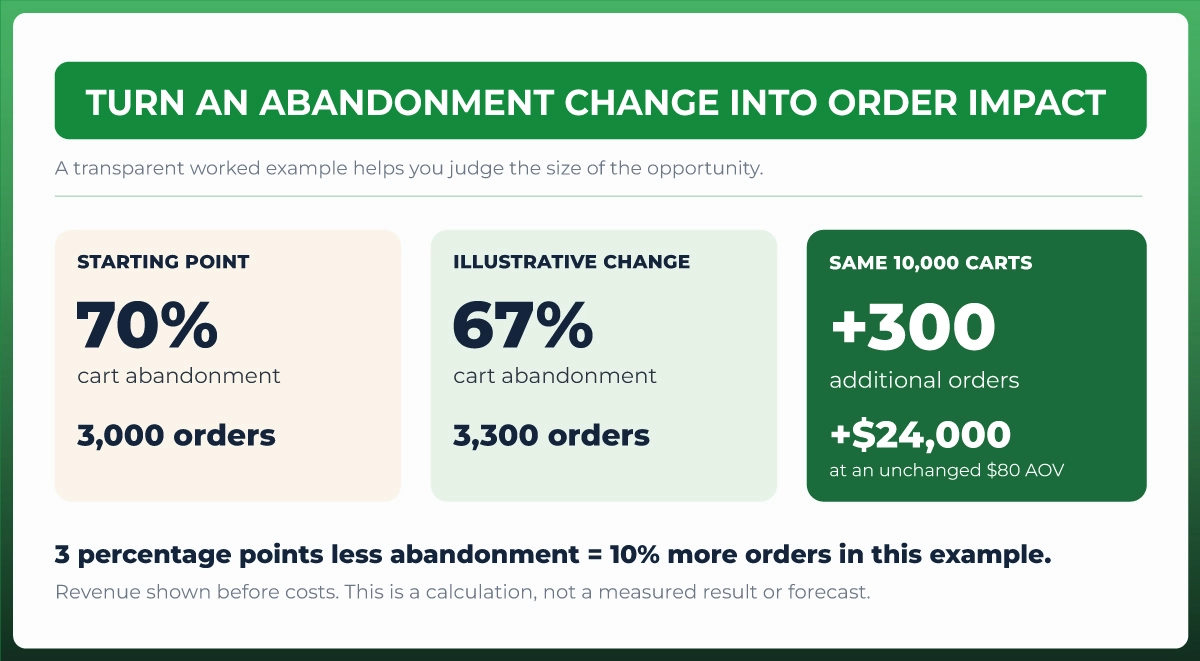
Illustrative calculation: with 10,000 carts, reducing abandonment from 70% to 67% adds 300 orders. At an unchanged $80 average order value, that represents $24,000 before costs. This is a three-percentage-point improvement and a 10% increase over the original 3,000 orders, not a forecast.
Compare completed orders, support issues, and contribution after discounts, payment fees, shipping subsidies, and returns. An attributed recovery order is not automatically an additional sale caused by a message. A suitable randomized holdout can help estimate that difference when volume supports a meaningful comparison.
Frequently Asked Questions
Why Do Shoppers Abandon Carts During Black Friday?
Shoppers may encounter unexpected costs, discount errors, difficult checkout, payment failures, or unclear delivery. Others are comparing offers or simply are not ready to purchase.
Is Cart Abandonment Always Higher on Black Friday?
No universal increase applies to every store. Compare your own rates using consistent definitions, traffic segments, and measurement windows, alongside the number of abandoned carts.
How Can Shopify Stores Reduce Cart Abandonment?
Test guest purchasing, discount rules, shipping rates, supported payments, and mobile checkout. Match recovery automations to cart or checkout events, then verify eligibility and exclusions.
How Can I Prevent Black Friday Discount Code Errors?
Test product eligibility, minimum spend, expiration settings, currencies, and stacking rules before launch. Explain exclusions clearly, and retest affected journeys whenever promotional settings change.
Do Abandoned Cart Emails Help Recover Lost Sales?
They can reconnect eligible shoppers with unfinished purchases. Monitor orders, revenue per recipient, unsubscribes, and margin, while distinguishing attributed purchases from genuinely incremental sales.
Should I Offer a Discount in a Black Friday Abandoned Cart Email?
Start with a helpful reminder. Consider a later incentive only when it fits your margins and customer context, and avoid automatically increasing an existing sale discount.
Final Thoughts
To reduce abandoned carts, Black Friday strategies should follow the evidence in your own store. Fix the clearest purchase obstacle, test a complete order, and check the result before scaling traffic. Keep recovery helpful, promises accurate, and profit visible alongside revenue.
Losing Sales To Abandoned Carts?
Optimize Your Ecommerce Checkout and Recover More Black Friday Sales With Expert Ecommerce Solutions From Ecomgiantz.
Ecomgiantz Team consists of our in-house experts who share their hands-on experience in ecommerce businesses, websites, marketplaces, etc. We also share the latest updates, insights, and market trends that can be helpful for your online business.