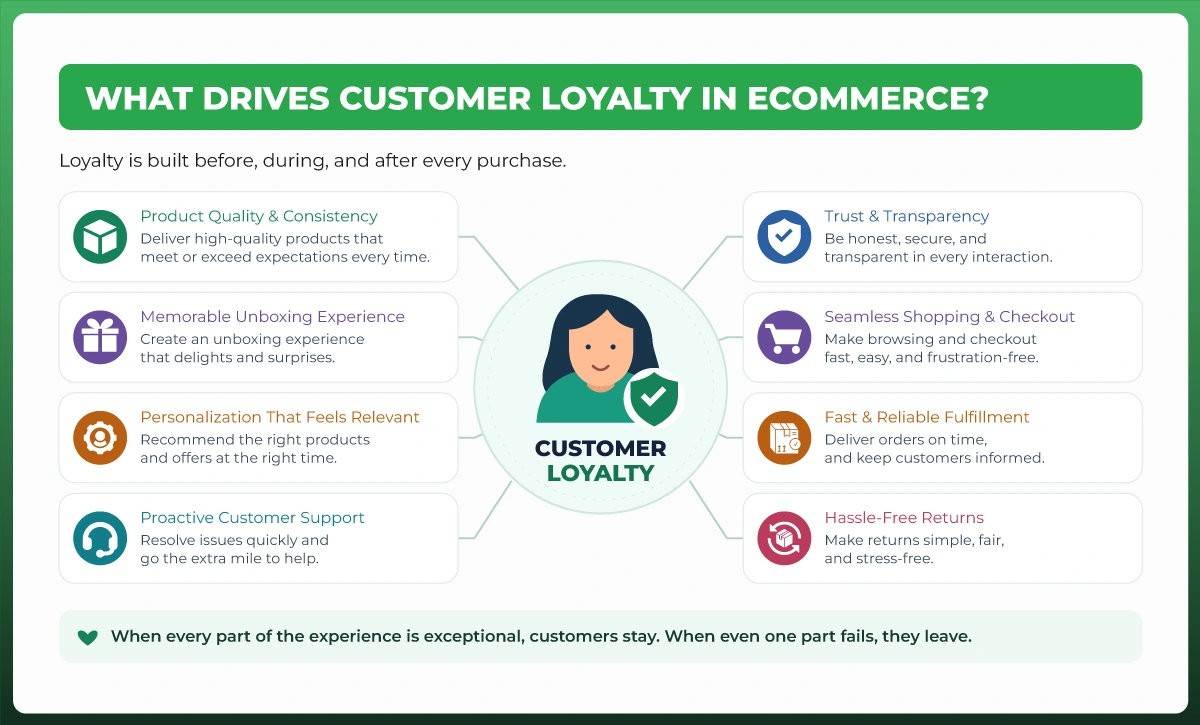
These are the core factors that drive customer loyalty in ecommerce: product quality and consistency, trust and transparency, a seamless shopping and checkout experience, fast and reliable fulfillment, personalization that feels relevant, and a strong post-purchase experience that includes proactive service and hassle-free returns.
Loyalty is not created by any single tactic. It is the combined result of everything that happens before, during, and after the purchase. When all those factors work together, customers stop comparison shopping and start defaulting to your store. When even one breaks down, they leave. And in most cases, they leave without telling you why.
This guide breaks down the specific drivers behind ecommerce customer loyalty, backed by current data and practical strategies you can apply to your own store, whether you sell on Shopify, Amazon, or any other platform.
Why Customer Loyalty Matters for Ecommerce Growth
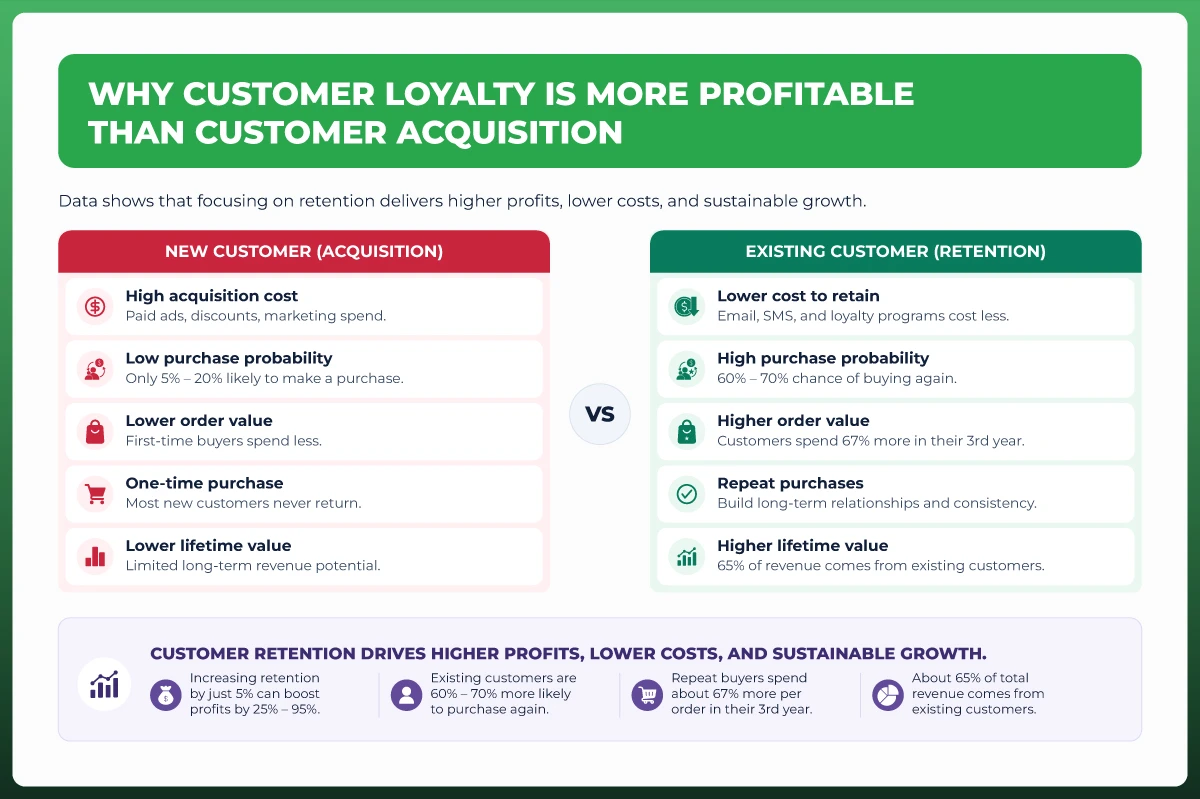
Most ecommerce brands spend the majority of their budget on customer acquisition. Paid ads, influencer deals, social campaigns. And that makes sense when you are trying to grow. But there is a problem: the cost of acquiring a new customer has jumped 40 to 60% since 2023, according to industry analysis.
Meanwhile, the average ecommerce store retains only 25 to 30%of its customers from one year to the next. That means 7 out of 10 buyers never come back.
Compare that to the economics of keeping customers around. Research from Bain and Company shows that increasing customer retention by just 5%can boost profits by 25 to 95 percent. Existing customers have a 60 to 70%probability of buying again, compared to just 5 to 20%for new prospects.
Returning customers also spend more. Data consistently shows that repeat buyers spend about 67%more per order in their third year as a customer compared to their first six months. And about 65%of a typical ecommerce store's total revenue comes from existing customers.
The math is clear. Customer acquisition gets you started. Customer loyalty is what makes you profitable. Every dollar invested in retention marketing works harder than a dollar spent chasing someone who has never heard of you.
Emotional vs. Transactional Loyalty: Why the Difference Matters
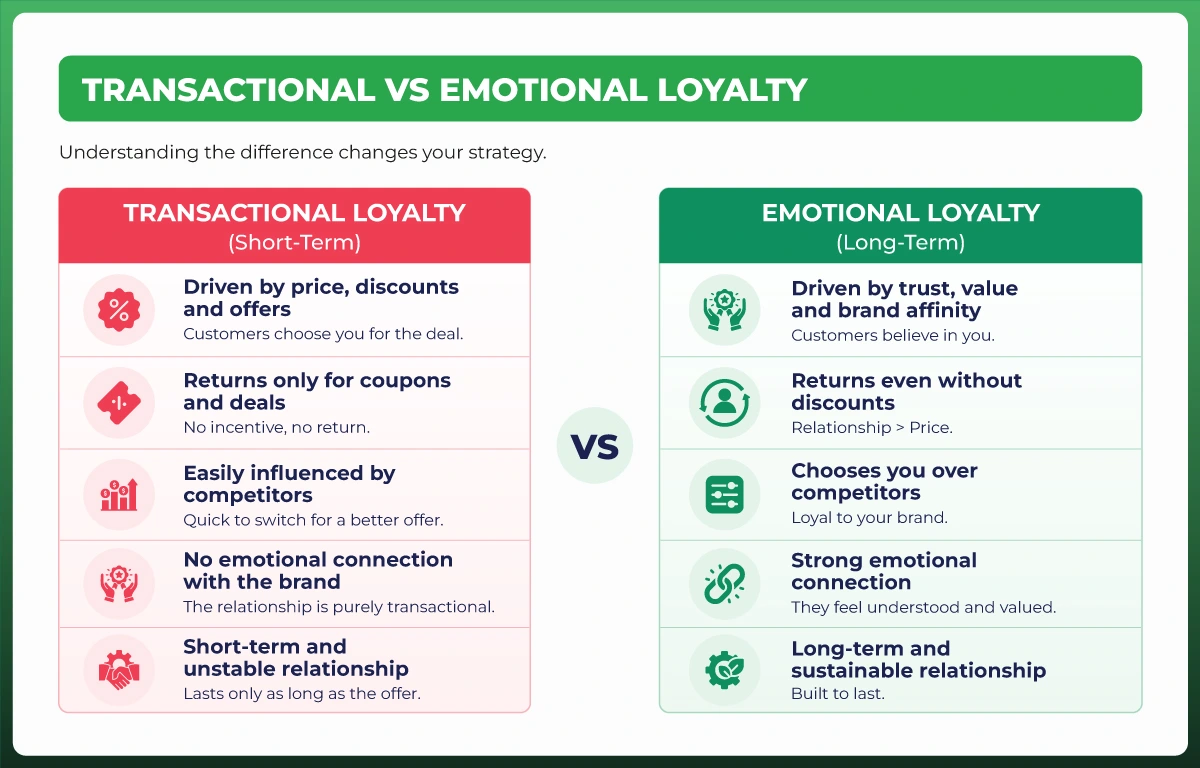
Not all loyalty is equal. There are two types, and understanding the difference will change how you approach your entire retention strategy.
Transactional Loyalty
This is the most common type. A customer keeps buying from you because of a price advantage, a convenient location, or a coupon they received. The relationship is purely functional. If a competitor offers a better deal tomorrow, the customer is gone.
Here is a simple test. If a customer only returns when you send a 20%discount code, that is transactional loyalty. The moment another store offers 25 percent, the relationship disappears. You have not built loyalty. You have trained a discount habit.
Emotional Loyalty
Emotional loyalty runs deeper. It is built on trust, brand affinity, and the feeling that a brand genuinely understands and values the customer. These are the customers who recommend you to friends, forgive the occasional mistake, and choose you even when a cheaper option exists.
Think about Amazon Prime. Members pay for the privilege of shopping there. That is emotional loyalty combined with value. They are not comparing shipping costs every time. They have decided: this is where I shop.
The goal for any ecommerce brand is to move customers from transactional to emotional loyalty. Personalized discounts and rewards programs can help start that journey. But lasting brand loyalty comes from consistently delivering an experience that makes the customer feel valued beyond the transaction.
The Core Drivers of Customer Loyalty in Ecommerce
Customer loyalty does not come from doing one thing well. It comes from consistently delivering across every stage of the customer journey. Here are the eight drivers that matter most, ordered by how a customer experiences your store.
Product Quality and Consistency
This is the foundation. No amount of marketing or personalization strategies will fix a product that disappoints. If what arrives does not match what was promised on the product page, the customer is not coming back.
Consistency matters just as much as quality. A customer who orders the same item three times and gets a different experience each time will lose confidence in your brand. Maintain strict quality control, especially when scaling. Your brand reputation is built one order at a time.
Trust and Transparency
Trust is the single biggest bridge between a first purchase and a long-term customer. And in ecommerce, where buyers cannot touch or try the product, trust has to be built deliberately.
Start with the basics. Accurate product descriptions. High-quality images that show the real product. No hidden fees that surprise customers at checkout. Clear, accessible return and refund policies.
Customer reviews play a major role here. Authentic reviews from real buyers reduce purchase anxiety and provide the social proof that advertising alone cannot deliver. Displaying both positive and negative reviews actually builds more trust than showing only five-star ratings.
Payment security is non-negotiable. Visible trust badges, SSL encryption, and well-known payment options all signal that you take customer data seriously. In an era of increasing data privacy concerns, how you handle customer data directly impacts brand loyalty.
Seamless Shopping and Checkout Experience
A complicated checkout is one of the fastest ways to lose a customer, and not just the sale. A frustrating shopping experience damages trust and reduces the likelihood of a return visit.
Baymard Institute research consistently shows that the average cart abandonment rate sits around 70 percent. Many of those abandoned carts are caused by fixable problems: unexpected costs at checkout, forced account creation, and slow page loads. A well-designed Shopify store that prioritizes speed, clarity, and mobile optimization removes these friction points.
Offer guest checkout. Support digital wallets like Apple Pay and Google Pay. Keep forms short. Let returning customers save their payment and shipping information. Every extra step you remove from the checkout process increases the chance a customer completes the purchase and comes back.
Fast and Reliable Fulfillment
You can have the best product and the smoothest checkout, but if the shipping process is slow, inaccurate, or confusing, the customer experience falls apart.
Today's customers expect fast shipping. Not necessarily free, but fast and predictable. Communicate expected delivery dates clearly at checkout. Send shipping confirmation with tracking links. And if there is a delay, tell the customer before they have to ask.
Order accuracy matters too. Sending the wrong item, the wrong size, or a damaged product creates a negative experience that one apology email cannot fix. This is what zero-defect fulfillment looks like: right product, right condition, on time, every time.
Hassle-Free Returns
Easy returns do not just reduce purchase anxiety. They actually increase total spending. Customers who know they can return an item without a headache are more likely to buy in the first place and more likely to buy again.
A clear, visible return policy builds customer satisfaction before the sale even happens. Make the process simple: prepaid labels, clear timelines, and fast refunds. Some stores even turn returns into loyalty opportunities by offering store credit with a bonus percentage, which encourages the customer to buy again instead of walking away.
Proactive Customer Service
Reactive customer support is when someone contacts you with a problem, and you solve it. That is the minimum. Proactive customer service is when you reach out before the customer even knows there is an issue.
For example: a delivery is delayed. Instead of waiting for the customer to notice and file a complaint, you send an email notification explaining the delay, giving a revised timeline, and offering a small goodwill gesture. That one proactive touchpoint can turn what would have been a negative review into a loyalty-building moment.
Offer multiple customer support channels: email, live chat, social media support, and phone. Speed matters. A 2025 Adobe study found that rude or unhelpful service is among the top three reasons consumers leave a brand entirely. Train your team to treat customer feedback as fuel for improvement, not just tickets to close.
Personalization That Feels Relevant
Personalization is one of the most powerful drivers of customer engagement. But there is a line between helpful and intrusive.
Helpful personalization uses purchase history, browsing behavior, and category affinity to surface personalized product recommendations that actually make sense. If a customer bought a coffee machine three months ago, recommending compatible filters is useful. Recommending products based on sensitive or unrelated browsing behavior is not.
Recommendation engines and algorithms can power this at scale. But even without advanced loyalty software, you can create a personalized experience through simple tactics: segmenting your email list by purchase behavior, sending replenishment reminders for consumable products, and creating personalized campaigns based on behavioral segmentation.
The data backs this up. Studies consistently show that 56%of shoppers become repeat buyers following a personalized experience. Personalization is not a feature. It is a retention strategy.
The Unboxing Experience
The unboxing moment is the first physical interaction a customer has with your brand after purchasing. It is your chance to create an emotional connection that no digital ad can replicate.
Custom packaging, branded tissue paper, a handwritten thank-you note, or a small surprise sample can all elevate a routine delivery into something memorable. These small touches signal that you care about the experience, not just the transaction.
Great unboxing experiences also drive organic content marketing. Customers share them on social media, creating user-generated content that serves as authentic, free brand advocacy.
How Trust Turns a First Purchase Into Long-Term Loyalty
Every driver mentioned above builds trust in some way. But trust itself deserves a closer look because it is the mechanism that turns a single transaction into a long-term relationship.
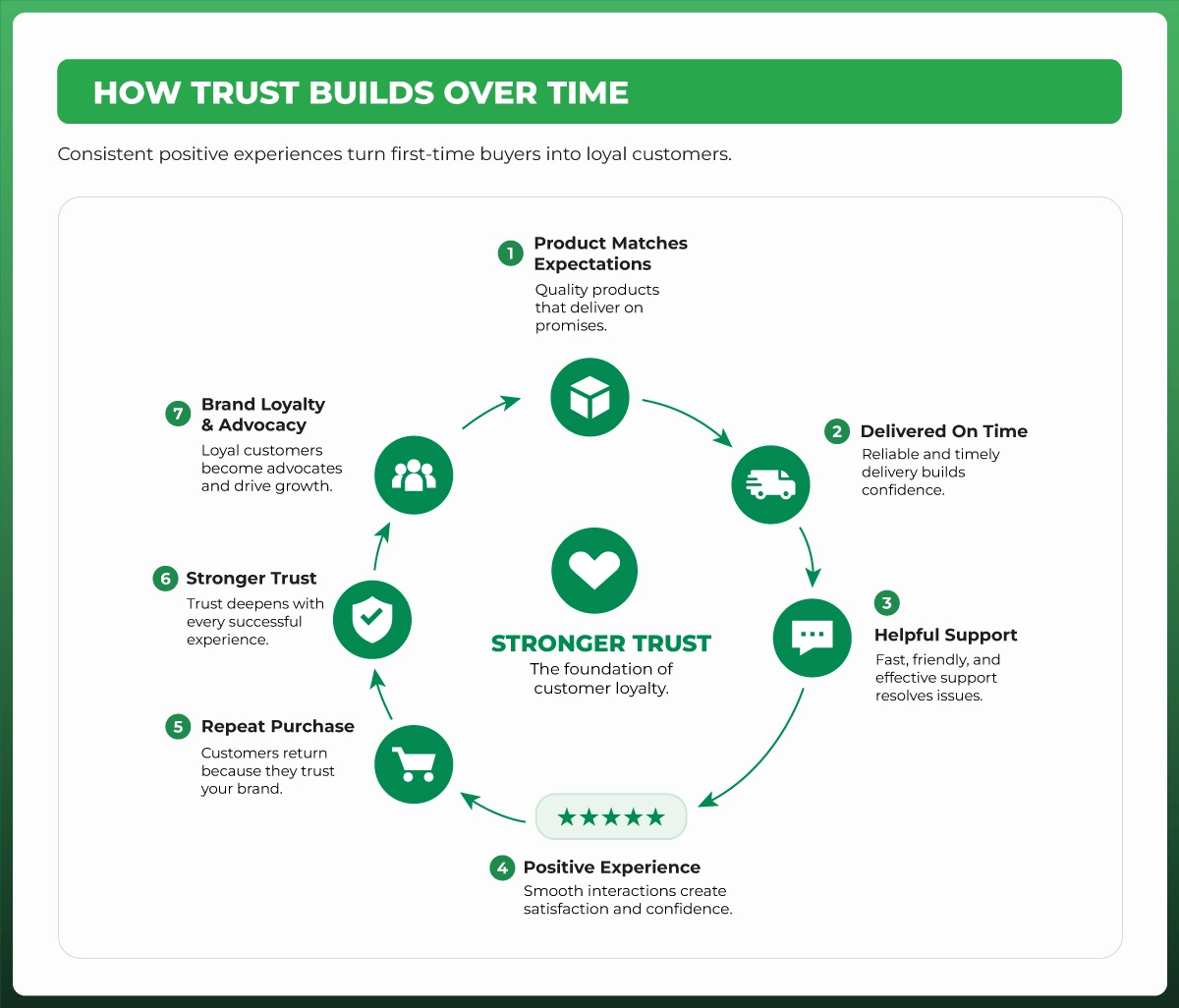
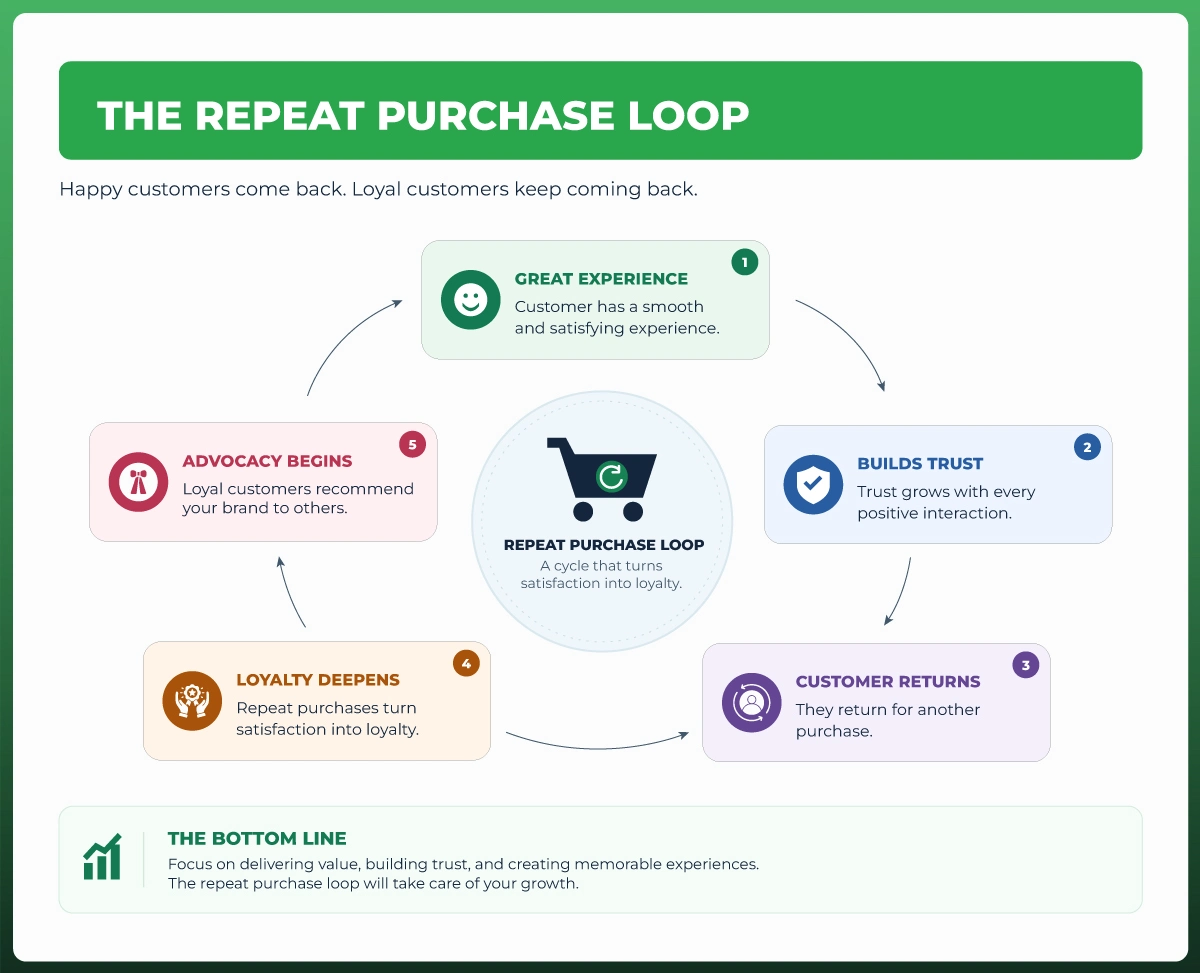
Trust is not a single moment. It accumulates. A customer places their first order. The product matches the description. It arrives on time. The quality is what they expected. Each of those small confirmations adds a layer of trust.
By the second or third purchase, something shifts. The customer stops evaluating your store against alternatives with every order. They start defaulting to you. That is what trust looks like in practice.
The reverse is also true. One misleading product description, one unexplained delay, one dismissive customer support interaction, and the trust accumulated over months can collapse instantly. Research shows that 86% of consumers stop buying from a brand after loyalty is lost.
Protect trust by keeping promises consistently. If you promise two-day shipping, deliver in two days. If you say your product is organic, make sure it actually is. If your return policy says 30 days, honor it without pushback. Transparency and consistency are the foundation of lasting customer loyalty.
Building an Omnichannel Customer Experience
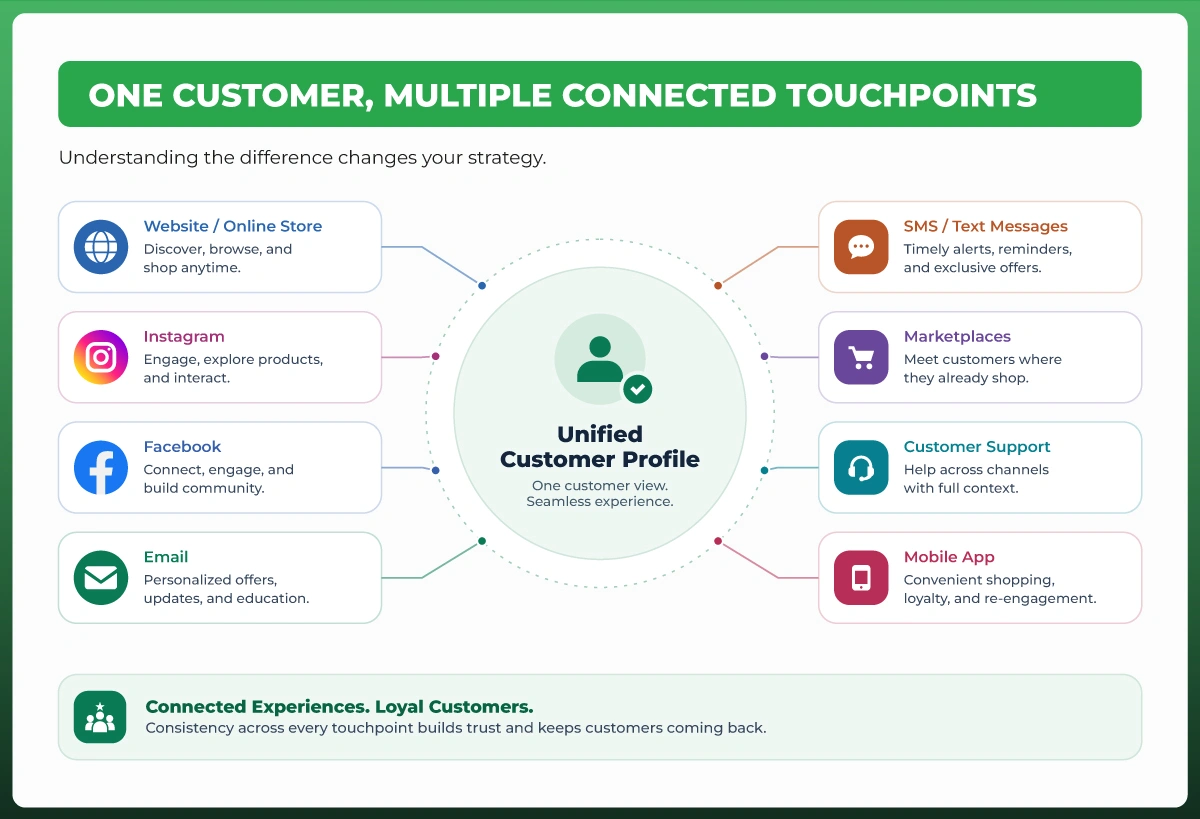
Your customers do not experience your brand through a single channel. They might discover a product through Instagram, visit your website on mobile, receive an abandoned-cart email, complete the purchase on desktop, get shipping updates via SMS, and later see a loyalty offer in their inbox.
That is at least six touchpoints. And every one of them needs to feel like it is coming from the same brand. Omnichannel communication means creating consistency across all of these interactions, so the customer journey feels seamless, not fragmented.
This goes beyond just being present on multiple platforms. It means your social media marketing, on-site messaging, email campaigns, and customer support channels all share the same voice, the same data, and the same understanding of who the customer is.
Companies with strong omnichannel engagement retain 89%of their customers, compared to just 33%for companies with weak omnichannel strategies. That is a massive gap, and it directly impacts repeat purchase rate and customer lifetime value.
Ecommerce Loyalty Programs That Actually Work
A loyalty program can be a powerful marketing tool for customer retention. But it is not a magic fix. The program has to be simple to understand, offer rewards customers actually want, and feel like a natural extension of your brand.
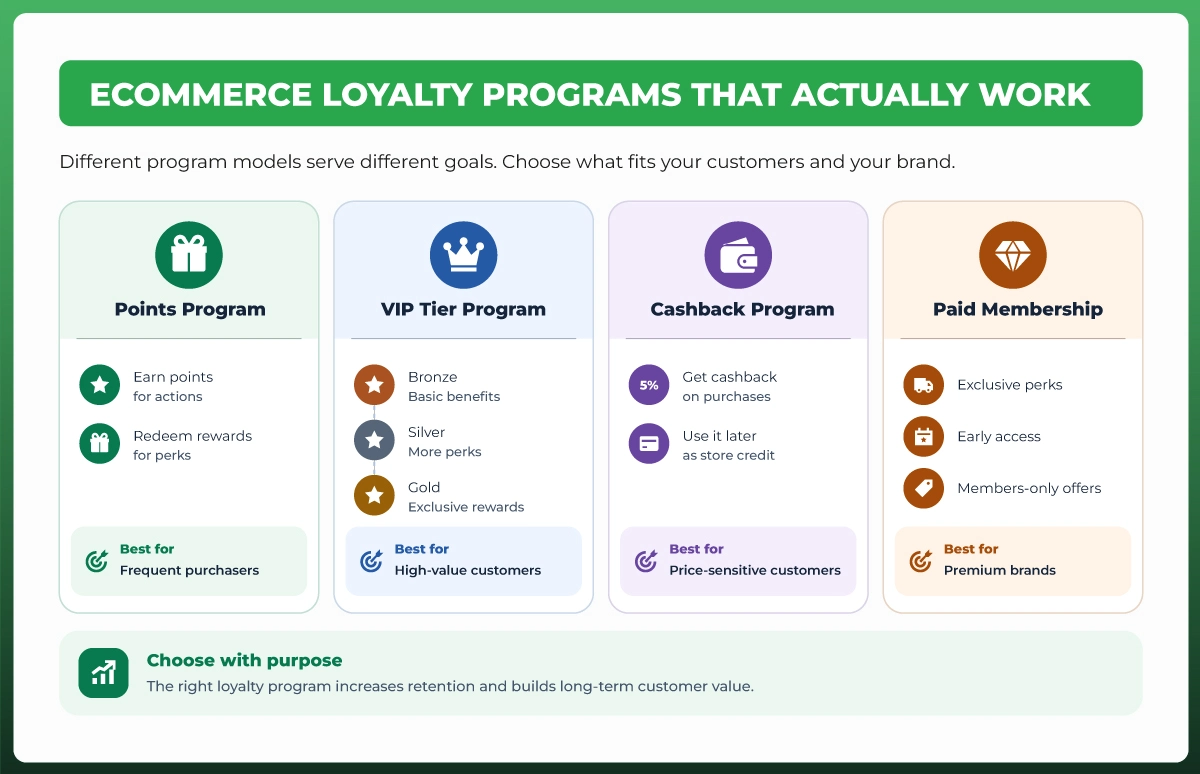
Here are the four most effective loyalty program models for ecommerce.
Points-Based Rewards Programs
Customers earn points for purchases and other actions like writing reviews, referring friends, or following your social media accounts. Points can be redeemed for discounts, free products, or free shipping. This is the most common model and works well for stores with frequent repeat purchases.
Tiered VIP Programs
Customers unlock higher tiers as their spending grows, earning progressively better rewards. This creates aspiration and a sense of status. VIP program structures generate 1.8 times higher ROI than non-tiered programs. They work especially well for brands with a wide range of products and price points.
Cash-Back Loyalty Programs
Instead of points, customers receive a percentage of their purchase back as store credit. The value proposition is immediately clear, and redemption feels straightforward. Cash-back loyalty programs are particularly effective when margins allow for a 3 to 5%return without hurting profitability.
Paid Membership Programs
Think Amazon Prime. Customers pay an annual or monthly fee for exclusive benefits like free shipping, early access to sales, or member-only pricing. This model works when the perceived value clearly exceeds the membership cost. Paid loyalty program members are significantly more likely to increase their spending after subscribing.
When You Should Not Launch a Loyalty Program
Not every store needs a loyalty program. If your margins are extremely thin, a customer loyalty program might erode profitability rather than grow it. If your product has a very long replacement cycle, like furniture or appliances, customers may not purchase often enough for a points system to feel rewarding.
If most of your customers are one-time buyers, fix the root cause first. A loyalty program on top of a poor customer experience just adds cost without solving the actual retention problem.
How to Measure Loyalty Program ROI
Track the customer loyalty program ROI by comparing the lifetime value of program members against non-members. Also monitor redemption rates, because low redemption means your rewards are not compelling enough. Industry benchmarks show that well-designed loyalty programs generate around 5.2 times average ROI. A/B testing different reward structures can help you find what works best for your specific audience.
The Post-Purchase Experience: Where Loyalty Is Won or Lost
Most ecommerce brands put all their effort into getting the sale. The product page, the ads, the checkout flow. But the period between checkout and delivery is where customer loyalty is truly decided.
Here is a practical framework for the post-purchase experience, broken into four stages.
Stage
What to Do
Why It Matters
Immediately After Purchase
Order confirmation email with order details, expected delivery date, and a thank-you message
Sets expectations and reassures the customer the order was received
During Fulfillment
Shipping confirmation with tracking link, proactive delay notifications if needed
Keeps the customer informed and reduces anxiety about delivery
After Delivery
Delivery confirmation, product care tips, setup instructions, or usage guides
Extends the experience beyond the box and builds product confidence
Drives the next purchase and deepens customer engagement
Each of these stages is an opportunity to strengthen the relationship. Skip them, and you leave money on the table. Execute them well, and you build the kind of customer lifecycle management that turns one-time buyers into long-term customers.
Retention Marketing Strategies That Build Loyalty
Retention marketing is not the same as running a loyalty program. A loyalty program rewards customers for staying. Retention marketing brings customers back at the right time, with the right message.
The most effective retention marketing tool for ecommerce is still email marketing. Automated email flows, specifically triggered by customer behavior, consistently outperform batch-and-blast campaigns. Automated emails produce 320%more revenue per dollar spent compared to standard promotional emails.
Key retention email flows include: welcome sequences for new customers, replenishment reminders for consumable products, win-back campaigns for inactive customers, and post-purchase follow-ups that request reviews or offer complementary products.
Beyond email, use data analytics and behavioral segmentation to create personalized campaigns across channels. Segment customers by purchase frequency, average order value, and recency. Your high-value customers should receive different messaging and offers than your one-time buyers.
Content marketing also plays a role. Educational blog posts, product guides, and how-to content keep customers engaged with your brand between purchases. This is especially effective for product categories with longer buying cycles.
A referral program is another powerful retention lever. Happy customers are often willing to recommend your brand, especially when both the referrer and the new customer receive a reward. Referrals carry built-in trust because they come from someone the new buyer already knows. Google Analytics and similar tools can help you track which channels and campaigns are driving repeat purchases, so you can allocate your budget accordingly.
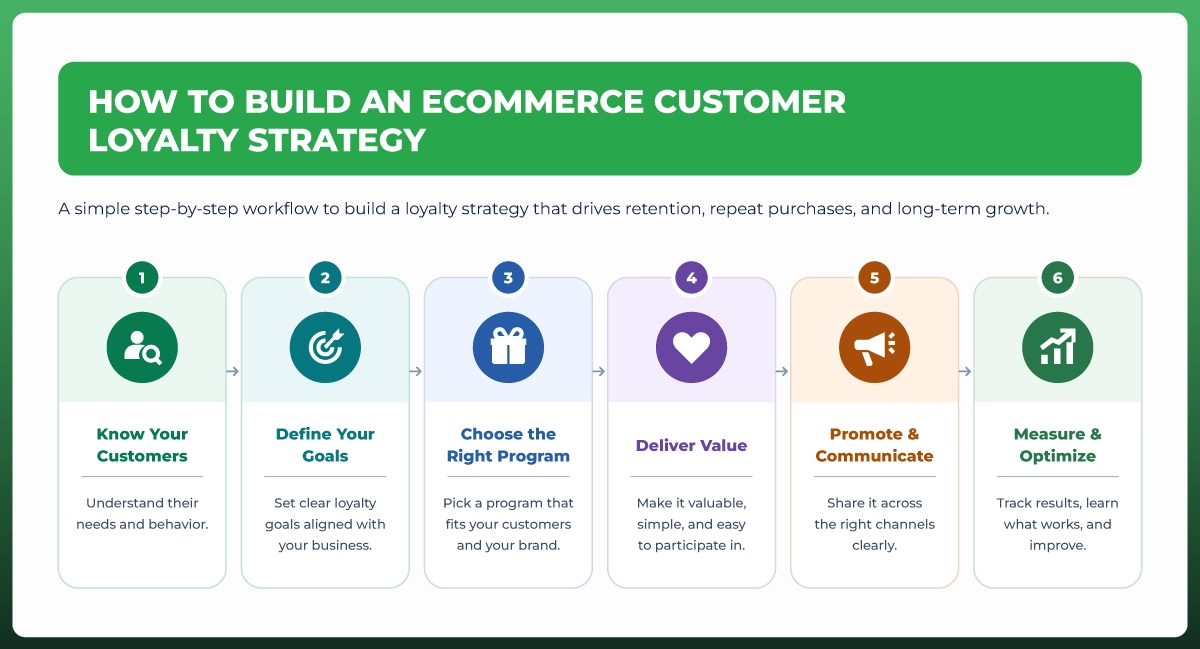
How to Build an Ecommerce Customer Loyalty Strategy
Knowing what drives loyalty is one thing. Putting it into action is another. Here is a step-by-step framework you can follow.
Step 1: Fix Product and Fulfillment Problems First
Before investing in loyalty campaigns or retention tools, audit your customer experience from end to end. Check product quality consistency, shipping accuracy, return process friction, and customer support response times. Building loyalty on top of a broken experience is like pouring water into a leaky bucket.
Step 2: Identify Why Customers Return (or Do Not)
Look at your data. What is your repeat purchase rate? Which product categories drive the most repeat orders? What does customer feedback say about why people come back or leave? Use retention metrics like purchase frequency, time between orders, and customer churn rate to understand your current baseline.
Step 3: Segment Customers by Behavior
Not all customers need the same approach. Segment them into groups: first-time buyers, repeat buyers, VIP customers (your top 5 to 10%by spending), inactive customers, and at-risk customers who have not purchased in a while. Each group needs a different message and a different offer.
Step 4: Create Relevant Retention Offers
Match your incentives to customer behavior rather than sending everyone the same blanket discount. A first-time buyer might need a personalized discount to encourage a second purchase. A VIP might value early access to new products over a coupon. An at-risk customer might respond to a targeted digital marketing campaign with a specific offer based on their past purchases.
Step 5: Build Post-Purchase Communication
Automate the post-purchase touchpoints: delivery updates, product education emails, review requests, replenishment reminders, and cross-sell recommendations. These are not optional extras. They are core drivers of the customer experience between purchases.
Step 6: Measure and Improve
Set up dashboards to track your key retention metrics monthly. Review what is working, run A/B tests on email subject lines, reward structures, and campaign timing. Loyalty strategy is not something you set and forget. It requires continuous optimization.
How to Measure Customer Loyalty in Ecommerce
If you cannot measure it, you cannot improve it. Here are the six most important metrics for tracking ecommerce loyalty and retention.
Metric
Formula
What It Tells You
Repeat Purchase Rate
Customers with 2+ purchases / Total customers x 100
The percentage of customers who buy more than once. Industry average is 25-30%.
Purchase Frequency
Total orders / Number of unique customers
How often the average customer buys. Higher frequency = stronger loyalty.
Customer Retention Rate
(Customers at end of period - New customers) / Customers at start x 100
What percentage of customers you keep over a given period.
Customer Churn Rate
Customers lost during period / Customers at start of period x 100
The inverse of retention. Lower is better.
Net Promoter Score (NPS)
% Promoters - % Detractors
How likely customers are to recommend your brand. A leading indicator of loyalty.
Customer Lifetime Value (CLV)
Average order value x Purchase frequency x Average customer lifespan
The total revenue a customer generates over their relationship with your brand.
Track these metrics monthly. Compare loyalty program members against non-members. Look at how each metric changes after you implement new retention strategies. The numbers will tell you what is working and where to invest next.
Frequently Asked Questions
What is customer loyalty in ecommerce?
Customer loyalty in ecommerce is when a buyer repeatedly chooses your online store over competitors, driven by trust, positive experiences, and the perceived value of your products and service. It goes beyond repeat purchases to include advocacy, brand preference, and forgiveness when things occasionally go wrong.
Why do ecommerce customers stop buying from a brand?
The most common reasons include poor product quality, slow or unreliable shipping, unhelpful customer service, misleading marketing claims, and pricing that no longer feels fair. Even a single bad experience can push a loyal customer to look elsewhere. Data shows 86% of consumers stop buying after loyalty is broken.
How do you increase repeat purchases in an online store?
Focus on the post-purchase experience first. Send timely shipping updates, follow up after delivery, request reviews, and offer personalized product recommendations based on previous purchases. Pair this with retention email flows, a well-designed rewards program, and consistently excellent fulfillment.
What is the difference between customer retention and customer loyalty?
Retention is about preventing churn. It is the act of keeping customers from leaving. Loyalty is deeper. It is the emotional and behavioral commitment a customer has to your brand, where they actively choose you even when alternatives are available. Retention is the outcome. Loyalty is the cause.
Do loyalty programs work for small ecommerce businesses?
Yes, but they need to be simple and sustainable. A small store does not need a complex tiered system. A straightforward points-based program with clear rewards can be highly effective. Start small, measure the impact on repeat purchase rate and average order value, and scale as you grow.
What is the most important factor in building ecommerce customer loyalty?
Consistency. Not any single tactic or tool, but the consistent delivery of a quality product, reliable service, and a shopping experience that respects the customer's time and trust. The brands that build lasting loyalty are the ones that get the basics right every single time.
Final Words
Lasting loyalty is not the product of an isolated tactic. It is not created by any single email sequence or a simple rewards program. Instead, it is the combined result of every touchpoint where your brand decides to prioritize trust and deliver genuine value beyond the transaction.
Successful brands do not rely on a secret formula. They win by mastering the basics: reliable fulfillment, proactive service, and a hassle-free return experience. They use data to offer personalization that feels relevant, ensuring every promise made on the product page is kept during the unboxing experience.
This is the core of sustainable growth. It is not about complex algorithms, but the consistent execution of a quality experience across every stage of the customer journey.
Repeat buyers spend more, drive organic advocacy, and stabilize your revenue. Investing in a retention strategy is not just a marketing choice; it is the most effective path to building a profitable and resilient ecommerce business.
Want More Repeat Customers?
Build lasting customer loyalty with expert ecommerce store management and retention-focused strategies from Ecomgiantz.
Ecomgiantz Team consists of our in-house experts who share their hands-on experience in ecommerce businesses, websites, marketplaces, etc. We also share the latest updates, insights, and market trends that can be helpful for your online business.