From our experience, the core Black Friday Cyber Monday marketing strategies are to start with an offer your margin can support, an audience likely to buy, and a clear plan for reaching that audience. As an ecommerce store owner, you need to build qualified interest before the sale, coordinate your channels through the weekend, and measure what remains after discounts, marketing, and order costs.
You can have a busy Black Friday and still feel disappointed when the numbers don’t meet your expectations. The orders arrive, but so do the advertising bills, shipping subsidies, and refunds. Before you approve another discount, decide what a worthwhile sale looks like for your business.
There is plenty of demand to compete for. Adobe's September 2026 forecast projects $47.5 billion in US online Cyber Week spending, including $12.9 billion on Black Friday and $15.1 billion on Cyber Monday. Those are projections, not completed sales or targets for an individual store.
How to Connect Black Friday, the Weekend, and Cyber Monday
Black Friday falls on November 27, 2026, and Cyber Monday follows on November 30. Plan for the days between them, too. In this guide, Cyber Week means the five-day period from US Thanksgiving through Cyber Monday; your own campaign may start earlier or finish later.
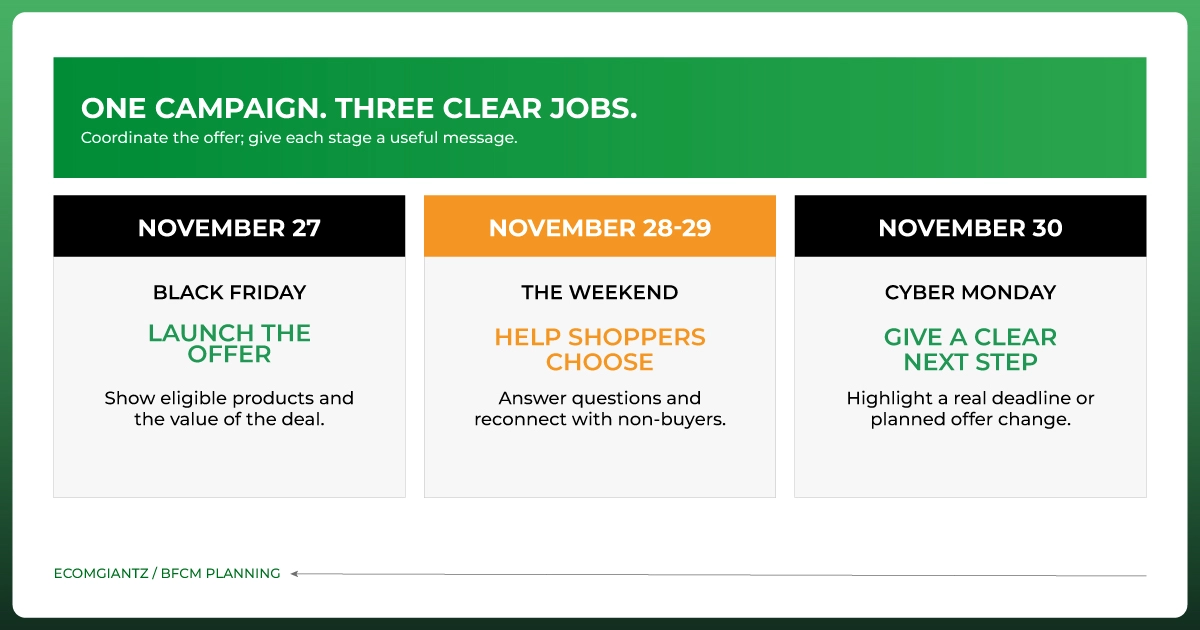
Connect your Black Friday marketing strategy and Cyber Monday marketing strategy through a shared offer plan. Change the message as shoppers move from discovery toward choosing a product, returning to a saved cart, or checking a deadline.
Campaign Stage
Main Job
Useful Message
Black Friday
Launch or reinforce the main offer
Show eligible products and the value of the deal
Saturday and Sunday
Help shoppers choose and revisit
Answer questions, feature bundles, and reconnect with non-buyers
Cyber Monday
Give undecided shoppers a clear next step
Highlight the genuine deadline or a planned offer change
You do not have to increase the discount on Monday. Keep the core offer if it still makes sense, then change the product emphasis, creative, or reminder. If you advertise a final deadline, make sure the promotion actually follows it, including the stated time zone.
12 Black Friday Cyber Monday Marketing Strategies to Apply
1. Set a Profit Goal and an Acquisition Cost Limit
Choose what you want BFCM to achieve: acquire customers for a product with repeat demand, introduce previous buyers to another category, or clear selected stock. Let that objective guide the offer and spending limit.
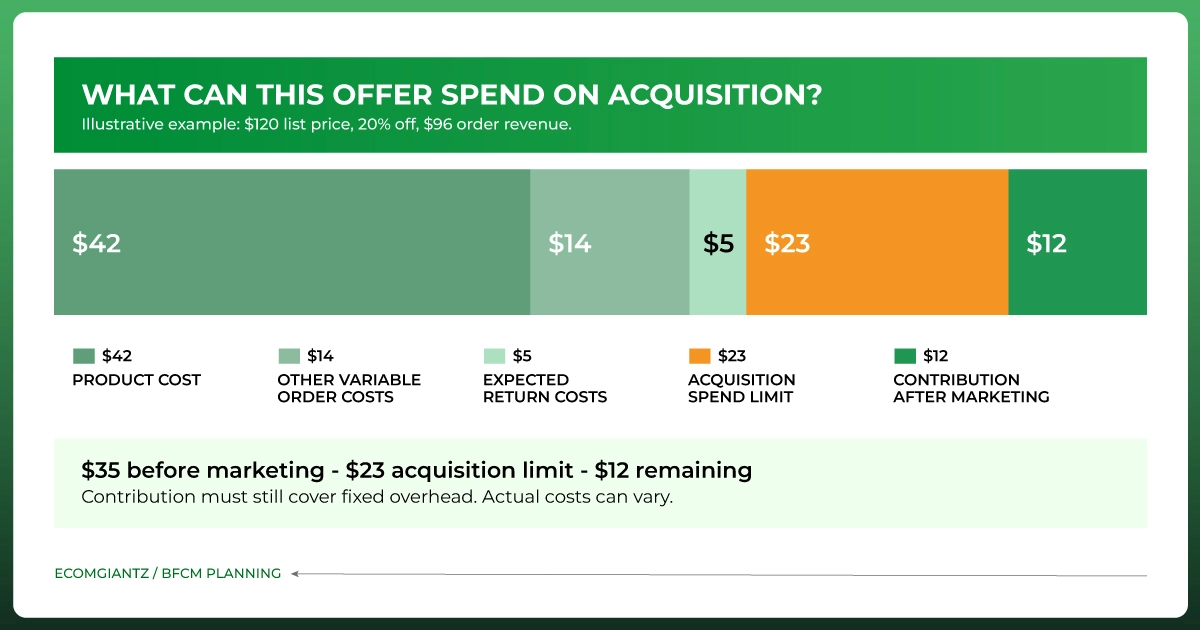
I would calculate contribution per order before approving the promotion. From discounted revenue, subtract product cost, payment fees, fulfillment, shipping subsidies, and expected return-related costs. Use the remainder to assess how much marketing spend the order can support.
Here is an illustrative example, not a benchmark. A $120 item sells for $96 after a 20% discount. Product cost is $42, other variable order costs are $14, and expected return-related costs are $5. That leaves $35 before marketing and fixed overhead.
If you want to retain $12 in contribution after acquisition, the acquisition limit is $23 for that order. Paying $28 leaves $7 instead. Check these limits by product or basket, then revisit them as the actual order mix and return costs become clearer.
2. Choose Black Friday Promotions That Fit Your Products
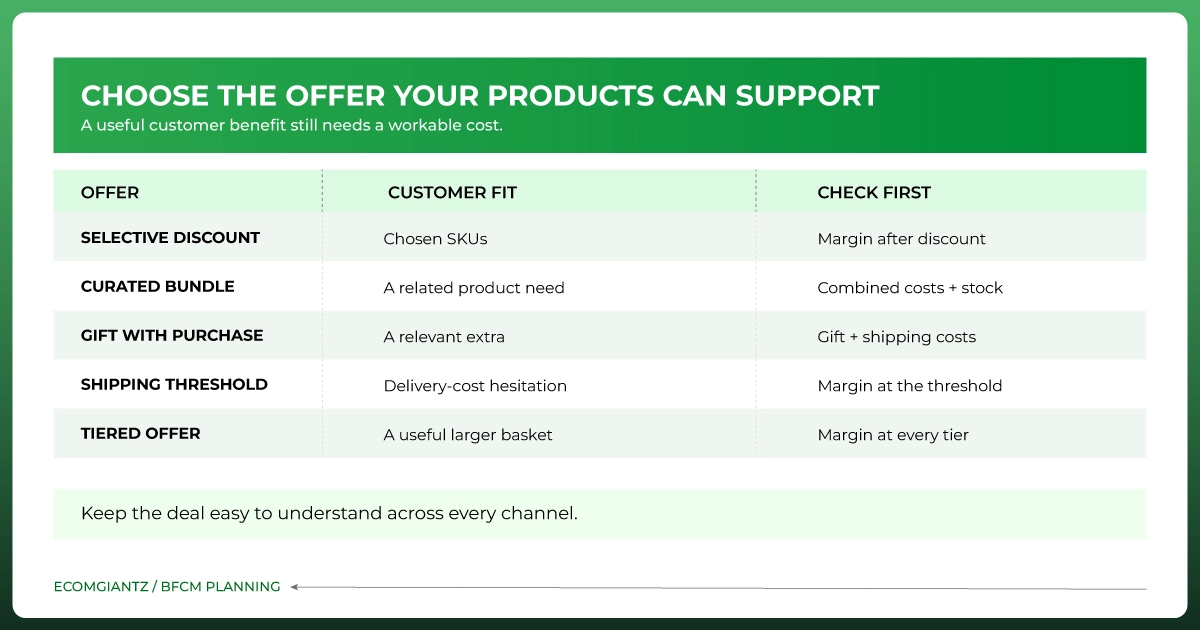
Before choosing a percentage, look at what the customer needs and what the product can afford. A useful starter bundle might appeal more than a discount on one item. A free-shipping threshold may help when delivery cost is the main hesitation, provided the additional margin covers it.
Compare Black Friday promotions using the total cost of the offer. A gift costs money to source and sometimes to ship. A bundle can increase revenue while reducing contribution. Tiered discounts can encourage larger baskets, but the deeper tier still needs enough margin to work.
Keep the choice manageable for shoppers, too. If someone needs to compare five codes to find the best deal, simplify the promotion. A clearly explained bundle or eligible-product offer gives your team a message it can repeat consistently across ads, email, and the sale page.
3. Segment Shoppers by Purchase Intent and Customer Value
Personalization starts with relevance. A first-time shopper may need product proof and an explanation of the offer. A previous customer might need a refill, a matching accessory, or access to a new range. Sending both groups the same product selection wastes useful information.
Build manageable segments from data you actually have. Start with engaged non-buyers, recent customers, repeat buyers, and relevant lapsed customers. Then look at category interest or purchase history. If your audience is small, avoid dividing it into groups too narrow to use meaningfully.
Match the message before changing the incentive. A returning apparel customer might appreciate accurate sizing notes for a new collection. Someone comparing kitchen appliances may need compatibility information. Neither automatically needs a larger discount; sometimes the unanswered question is what prevents the purchase.
4. Build Demand Before the Sale With Early Access
Use the weeks before launch to grow a qualified email or SMS audience. Give people a specific reason to sign up, such as early access, a product preview, or a relevant price alert. Make the value and the expected communications clear at signup.
Collect appropriate permission for each channel; an email subscription does not automatically authorize promotional texts. Keep list growth focused on interested shoppers, and prepare the sending infrastructure separately so you can deliver the promised communications.
Wishlists can reveal which products people want, while previews help them decide before sale week. VIP access can reward existing customers. Use a waitlist when a real launch or access limit warrants one, and explain what joining does and does not guarantee.
Track engagement and product interest alongside signup volume. A relevant gift guide can attract prospects interested in your catalog; an unrelated giveaway prize may attract people who have little reason to buy. Choose a signup promise your team can reliably deliver.
5. Create a Sale Page That Matches Your Campaign
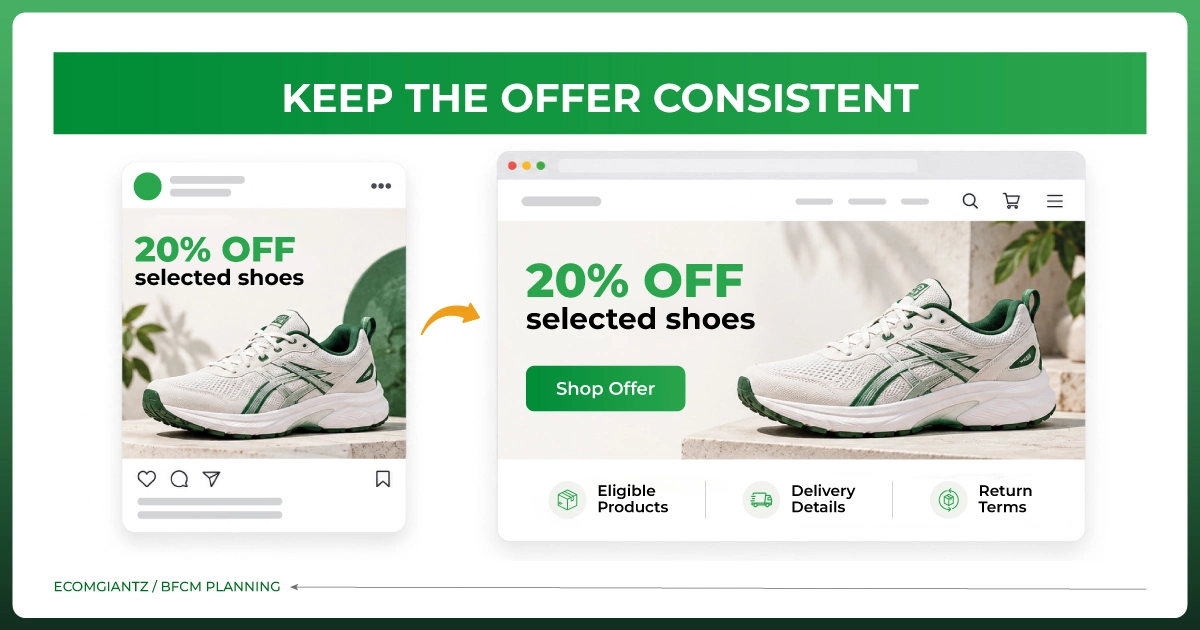
Send shoppers to the offer you advertised. If an ad promises 20% off selected running shoes, the destination should show eligible shoes and explain exclusions. A generic homepage makes shoppers search again, while an unexpected change in the offer gives them reason to hesitate.
Make eligibility, availability, prices, exclusions, and return terms easy to find. Include delivery deadlines where relevant, especially for gifts. Avoid a universal shipping cutoff when delivery dates differ by destination or product, and keep the offer consistent through checkout.
Google's published holiday-page guidance from 2020 recommends creating pages early, linking them prominently, and reusing meaningful URLs annually. Update your existing seasonal page rather than creating a new year-specific address each November. Publishing early gives discovery time; it does not guarantee indexing or rankings.
Use a combined page for a shared campaign, or separate recurring pages for distinct Friday and Monday offers. Keep prices and stock accurate, then update the page when the promotion ends so customers see current information.
6. Coordinate Email and SMS Around the Same Offer
Email gives you room to explain product value, compare options, and introduce the campaign. SMS can support concise, time-sensitive reminders for subscribers who want them. Plan both around the same offer rules so customers receive a consistent explanation wherever they engage.
Build interest, announce availability, and remind undecided shoppers before a real deadline. Stop recovery prompts after that order is purchased. Check that scheduled and automated messages link to the current offer and reflect its exclusions, especially when the campaign changes on Monday.
For detailed segmentation, campaign scheduling, templates, and flows, use our Black Friday email marketing strategy guide. Here, the priority is making email and SMS support the wider BFCM marketing strategy rather than operate as disconnected promotions.
7. Allocate Paid Media by Intent and Product Economics
Give campaigns a defined job: search ads can reach product comparisons, social creative can demonstrate use, and retargeting can reconnect with non-buyers. Choose channels from your audience and previous results, then assign budgets to those specific purposes.
For a dedicated first-time customer budget, use supported exclusions or acquisition settings to reduce spend on known existing customers. Google distinguishes acquisition modes that prioritize new buyers from those focused on new customers only. Choose settings that match the campaign objective.
Manage repeat-customer offers separately where useful, and time accessory or replenishment messages to the purchase. Avoid assuming audience matching identifies every customer perfectly. Reconcile reported new-customer sales with your store records before relying on them to justify another budget increase.
Scale against your acquisition limit and available stock, with creative approved before launch. You can also hire ecommerce PPC management services that can support channel selection, campaign management, and performance monitoring when your team needs help evaluating the next budget decision.
8. Use Social Content and Creators to Answer Buying Questions
The best starting point for Black Friday marketing ideas is often your support inbox. Look for questions about sizing, compatibility, materials, setup, or bundle contents. Turn those answers into short demonstrations, comparison posts, and gift recommendations tied to the products you intend to promote.
Choose creators with a relevant audience. Provide accurate product information and offer terms while leaving room for their explanation. Agree on content usage and required disclosures before reusing the work in ads, email, or sale pages.
Use genuine customer content with permission and retain its context. Give shoppers a useful demonstration alongside the offer. Track product-page visits and resulting orders to identify content that helps people choose, rather than judging everything by views.
9. Coordinate Storefront and Marketplace Promotions
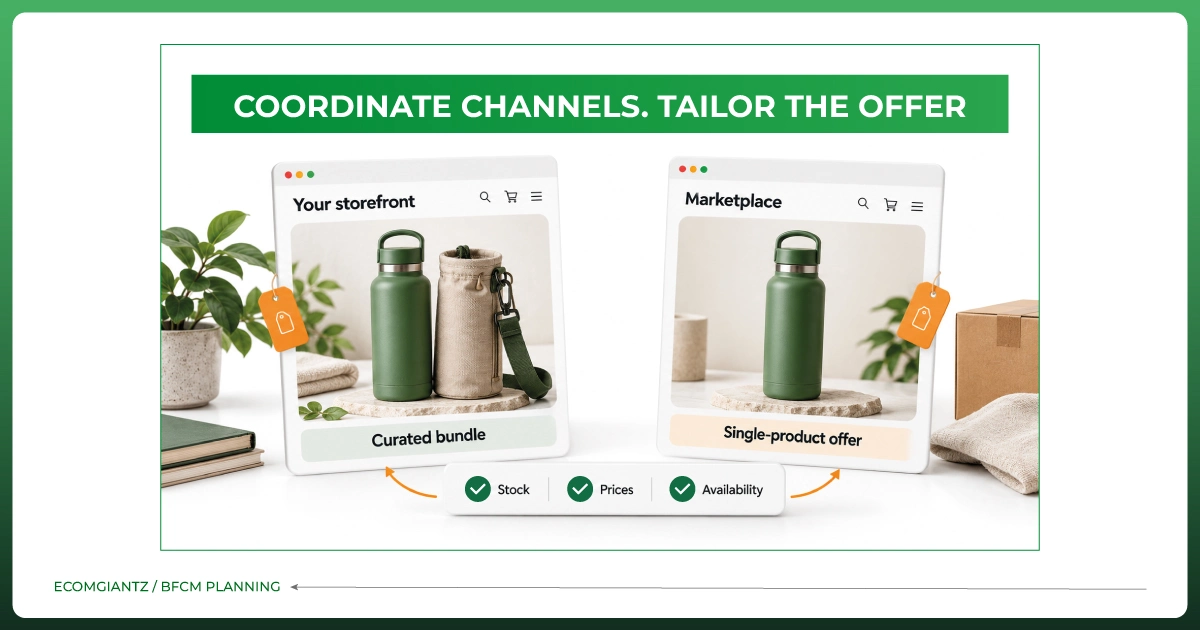
Black Friday ecommerce marketing gets more complicated when the same catalog sells through your website and marketplaces. Map the offer for each channel before creating ads. Include eligible products, effective prices, available units, campaign dates, and the destination each promotion should use.
Coordination does not require identical offers. Marketplace commissions, promotional rules, and fulfillment costs can differ. A website bundle might not translate directly to an Amazon promotion. Choose a channel-specific offer that works financially and is clear to the customers who see it.
Check that feeds and ads reflect current availability and prices. Update campaigns when a promoted variant sells out, and stop advertising a bundle if an essential component becomes unavailable. Give shoppers an appropriate alternative where possible.
For stores juggling several systems, multichannel software management can support catalog, inventory, and order coordination. Connect the marketing plan to these workflows, so campaigns promote products that remain available and your business can fulfill.
10. Make Mobile Purchasing Easy
Mobile deserves a complete purchase check. Adobe reported that 57.5% of US online Cyber Monday sales in 2025 came through mobile devices. That is a spending share, not a traffic share. Use your own device results to identify where customers struggle.
Follow the promoted journey on a phone. Can you recognize the advertised offer, select the right variant, see the payable price, and understand delivery? Check whether pop-ups cover important information or whether choosing another size silently changes discount eligibility.
Baymard's 2026 abandonment breakdown, excluding shoppers who were just browsing, reports that 40% cited high extra costs and 20% cited slow delivery. Those figures are not percentages of all abandoned carts. They support making costs and delivery expectations visible before payment.
Then check guest checkout, available payment methods, and order confirmation. Keep recommendations optional so they do not obstruct payment. For the broader technical and operational checks, work through our BFCM checklist for ecommerce before sending additional traffic.
11. Give Cyber Monday a Clear Reason to Buy
Your Cyber Monday marketing ideas should follow what happened over the weekend. Which products drew interest but fewer purchases? Which questions kept appearing? What stock remains? Use those answers to choose the products and explanation you feature on Monday.
You might highlight a complementary bundle, bring an overlooked category forward, or remind non-buyers that the existing offer ends soon. Cyber Monday promotions do not need a deeper discount to be relevant. A clearer product choice or better answer may be enough.
Review any new incentive against stock, margins, and price promises made to Friday buyers. Send offer reminders to relevant non-buyers; recent purchasers may need delivery or product-use information first. Use last-chance language only when the deadline is real, and communicate planned extensions honestly.
12. Turn Holiday Buyers Into Relevant Repeat Purchases
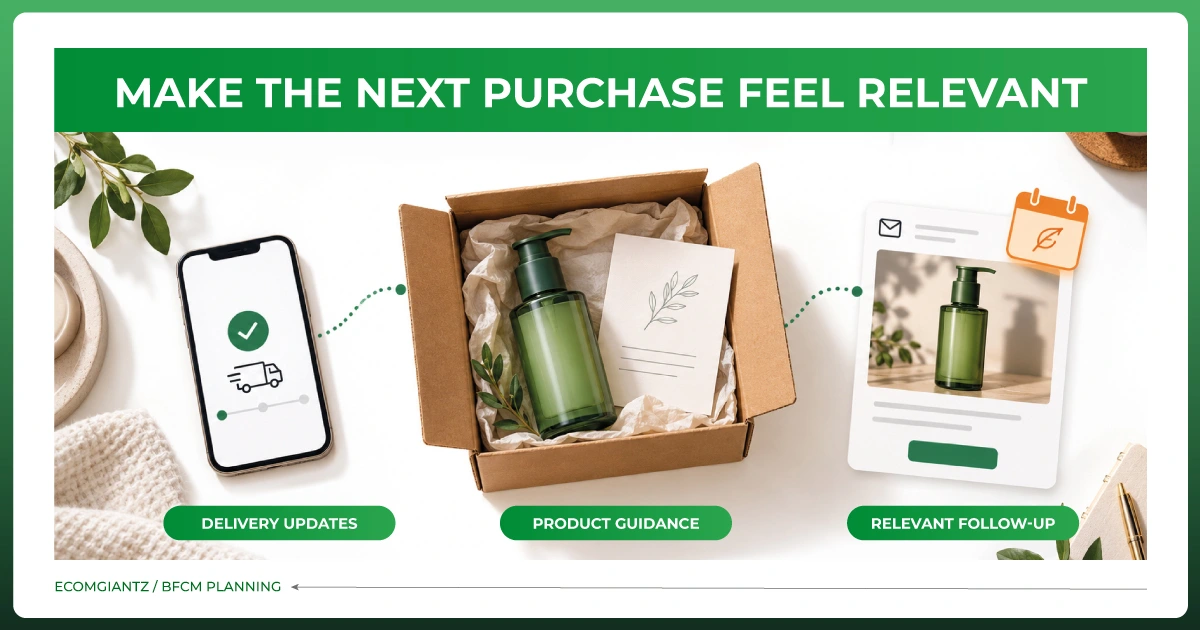
Start with helping customers receive and use what they bought. Give accurate delivery expectations, clear setup or care instructions, and an accessible support route. Provide sizing and compatibility guidance before purchase as well. These steps can help prevent avoidable disappointment and returns.
Follow-up timing should reflect the product. Consumables may suit replenishment reminders based on expected use. Electronics may suit an accessory recommendation after delivery. Apparel buyers may respond to a related collection later. A gift purchase may require a different assumption about who uses the item.
Use relevant loyalty benefits and track first-time BFCM buyers as a cohort, meaning customers acquired during the same period. Compare retained orders, return reasons, and repeat purchases over a suitable window. Some categories need months before you can judge the lasting value of acquisition.
Build Your BFCM Marketing Calendar
Work backward from your first promotion. Record offer changes, audiences, and message approvals together so your team can coordinate ecommerce holiday marketing without searching several separate schedules. Assign an owner to each campaign phase.
Phase
Main Marketing Work
Decision to Confirm
October
Review products, audiences, and recent performance
Campaign objective and affordable offers
Early November
Grow qualified interest and prepare destinations
Sign-up promise and core campaign message
Launch period
Activate the coordinated campaign
Live offer, eligible stock, and channel budgets
Saturday and Sunday
Answer questions and review customer response
Products and audiences needing more attention
Cyber Monday
Apply the planned message or offer emphasis
Accurate deadline and updated availability
Post-BFCM
Support product use and plan relevant follow-up
Timing based on usage and purchase cycles
Post-purchase work can extend well beyond December. Put the next relevant purchase window on the calendar, whether that means a skincare refill, an accessory after an electronics delivery, or a seasonal apparel recommendation. Let customers guide the timing instead of choosing one follow-up date for everyone.
How to Measure BFCM Marketing Performance
Agree on reporting definitions before launch. Establish orders and revenue from store records, then use platform reports to examine attributed activity. Adding platform-attributed revenue together can overstate sales when several platforms credit the same purchase.
Measure
What to Review
Decision It Supports
Contribution after marketing
Revenue after discounts minus defined variable costs and marketing
Whether the offer meets your contribution target
New-customer acquisition cost
Acquisition spend divided by verified first-time customers
Whether more acquisition spend is affordable
Conversion rate
Completed orders relative to sessions, using consistent definitions
Where audience or purchase friction needs investigation
AOV and contribution per order
Basket revenue together with the cost of serving it
Whether larger orders are financially useful
Refunds and returns
Refund amounts, retained revenue, and return-related costs
Whether initial results hold after the sale
Repeat purchase rate
Customers buying again within a defined cohort window
Whether acquired customers return
Keep returns accounting consistent. Use an expected-cost allowance during planning, then replace it with actual results as they become available. Avoid subtracting the same refund twice through both net revenue and a separate cost line. Contribution after marketing still has to cover fixed overhead.
Review attributed sales separately from incremental sales. Attribution assigns credit; it does not establish that a customer would not have purchased without the campaign. Where feasible, use a comparison group to investigate lift. If that is impractical, acknowledge the limitation and review performance against relevant baselines.
Common BFCM Marketing Mistakes
Copying another store's discount without checking your own costs.
Advertising an offer that changes unexpectedly after the click.
Giving every audience the same products and incentive.
Promoting a variant or bundle that is no longer available.
Using timers or stock claims that do not reflect reality.
Counting one order in several platform reports as several sales.
Making Monday promises that contradict what Friday buyers were told.
Frequently Asked Questions
What Is a BFCM Marketing Strategy?
A BFCM marketing strategy connects products, customer segments, offers, channels, and campaign timing to business goals. It covers promotion before and during Black Friday and Cyber Monday, with spending limits and measurement that account for acquisition and order costs.
When Should I Start Black Friday Marketing?
Begin early enough to prepare offers, creative, sale pages, and qualified audiences before November 27. Leave time to test the purchase journey. If you start late, prioritize proven channels and reduce complexity so you can review the campaign properly.
Should Black Friday and Cyber Monday Have Different Offers?
Different offers are optional. You can keep the core offer and change Monday's product emphasis or deadline reminder. Change the incentive when stock and margins support it, while respecting price promises made to earlier buyers throughout the event.
Can I Run Black Friday Promotions Without Large Discounts?
Yes. Consider bundles, relevant gifts, early access, or an affordable shipping benefit. Explain the value clearly and calculate the total cost. Choose an offer that fits your products and audience rather than matching another retailer's advertised discount percentage.
Which Channels Should a Small Ecommerce Store Prioritize?
Prioritize channels with an engaged audience or reliable conversion evidence, such as email, search ads, or a marketplace. Coordinate them around a clear destination. Expand when your team can manage the extra work and measure whether the investment helps.
How Do I Know Whether My BFCM Campaign Was Profitable?
Reconcile revenue, discounts, variable order costs, marketing, refunds, and returns. Evaluate contribution after marketing, then account for fixed overhead when assessing profit. Review acquisition costs and repeat purchases separately over a period appropriate to your product's purchase cycle.
Choose Your Next BFCM Marketing Move
Start with one promoted product or bundle. Calculate the contribution you want to retain, choose the customer group most likely to value it, and check the destination they will see. Then decide which channel can reach that group within your spending limit.
Evaluate Black Friday Cyber Monday marketing strategies against your numbers and customer promises. Choose offers and channels you can support, then review retained revenue and repeat purchases after the initial orders have arrived.
If your sales page is making the offer harder to buy, explore Ecomgiantz's web design and development services for help improving product discovery and the purchase journey. Give shoppers a clear path from campaign click to checkout before committing more budget to traffic.
Ready To Boost Your BFCM Sales?
Grow Your Ecommerce Sales With Expert Marketing Strategies From Ecomgiantz.
Ecomgiantz Team consists of our in-house experts who share their hands-on experience in ecommerce businesses, websites, marketplaces, etc. We also share the latest updates, insights, and market trends that can be helpful for your online business.