Is Dropshipping Still Profitable in 2026?
Dropshipping is still profitable in 2026, but success requires strong product research, reliable suppliers, smart marketing, healthy profit margins, automation, and a customer-focused brand strategy.

Dropshipping is still profitable in 2026, but success requires strong product research, reliable suppliers, smart marketing, healthy profit margins, automation, and a customer-focused brand strategy.
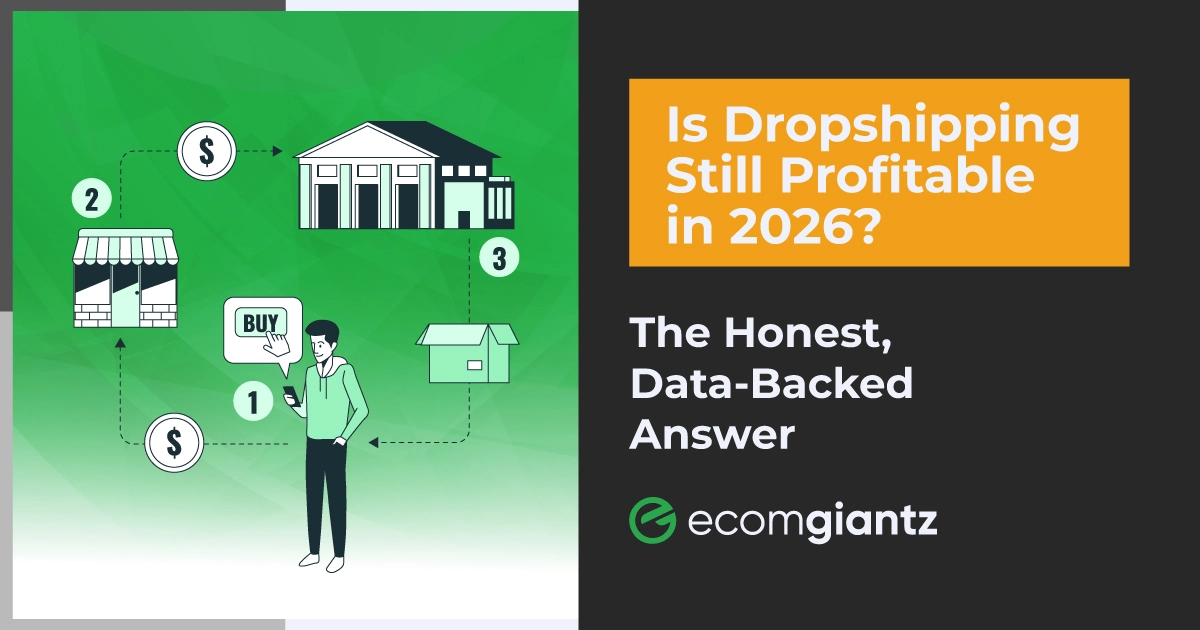


Yes, dropshipping is still profitable in 2026. But the version of it that worked five years ago is not. That distinction matters more than any market-size statistic because the model hasn't disappeared. It's just changed enough that the old playbook now loses money, while a newer, sharper approach still works.
Net profit margins typically land between 15% and 25% for stores with disciplined unit economics, strong product selection, and at least one reliable supplier relationship. The global dropshipping market is valued at roughly $464 billion and is growing at over 20% annually. People aren't just searching for dropshipping. They're starting it, with search volume for "how to start dropshipping" projected to rise roughly 23% over the next twelve months, according to Ahrefs' forecast data. The opportunity is real. Yet, the easy money is not.
After building and consulting on dropshipping stores for over a decade across the US, UK, Canada, Australia, and the Middle East, I've watched two waves of operators pass through this space. The first wave treated it like a loophole. The second treats it like a real business. This guide is written for the second group, the people who want real numbers, not hype, before they commit.
| Our Shopify store design and development service is where most of the operators referenced in this guide end up once they've decided to build a store that actually converts. |
We're saying again, yes.
The version of dropshipping that is dead looks like this: find a cheap product on AliExpress, list it on a Shopify store with a 5x markup, run Facebook ads, and wait three to four weeks for the product to arrive from Shenzhen in a plain polybag. That model stopped working once customers got burned enough times to stop trusting stores that operate this way.
What replaced it is what the rest of this guide describes. Niche-focused stores with real brand positioning, faster shipping through US/EU-based suppliers or platforms like CJ Dropshipping and Zendrop, genuine product research, and unit economics managed like any other real business.
If you read enough forums and community threads, you'll notice the same pattern. Most people who say dropshipping is dead tried it for 60 to 90 days, burned through $500 to $2,000 on ads with no differentiation, and quit. The people who say it still works are the ones who treated it like an actual business from the start.
| Pros | Cons |
| Low startup cost ($200-600/month) | Thin net margins (15-25% typical) |
| No inventory or warehouse needed | Rising ad costs across Meta and Google |
| Easy to test products quickly | Heavy supplier dependency |
| Location-flexible, fully remote | Customer service burden falls on you |
| Scales without proportional overhead | Return rates vary widely by category |
| Access to global customer base | Shipping speed still a trust barrier |
Before we get into margins and costs, let's start with something none of the other guides on this topic bother to show you: what people are actually searching for, and what those patterns tell us about whether dropshipping is growing, shrinking, or just changing shape.
| Keyword | Country | Volume | KD | CPC | Forecast Direction |
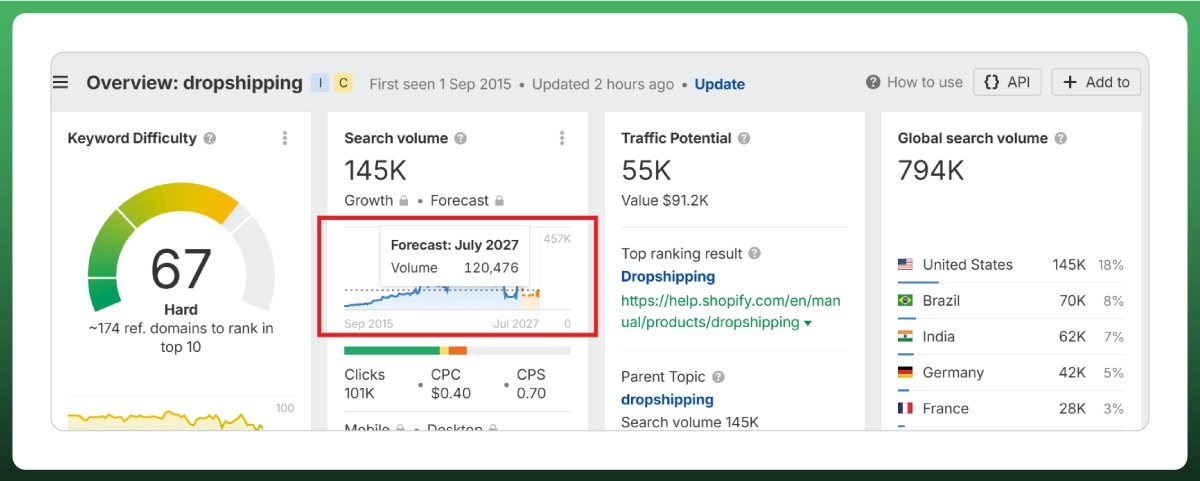
| dropshipping | US | 145K | 67 (Hard) | $0.40 | Down ~17% |
| dropshipping | UK | 23K | 15 (Medium) | $1.30 | Flat (~4% down) |
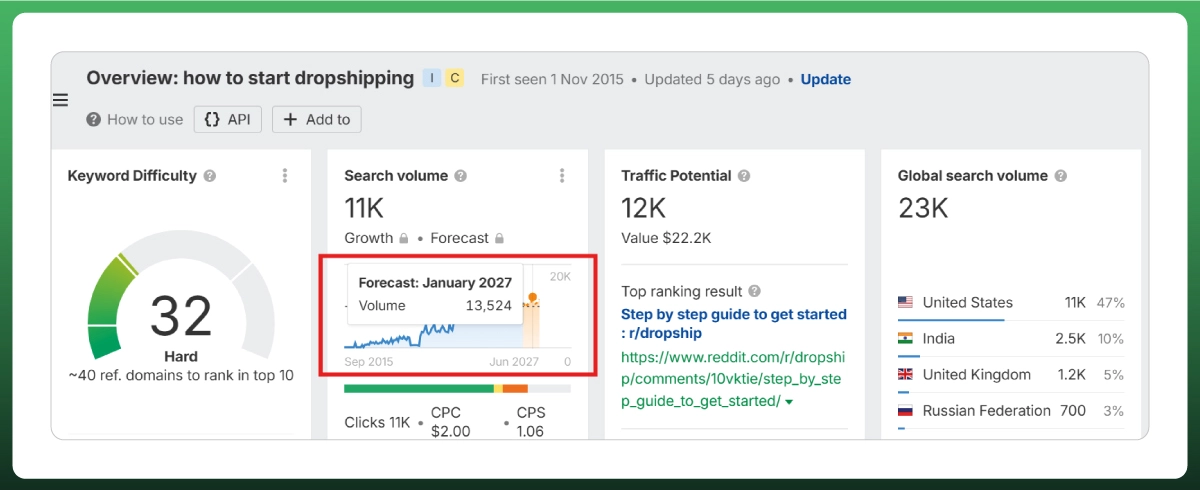
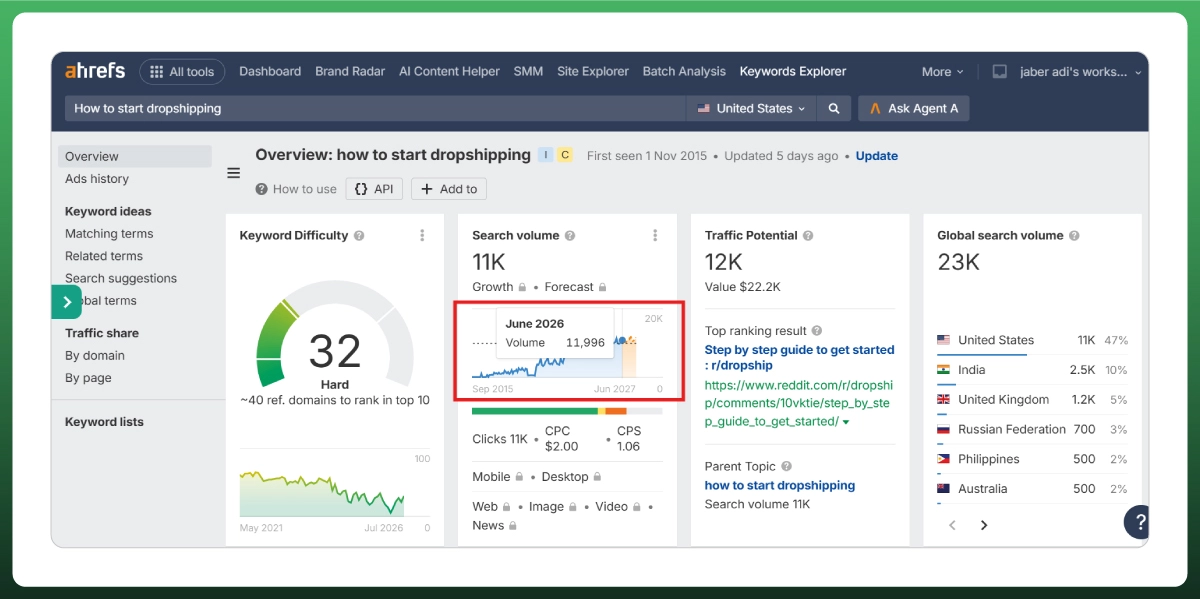
| how to start dropshipping | US | 11K | 32 (Hard) | $2.00 | Up ~23% |
| dropshipping business ideas | US | 900 | 2 (Easy) | $0.50 | Rising |
The headline found here is genuinely interesting. General search interest for the bare term "dropshipping" is forecast to cool slightly over the next year. But "how to start dropshipping" is projected to climb roughly 23% over that same window. That's not a contradiction. It's a signal: casual curiosity is fading while actual entry intent keeps growing.
Ahrefs 1-year forecast: "dropshipping" (US) projects a decline to 120,476 by July 2027
Ahrefs 1-year forecast: "how to start dropshipping" (US) projects growth to 13,524 by January 2027
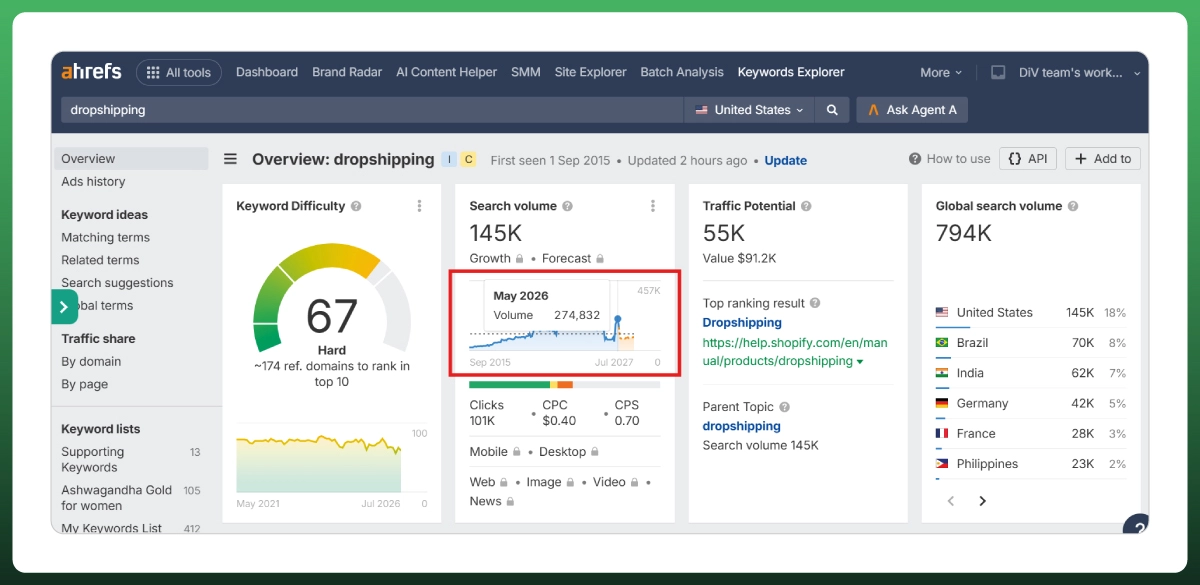
Ahrefs Keyword Explorer: "dropshipping" (US)
Ahrefs Keyword Explorer: "how to start dropshipping" (US)
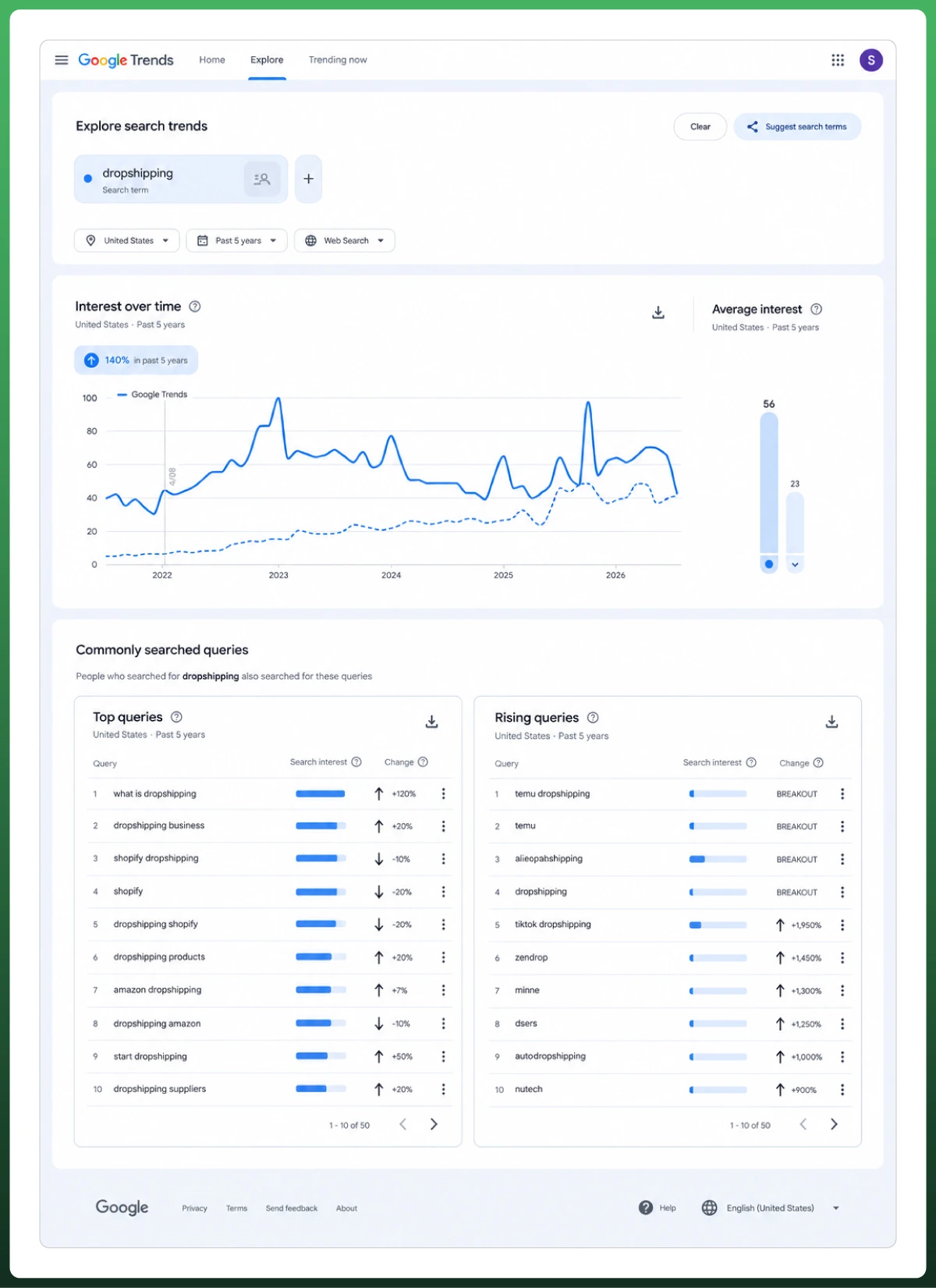
Google Trends confirms the same pattern from a different angle. US search interest in "dropshipping" over the past five years is up 140% compared to the preceding five years. Worldwide, that figure is 170%. The past-year view shows a 30% increase over the year before it.
Google Trends: "dropshipping" (US, 5 years)
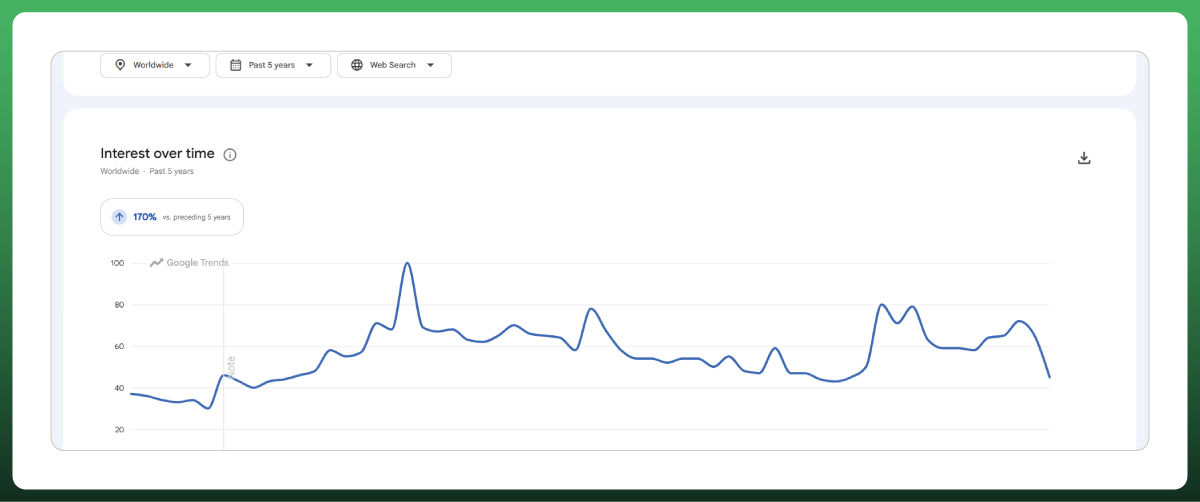
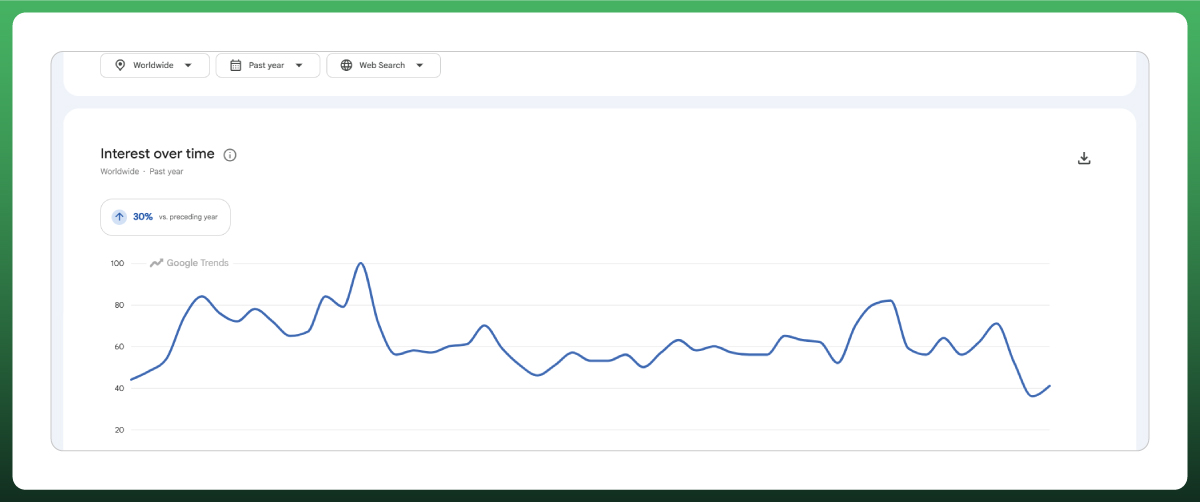
Worldwide, the shape is nearly identical, just with a higher growth rate and a second, larger spike layered in during late 2025 into 2026. The past-year view zooms into exactly the window we break down in the monthly table below, and it shows the same rise-then-drop shape.
Google Trends: "dropshipping" (Worldwide, 5 years, +170% vs. preceding 5 years)
Google Trends: "dropshipping" (Worldwide, past year, +30% vs. preceding year)
Averaged five-year growth percentages look great in a headline, but they hide what actually happened month to month. Here's the raw Ahrefs monthly search volume for "dropshipping" in the US and UK from January through July 2026:
| Month | US Volume | UK Volume |
| January 2026 | 115,375 | 31,753 |
| February 2026 | 79,563 | 11,288 |
| March 2026 | 227,973 | 25,469 |
| April 2026 | 248,062 | 25,388 |
| May 2026 | 274,832 | 24,350 |
| June 2026 | 203,897 | 20,190 |
| July 2026 | 108,914 | 23,398 |
Source: Ahrefs monthly search volume export, US and UK, July 2026.
Two things stand out. First, the US saw a sharp spike from March through June 2026; volume more than doubled at its peak, before pulling back to roughly its January baseline in July. Second, the UK did not show the same spike over the same window. That asymmetry is worth noting: the US-only surge lines up closely with the period when US tariff policy on imported goods was making headlines, including the Supreme Court ruling on tariff authority in February and a trade court refund order in March.
We can't prove searches were driven by tariff news rather than something else, but a US-specific spike with no UK equivalent, during exactly the window US trade policy was unsettled, is a pattern worth naming rather than smoothing over with an averaged five-year growth stat.
The honest takeaway: don't read either the 140% five-year growth figure or the July pullback in isolation. Interest in dropshipping is structurally higher than it was five years ago, and it's also genuinely volatile month to month, sometimes for reasons connected to real-world policy news rather than organic business interest.
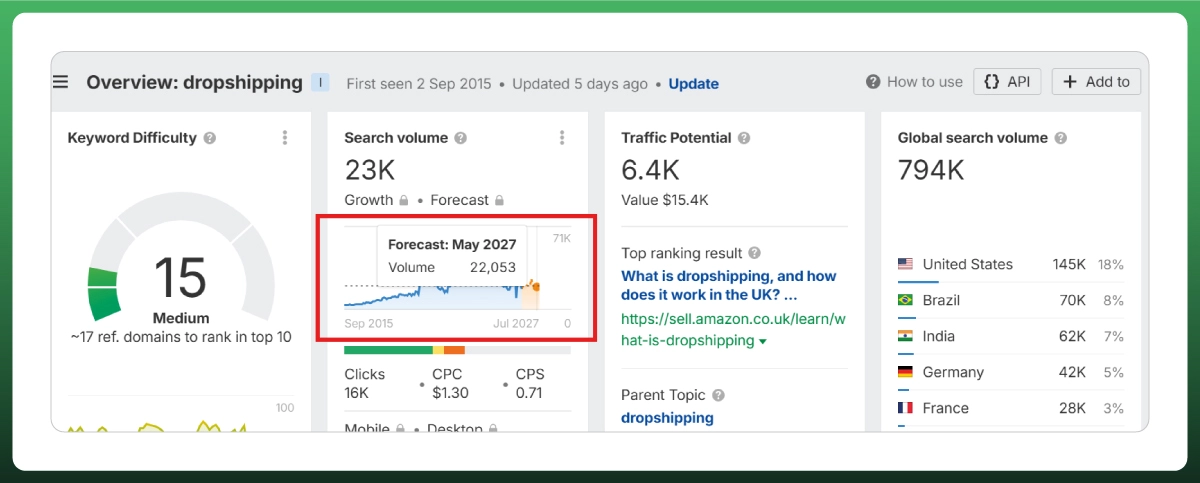
Ahrefs forecast: "dropshipping" (UK), showing the search volume and 1-year forecast panel
One more pattern worth flagging from the Google Trends rising queries data: search interest in AliExpress dropshipping dropped 40% over the past five years, while CJ Dropshipping rose over 400% in the same period. That's a real, measurable supplier migration away from the old AliExpress model toward faster-fulfillment platforms, and it directly supports the "old model is dead, new model isn't" thesis you'll see throughout this guide.
Global Search Volume by Region
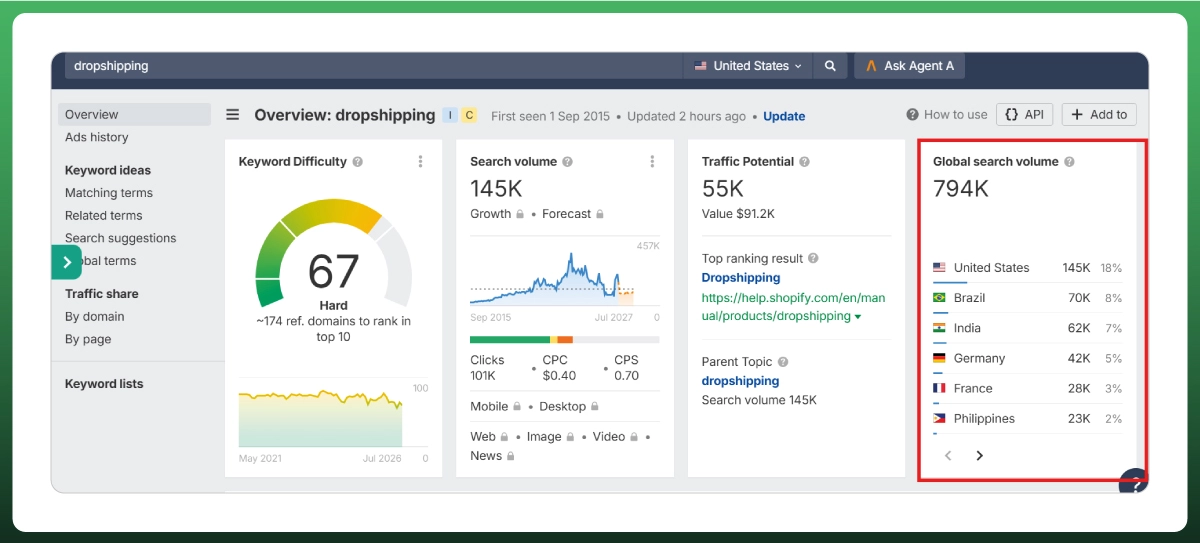
The global search volume for "dropshipping" sits at 794K monthly across all countries. Here's how it breaks down by region:
| Country | Monthly Volume | Share |
| United States | 145K | 18% |
| Brazil | 70K | 8% |
| India | 62K | 7% |
| Germany | 42K | 5% |
| France | 28K | 3% |
| Philippines | 23K | 2% |
Source: Ahrefs Keyword Explorer, July 2026.
Here is the formula every dropshipping decision should run through before a single dollar gets spent on ads. This is not a theory. It's the exact math that determines whether a store is actually profitable or just generating revenue that looks good in a screenshot.
Net Profit = Revenue - Product Cost - Shipping - Transaction Fees - Ad Spend - Refunds
Every cost that touches an order belongs in that equation. The moment you leave one out, your "profit margin" is a lie. This is where most beginners get tripped up; they see a 3x markup and assume they're keeping 200% when the real number after all costs is closer to 15% to 25%.
| Low Ticket ($25) | Mid Ticket ($75) | High Ticket ($200) | |
| Selling Price | $25.00 | $75.00 | $200.00 |
| Product Cost | $8.00 | $22.00 | $70.00 |
| Shipping | $3.00 | $5.00 | $12.00 |
| Transaction Fees (3%) | $0.75 | $2.25 | $6.00 |
| Ad Spend (per sale) | $8.00 | $18.00 | $35.00 |
| Refunds (est. 5%) | $1.25 | $3.75 | $10.00 |
| Net Profit | $4.00 | $24.00 | $67.00 |
| Net Margin | 16% | 32% | 33.5% |
The pattern is consistent: higher ticket items absorb fixed costs better and leave more room for ad spend without destroying the margin. This is why high-ticket niches and high-ticket items keep coming up as a profitability lever across every serious operator conversation.
| Store Stage | Monthly Revenue | Typical Net Profit | Timeline |
| Beginner (testing) | $0 - $5,000 | $0 - $750 | Months 1-3 |
| Growing (1-2 winners found) | $5,000 - $25,000 | $750 - $5,000 | Months 4-8 |
| Established (optimized) | $25,000 - $100,000+ | $5,000 - $20,000+ | Months 9-18+ |
These ranges draw from TrueProfit's analysis of over 1,200 Shopify stores and Dropbuild's data from 26,500 store builds. The numbers are real, but they represent stores that survived. The ones that didn't, and there are many more of those, typically never cleared the testing phase. Our digital marketing service helps store owners move through that testing phase faster by eliminating the most common ad-spend mistakes before they compound.
Is dropshipping legal? Yes, in every major market, including the US, UK, Canada, Australia, and the UAE. A related question people ask is whether dropshipping is illegal, and the answer is no. It is a legitimate fulfillment model. What is illegal is selling counterfeit goods or misrepresenting products, which is a different problem entirely. But "legal" doesn't mean "no rules." Here's what you actually need to cover.
You need a registered business entity in most jurisdictions before processing payments. In the US, that typically means an LLC or sole proprietorship. In the UK, a sole trader registration or a limited company. In Australia, an ABN. This is not optional if you want a payment processor to take you seriously.
If you sell to US customers, you are likely required to collect sales tax in states where you have economic nexus, which can trigger at surprisingly low revenue thresholds. In the UK and EU, VAT applies. In the UAE, a 5% VAT has been in effect since 2018. Get this wrong, and the liability compounds quietly until it becomes a real problem.
You are the seller of record even though you never touch the product. If a product injures a customer, you share liability. This is why product selection matters beyond just margin, and why sample products should be ordered and tested before any product goes live in your store.
Amazon allows dropshipping but requires that you be the seller of record, that no third-party branding appears on packing slips that you handle all returns and customer support yourself. eBay has similar requirements. Violating these policies can result in account suspension without warning.
The US eliminated the $800 de minimis exemption for certain imports in 2025, which means individual orders shipped directly from overseas suppliers now face customs duties that didn't exist before. This directly impacts the unit economics of any store still relying on per-order fulfillment from China without a domestic warehouse or consolidation partner.
Every competitor article on this topic repeats the same claim: customers demand two-day shipping, and dropshipping can't deliver that, so it's doomed. Here's what McKinsey's actual consumer research shows instead.
In other words, cost and reliability matter more than raw speed. That directly reframes dropshipping's biggest perceived weakness. You don't need to match Amazon Prime. You need to set a clear delivery window, meet it, and not surprise customers with hidden fees at checkout.
The practical solutions are already in use. US/EU-based suppliers through platforms like CJ Dropshipping and Zendrop can deliver within 3 to 7 days domestically. Stores offering transparent tracking and realistic delivery estimates see significantly fewer support tickets and refund requests. The stores that still ship from China with 20-day timelines and no tracking are the ones feeding the "dropshipping is dead" narrative, and honestly, they deserve to.
The global dropshipping market grew from roughly $365 billion in 2024 to an estimated $464 billion in 2025 (Grand View Research), with projections north of $1.25 trillion by 2030. Google Trends interest is up 170% over the preceding five years worldwide. The market is not dead. The lazy approach to it is.
It's not market saturation. It's idea saturation. The same ten product categories get recycled on every "best dropshipping products" list, which makes those specific niches feel crowded. Meanwhile, hundreds of underserved sub-niches exist with real demand and almost no competition. The saturation is in the advice, not the opportunity.
Shopify's own guidance puts a realistic lean startup budget at $200 to $600 per month once you account for the platform, domain, essential apps, and initial ad testing. Many first-time founders spend several times that in their first 90 days once paid acquisition and product testing enter the picture. Starting costs are low by business standards, but they are not zero.
Is AI dropshipping profitable? AI tools genuinely help with product research, ad creative generation, and dropshipping automation for order processing. But they don't replace strategy, supplier relationships, or customer service judgment. The stores winning with AI are using it to execute faster, not to avoid doing the work entirely.
Most successful dropshipping products are not viral sensations. They're boring, functional items that solve a specific problem for a specific buyer and sell steadily month after month. Chasing virality is a recipe for one good week followed by twelve bad ones.
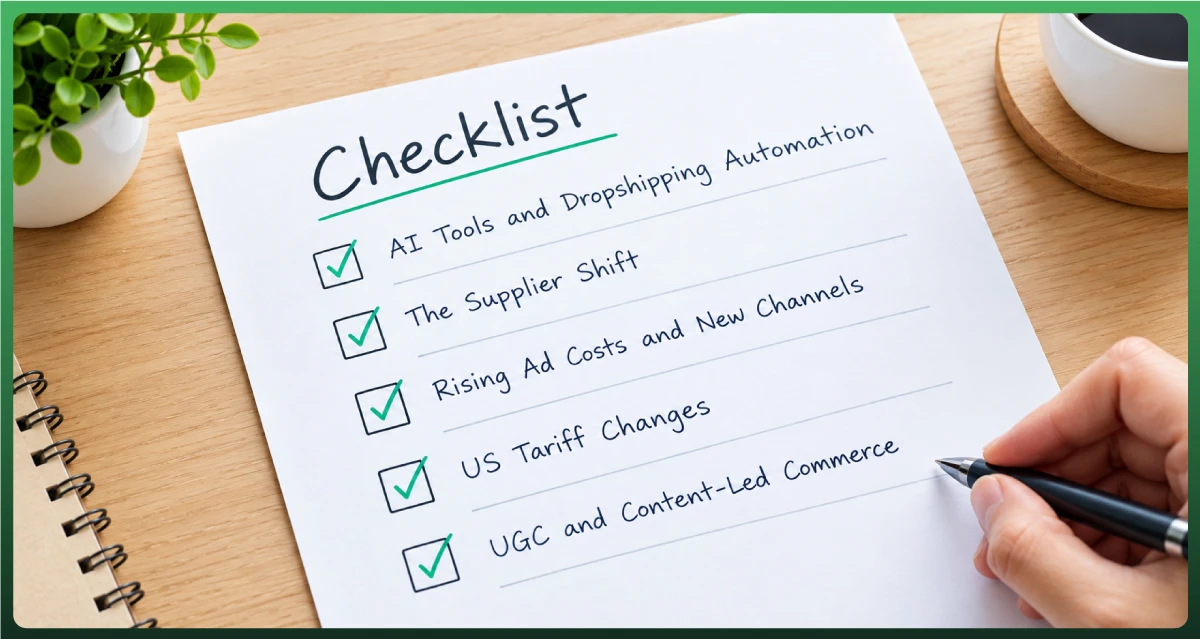
AI store builder platforms, automated product research tools like Jungle Scout, and AI-powered ad creative generators have genuinely lowered the operational burden. About 33% of ecommerce sellers have now fully integrated AI into their operations (Statista), and another 47% are experimenting. The competitive advantage isn't having these automation tools anymore. It's knowing how to use them well.
The move away from AliExpress toward faster-fulfillment suppliers (CJ Dropshipping, Zendrop, US/EU-based warehouses) is the single biggest operational change in dropshipping over the past three years. Stores using domestic suppliers report faster delivery, lower return rates, and measurably better customer experience. This shift also affects supplier quality, since working with a dedicated agent rather than public marketplace sourcing gives you quality control you never had before.
Meta CPMs and Google Ads costs have been climbing steadily, which compresses margins for stores that depend entirely on paid ads. Facebook Ads and Instagram Ads remain effective but more expensive per acquisition than they were even two years ago. The response from profitable operators has been channel diversification: TikTok Shop (projected $112 billion GMV in 2026), Google Shopping campaigns via Performance Max, and email list building for retention rather than pure acquisition. Our social media marketing service builds exactly this kind of multi-channel approach.
The elimination of the $800 de minimis exemption and the introduction of new import duties in 2025-2026 have added real cost to the per-order model for stores shipping directly from overseas. This is an evolving situation. The legal status is still shifting (the Supreme Court ruled on IEEPA tariff authority in February 2026, and a trade court ordered refunds on certain duties in March 2026). For the latest rates, check USITC directly rather than relying on any blog summary, including this one.
User-generated content has become the default creative format for dropshipping ads. Polished brand ads still work for established stores, but for new product testing, short-form UGC shot on a phone consistently outperforms studio content on both Meta Ads and TikTok. First-party data collection through email and SMS is also increasingly critical as third-party cookies continue to be phased out.
Based on every trend line we've tracked, three shifts are already underway for the year ahead.
The honest answer depends on where you're starting from.
| If you are... | Dropshipping is... | Why |
| A complete beginner with under $500 | Worth testing carefully | Low barrier to entry, but budget for a 3-month learning curve before expecting profit |
| A side hustler with marketing skills | A strong fit | Your existing ad skills directly transfer; focus on product selection and supplier quality |
| An existing ecommerce operator | A valid expansion channel | Use it to test new product lines without inventory risk before committing to wholesale |
| Someone expecting passive income | Not a good fit | This requires active management of ads, suppliers, and customer support |
| Someone with no marketing budget | Not viable right now | Organic traffic takes months; you need at least $500-1,000 for initial ad testing |
Not every business model fits every person. Here's who will almost certainly lose money here rather than make it.
| Our Shopify store management service handles the operational and conversion optimization layer so store owners can focus on the product and marketing decisions that actually drive profitability. |
We published a full deep-dive guide covering 22 profitable dropshipping niches with margin ranges, product examples, and validation frameworks. Here's the short version of what's working best right now.
| Niche | Margin | Competition | Beginner Friendly |
| Ergonomic WFH Accessories | High | Medium | Yes |
| Premium Pet Wellness Gear | High | Medium-High | Yes |
| Golf Training Aids | Very High | Low | No |
| Magnetic Phone Accessories | High | High | Yes |
| Fitness Recovery Tools | High | Medium | Yes |
| Travel Organization Gear | Medium-High | Medium | Yes |
For the full breakdown of all 22 niches, including product lists, upside, and risk factors, read our complete guide on profitable dropshipping niches.
This is one of the most common comparisons people make before choosing a model. Here's how they actually stack up.
| Factor | Dropshipping | Affiliate Marketing |
| Startup Cost | $200-600/month | Near zero |
| Margin Range | 20-40% | 5-15% commission |
| Brand Ownership | You own the brand | You promote someone else's |
| Customer Relationship | You own it | The merchant owns it |
| Customer Service | Your responsibility | None |
| Scalability Ceiling | High (build a sellable asset) | Limited (tied to traffic) |
| Income Control | You set prices | Commission rates set by merchant |
The core tradeoff is simple. Affiliate marketing is easier to start and carries no customer service burden, but your earning ceiling is capped by someone else's commission structure, and you never own the customer. Dropshipping requires more work, more capital, and more risk, but what you build is a brand you own and can eventually sell. Established ecommerce businesses routinely sell for 2x to 4x annual profit.
| Factor | Dropshipping | Private Label | Wholesale | Print on Demand | Amazon FBA |
| Startup Cost | Low ($200-600) | High ($5K-20K+) | Medium ($2K-10K) | Very Low | Medium ($3K-10K) |
| Margin | 15-40% | 40-70% | 25-50% | 20-40% | 15-30% |
| Inventory Risk | None | High | Medium | None | High |
| Brand Control | Medium | Full | Low | Medium | Low |
| Shipping Speed | Varies (3-20 days) | You control | You control | 7-14 days | 1-2 days (Prime) |
| Scalability | High | Very High | Medium | Medium | High |
Here's what we found across Shopify community forums, Reddit threads, and practitioner blogs, organized by the patterns that keep recurring rather than cherry-picked success stories. Our email marketing service was built partly in response to the retention gap these communities consistently describe.
Is dropshipping still profitable in 2026? Yes. But the bar for what "profitable" requires has risen, and it will keep rising. The dropshipping profit margins that matter are net margins after every cost, not the gross markup that looks good in a product listing. The dropshipping success rate favors operators who commit to at least six months of disciplined testing, manage their unit economics from day one, and build something a customer would trust enough to come back to.
The global dropshipping market is growing. The tools are better than they've ever been. The supply chain is shifting toward faster, more reliable fulfillment. If you're willing to do the work, the opportunity is real. If you're looking for easy money, it's not here anymore, and that's probably a good thing for everyone who's serious about building something.
If you're ready to move from research to execution, get in touch with us here, and we'll help you build a store that's actually designed to convert the traffic you earn.

No related posts found.


