How Ecomgiantz planned, rebuilt, migrated, and relaunched an established beverage e-commerce site on Shopify while protecting live-store continuity and existing business data.
Project Overview
Mór Irish Gin needed a cleaner e-commerce setup without interrupting an active store. The brand was running on WordPress and WooCommerce. But day-to-day store management had become harder than it needed to be. The existing setup also created SEO and technical concerns that made future growth less straightforward.
We, as Ecomgiantz, were brought in to handle the complete WordPress-to-Shopify migration. The job included planning the transition, protecting the live site during development, rebuilding the storefront on Shopify, moving key ecommerce data, checking the new buying journey, and transferring the domain only when the new store was ready to go live.
The Client Need: A More Manageable Ecommerce Platform
The main request was straightforward. Move the existing WooCommerce store to Shopify and make the new setup easier to operate. For a beverage brand, the storefront is not only a product catalog. It also needs to support brand storytelling, product discovery, purchasing, customer accounts, shipping expectations, and regional storefront settings without creating unnecessary backend complexity.
The migration had two priorities. Preserve important business data and the customer-facing experience. Then create a Shopify foundation the client could manage more comfortably. A rushed move could have caused missing products, broken links, lost order history, or avoidable downtime. So the work had to be staged carefully.
What Was Holding the WooCommerce Store Back
1. Store Management Was Too Hands-On
The client was facing difficulties while handling WooCommerce functions and maintaining the store efficiently. WordPress can be highly flexible. But a growing ecommerce setup may require ongoing attention across plugins, themes, updates, integrations, hosting, security, and compatibility.
2. SEO Needed a Cleaner Technical Foundation
The existing site also had poor SEO performance concerns. During an e-commerce platform migration, SEO risk can increase if URLs, metadata, indexable pages, redirects, navigation, and domain settings are not handled carefully. Our migration plan treated search continuity as part of the technical launch process.
3. The Live Store Could Not Be Disrupted
The biggest operational challenge was rebuilding the site while the current store remained available to customers. We needed a controlled development environment, a clear data-transfer sequence, and a launch checklist that reduced the chance of customers landing on an incomplete storefront.
The Challenges We Had to Solve
A WooCommerce to Shopify migration is not a copy-and-paste exercise. The platforms structure products, customers, orders, themes, URLs, and applications differently. Our job was to translate the existing store into Shopify while keeping the customer experience coherent and essential e-commerce.
- Data integrity: Products, customer records, order history, and content had to be backed up and transferred without unnecessary loss or duplication.
- Platform differences: WooCommerce theme behavior and plugins do not transfer directly into Shopify. So the storefront had to be rebuilt for Shopify rather than cloned mechanically.
- SEO continuity: Page structure, URLs, redirects, indexability, and domain changeover needed attention to reduce migration-related search disruption.
- Launch timing: The final domain switch had to happen only after the Shopify build, content, products, cart, and essential storefront flows had been checked.
- Short project window: The complete migration was planned and delivered within a one-week timeframe. This required a clear sequence and fast QA.
Our Migration Approach to Mor Irish Gin
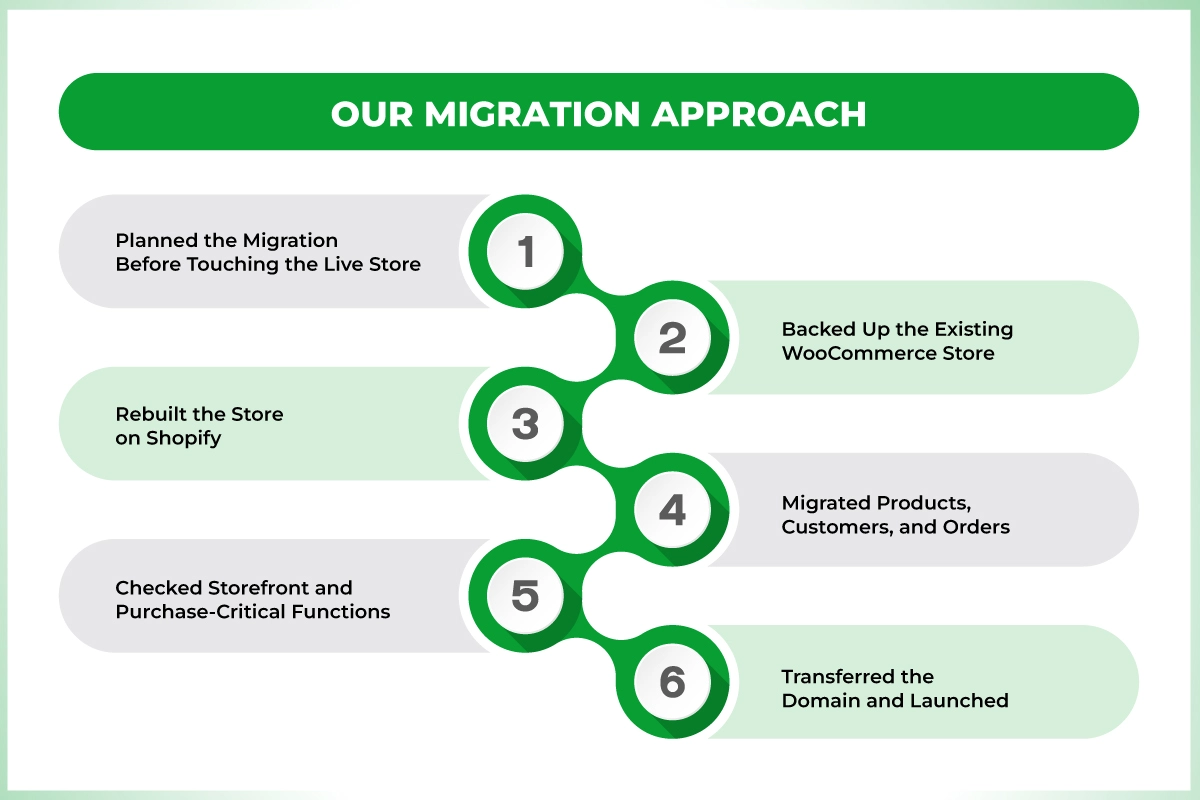
Step 1: Planned the Migration Before Touching the Live Store
We started by mapping the work into a practical migration sequence. The existing WooCommerce site remained the reference point while the Shopify build was prepared separately. This gave the team a controlled way to rebuild, compare, and test.
Step 2: Backed Up the Existing WooCommerce Store
Before transferring anything, we secured a full backup of the existing ecommerce data. That included products, site content, customer information, order records, and other important store data available from the WooCommerce setup. The backup created a recovery point and reduced the risk of irreversible data loss.
Step 3: Rebuilt the Store on Shopify
Next, we developed the new storefront through our Shopify website development process. Instead of forcing WordPress-specific behavior into the new platform, we recreated the customer journey around Shopify’s native ecommerce structure. The goal was to keep the Mór Irish Gin brand recognizable in the major cases.
Step 4: Migrated Products, Customers, and Orders
Once the Shopify structure was ready, we transferred the core commerce records from WooCommerce. Product information was moved into the Shopify catalog. This was followed by customer and historical order data, where the platform structure allowed it. We then checked records for obvious formatting, duplication, and storefront display issues.
Step 5: Checked Storefront and Purchase-Critical Functions
Before launch, we reviewed the new store from a shopper’s perspective. That included product discovery, product pages, cart behavior, account access, navigation, responsive presentation, and other purchase-critical paths. The live Shopify storefront now supports customer accounts, cart functionality, multiple payment methods, country or region selection, and multilingual options.
Step 6: Transferred the Domain and Launched
After completing all necessary tests on the Shopify store, we migrated the domain to the new platform. We treated this domain migration not as a starting point but as the final step of implementation. This approach ensured a well-managed transition for customers. This minimized the duration of any potential service disruptions.
Services Delivered by Ecomgiantz
- WordPress and WooCommerce store assessment
- WooCommerce site and e-commerce data backup
- Shopify store setup and development
- Storefront recreation and responsive configuration
- Product catalog migration
- Customer and order data migration
- Navigation and key page setup
- Basic migration-focused SEO checks and redirect planning
- Cart and customer journey QA
- Domain connection and Shopify launch support
Specialized Tools and Platforms We Used
The project used WordPress and WooCommerce for source data and Shopify for the new store. We also used CSV export and import workflows, Shopify Admin, DNS and domain-management tools, responsive browser testing, and search-oriented checks for migration-sensitive URLs and indexing settings.
Results and Project Impact We Brought
Ecomgiantz helped Mór Irish Gin move from a difficult-to-manage WooCommerce setup to a fully developed Shopify storefront in just one week. The migration focused on preserving essential e-commerce data, simplifying store operations, and creating a more manageable platform for future growth.
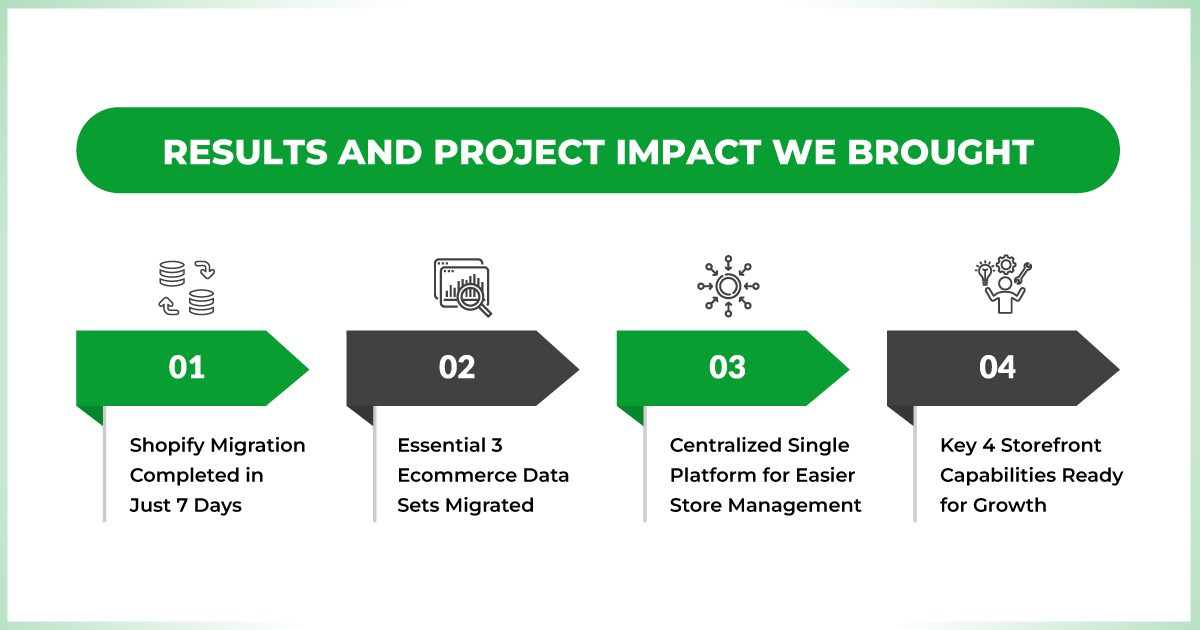
1. Shopify Migration Completed in Just 7 Days
We completed the WordPress to Shopify migration within the one-week project timeline. From backing up the old website to developing the new Shopify store and connecting the domain, we followed a planned process to minimize disruption.
2. Essential 3 Ecommerce Data Sets Migrated
We transferred three critical types of ecommerce data: products, customer information, and order records. This helped Mór Irish Gin maintain essential store information during the platform transition without starting its product catalog and customer database from scratch.
3. Centralized Single Platform for Easier Store Management
We replaced the client’s complicated WooCommerce setup with Shopify’s centralized management system. The new platform gives the team a simpler way to manage products, monitor orders, access customer information, and update storefront content.
4. Key 4 Storefront Capabilities Ready for Growth
The new Shopify store supports four essential areas: customer accounts, shopping cart and checkout functionality, regional selling settings, and multilingual options. Together, these capabilities provide a more flexible shopping experience and a stronger foundation for future ecommerce improvements.
Why This Migration Worked
This project succeeded because of sequencing. We did not start by pointing the live domain at an unfinished Shopify store. We planned the migration, backed up the WooCommerce environment, rebuilt on Shopify, transferred the important records, checked the buying journey, and only then completed the domain move.
For e-commerce brands considering a WordPress to Shopify migration, that order matters. A fast project can still be controlled when the team protects data, understands platform differences, and treats launch as a final validated step. For Mór Irish Gin, the result was a cleaner Shopify foundation delivered within one week.