
What Is Add-to-Cart Rate?
Add-to-cart rate (ATC rate) measures how often visitors add a product to their shopping cart. It captures a key step between browsing and checkout and makes it a useful indicator of purchase interest.
A shopper may add a product without completing an order. That action signals interest, not a sale. Ecommerce owners use this metric to assess whether their products, prices, and shopping experience encourage customers to move forward.
How Do You Calculate Add-to-Cart Rate?
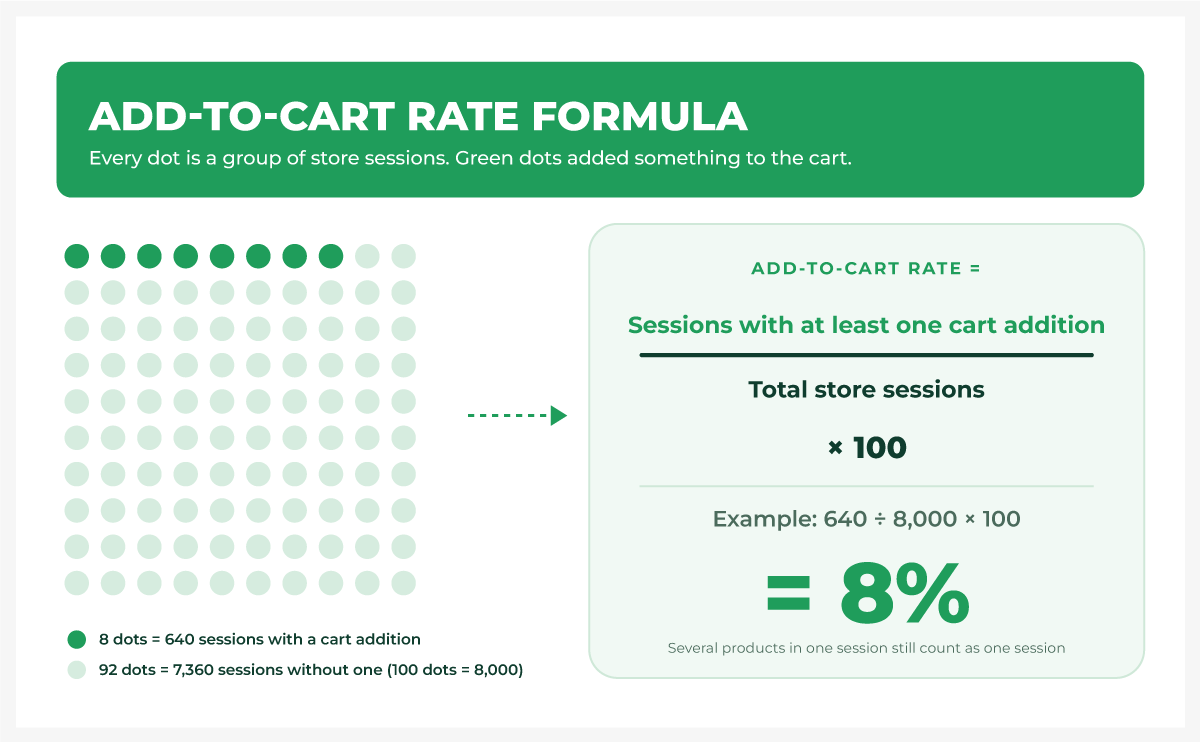
Add-to-cart rate = (Sessions with at least one cart addition ÷ Total store sessions) × 100
For example, if an online store receives 8,000 sessions and 640 of those sessions include a cart addition, its add-to-cart rate is 8%. Adding several products during one session still counts as one qualifying session.
Some product-level reports use product views as the denominator instead. Keep the calculation method consistent when comparing performance across periods or tools.
Why Is Add-to-Cart Rate Important?
This metric helps locate friction before checkout. A low rate may point to unclear product benefits, unconvincing visuals, unexpected prices, poor mobile usability, or traffic that does not match the offer.
If many shoppers add products but few purchase, investigate later steps such as shipping costs and checkout usability. Review the add-to-cart rate alongside the conversion rate and cart abandonment to understand the full customer journey.
What Is a Good Add-to-Cart Rate?
There is no single target for every store. Shopify’s 2026 ecommerce metrics guide cites a 6.07% global average from Dynamic Yield. However, this benchmark uses product-page views, not total store sessions. Therefore, it is not directly comparable to the session-based formula used here.
The most useful benchmark is your own rate, measured consistently and compared with similar products and previous periods.
How Can Ecommerce Stores Improve Add-to-Cart Rate?
- Improve product information. Show useful photos, dimensions, benefits, and accurate details. Clear product descriptions and visual design help shoppers judge value.
- Make costs clear. Display prices, stock status, delivery estimates, and return terms before shoppers reach checkout.
- Simplify mobile shopping. Keep purchase buttons visible, reduce loading delays, and make variants easy to select. Good Shopify store design supports these improvements.
- Strengthen trust. Place authentic reviews, secure-payment details, and delivery information close to purchase decisions.
- Test traffic and page changes. Compare devices and acquisition channels, then test product imagery, page layout, and offers. Keep ecommerce marketing campaigns aligned with the landing page.
How to Track Add-to-Cart Rate?
Ecommerce owners can track the add-to-cart rate through Shopify Analytics or Google Analytics 4 (GA4).
- Shopify Analytics: Check the Added to cart rate metric or compare sessions with cart additions against total sessions.
- Google Analytics 4: Verify the add_to_cart event and use a session-based segment to calculate the rate. Avoid confusing event counts with qualifying sessions.
- Performance analysis: Compare results by device, traffic source, and date range to identify shopping friction and measure improvements.
Frequently Asked Questions
Does adding a product to a cart count as a conversion?
It counts as a micro-conversion, but not a completed purchase. Sales conversion requires an order.
Does adding multiple items increase the add-to-cart rate?
Not in a session-based calculation. One session with several cart additions counts once.
What does a high add-to-cart rate but low sales rate mean?
Shoppers show interest but may encounter friction later. Review shipping charges, payment options, and checkout steps.
How is the add-to-cart rate different from the cart abandonment rate?
The e-commerce add-to-cart rate measures entry into the cart. Cart abandonment rate measures how many initiated carts do not result in a completed order, based on the chosen tracking definition.