
What Is Annual Recurring Revenue (ARR)?
ARR measures the annualized value of a company’s active subscription payments at a specific point in time. It is common in software businesses. But it also applies to ecommerce brands offering repeat deliveries, memberships, or other renewing plans.
For example, an online skincare store may sell individual products and monthly replenishment subscriptions. Only the subscription income counts toward ARR; one-time purchases do not.
How to Calculate Annual Recurring Revenue
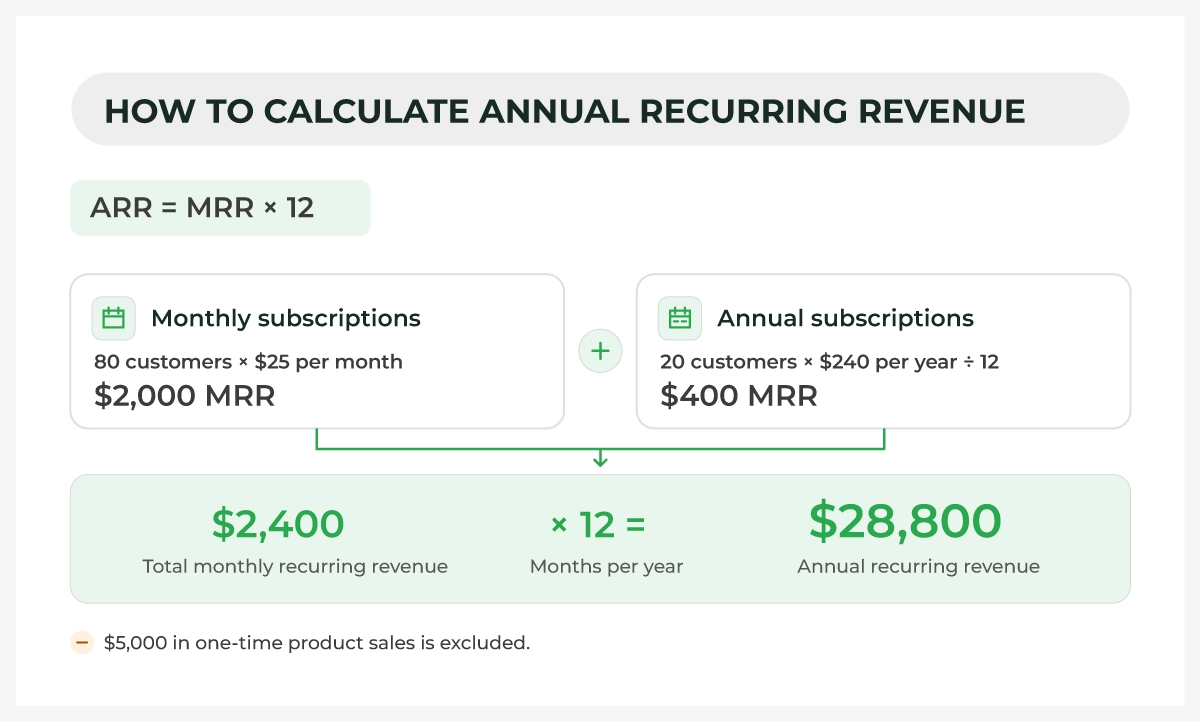
The standard calculation converts current monthly recurring revenue (MRR) into a yearly figure. Annual subscriptions should first be divided by 12 when calculating MRR. So each plan is counted once. The ARR formula:
| ARR = MRR × 12 |
Example: A subscription store has 80 customers paying $25 each month and 20 customers paying $240 each year. The monthly plans contribute $2,000 MRR, while annual plans contribute $400 MRR ($4,800 ÷ 12).
Total MRR: $2,400.
ARR: $2,400 × 12 = $28,800.
A further $5,000 in one-time product sales is excluded.
What Counts Toward ARR?
Include revenue that continues under active subscription terms. Exclude amounts that cannot reasonably be expected to recur.
| Revenue type | Include in ARR? | Why |
| Active monthly or annual subscriptions | Yes | Predictable, renewing payments |
| Ongoing subscription add-ons | Yes | Recurring charges linked to an active plan |
| One-time product orders or setup fees | No | Not recurring payments |
| Canceled plans or uncommitted usage charges | No | No active, predictable recurring commitment |
ARR vs. MRR vs. Total Revenue
These metrics measure different parts of the business. ARR and MRR describe the current subscription base; total revenue captures sales earned over a reporting period.
| Metric | What it shows | One-time sales included? |
| ARR | Annualized value of active subscriptions | No |
| MRR | Monthly value of active subscriptions | No |
| Total revenue | Revenue earned from all sales in a period | Yes |
Why ARR Matters for Ecommerce Businesses
For stores with a subscription model, ARR provides a clear reference point for budgets and growth plans. It helps owners see how upgrades, new subscriptions, and cancellations affect the recurring revenue base.
ARR becomes more useful alongside churn, profit margins, and customer acquisition costs. Retention efforts can also support the long-term stability of subscription income.
New subscribers, renewals that preserve active plans, and upgrades support the recurring revenue base. Cancellations, downgrades, and lower recurring prices reduce it. These changes should be reflected when reporting the current annual recurring revenue figure.
Important Limitations of ARR
ARR is a snapshot of the current subscription run rate, not guaranteed sales or profit. Actual collections may differ because of churn, failed payments, refunds, or pricing changes. As Stripe explains, recurring revenue metrics are also distinct from accounting revenue.
For a store that primarily sells one-off products, total sales, repeat purchase rate, and profit may be more useful. Some platforms also define ARR as “annualized run rate” instead of limiting it to annual contracts. So apply one definition consistently.
Frequently Asked Questions
What does ARR stand for in business?
ARR stands for annual recurring revenue. It expresses the value of active recurring subscriptions every year.
Is ARR always calculated as MRR × 12?
MRR × 12 is the common annualized method. Some companies use a stricter annual-contract definition. So reporting rules should be stated clearly.
Can an ecommerce business have ARR?
Yes. Subscription boxes, replenishment plans, and paid memberships can create ARR. Ordinary one-time orders do not.
Is ARR the same as annual revenue?
No. Annual revenue covers actual sales over the year, including one-time transactions. ARR annualizes current recurring subscriptions.
What is a good ARR for an online store?
There is no universal target. Compare ARR growth with churn, customer acquisition costs, and the margins of the subscription business.