
What Is AI Merchandising?
AI merchandising is the use of AI and machine learning to decide which products appear to shoppers and in what order. It analyzes product details, browsing behavior, searches, sales, and other relevant signals to make digital shelves more useful and responsive.
Unlike fixed product sorting, AI-powered merchandising can adjust listings as customer interests and store conditions change. Store owners still set rules for promotions, brand priorities, product availability, and other business needs.
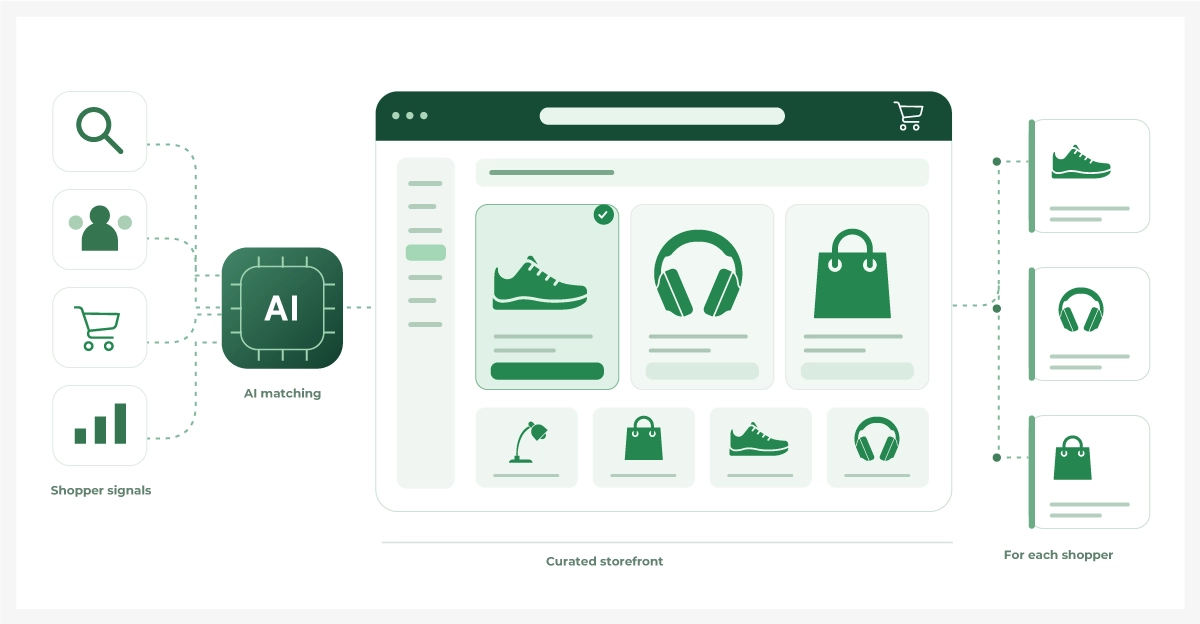
How Does AI Merchandising Work?
An ecommerce merchandising system connects product catalog data with shopper interactions. Models then estimate which items are relevant or likely to perform well. Business rules control what can appear. Results can be refined using new engagement and sales data.
Common Uses of AI Merchandising
- Product ranking: Reorder products on search and category pages based on relevance, demand, and merchandising priorities.
- Personalized product recommendations: Suggest items that fit a shopper’s interests or complement products already viewed.
- Inventory-aware displays: Reduce visibility for unavailable items and highlight suitable in-stock alternatives.
- Automated merchandising insights: Identify search gaps, underperforming collections, and emerging shopper preferences.
Example of AI Merchandising in an Online Fashion Store
A shopper searches for “running shoes” and frequently clicks lightweight styles. The store can prioritize relevant lightweight options, recommend matching socks, and avoid featuring out-of-stock sizes. Another shopper may see a different order based on their interests. The goal is easier discovery, not simply showing the same bestsellers to everyone.
AI Merchandising vs. Traditional Merchandising
The main difference between AI merchandising and traditional ecommerce merchandising is how products are selected, ranked, and displayed.
| Features | Traditional Merchandising | AI Merchandising |
| Product Ranking | Uses manual sorting and fixed rules | Uses data-driven, dynamic product ranking |
| Personalization | Shows similar products to most shoppers | Tailors product recommendations to shopper preferences |
| Decision-Making | Relies on human judgment and sales reports | Analyzes shopping patterns and customer intent |
| Optimization | Requires manual adjustments | Can automatically adjust product visibility based on new data |
| Scalability | Requires more manual work as catalogs grow | Supports automated merchandising across large catalogs |
Benefits and Limitations of AI
AI merchandising can make product discovery more relevant, reduce repetitive manual sorting, and support conversion and average order value. AI drives rapid automation, 24/7 service, and instant analytics. It can refine digital campaigns through automated A/B testing.
However, results depend on accurate product data, reliable tracking, and sensible merchandising controls. AI does not guarantee higher sales. Performance should be checked without assumptions.
How Can Ecommerce Owners Get Started?
- Begin with clean product attributes, accurate stock information, and clear category structures.
- For new stores or products with little behavioral data, ensure the tool can use product attributes, curated merchandising rules, or relevant popular items as a fallback.
- Define one measurable goal, such as improving category-page conversion or product recommendation engagement.
- Start with a limited set of pages, check the results, and expand only when the changes prove useful.
Frequently Asked Questions
Is AI-driven merchandising the same as personalization?
No. Personalization is one use of AI merchandising, which also covers ranking, search, and inventory-aware product placement.
Does AI merchandising replace a human merchandiser?
No. AI automates data-driven decisions while people set strategy, brand rules, and promotional priorities.
Can small ecommerce stores use AI merchandising?
Yes. Stores can begin with basic recommendation or search tools and expand as their catalog and data grow.
What data does AI merchandising need?
Common inputs include product attributes, availability, searches, clicks, carts, and order data.
How can AI merchandising success be measured?
Monitor conversion rate, revenue per visitor, search engagement, and average order value; compare results through testing.