
What Is Agentic Commerce?
Agentic commerce is an ecommerce model in which AI agents carry out shopping tasks for consumers or businesses. It’s a subset of AI commerce. Unlike tools that only suggest products, these agents can plan steps, use store information, and take actions with limited human involvement.
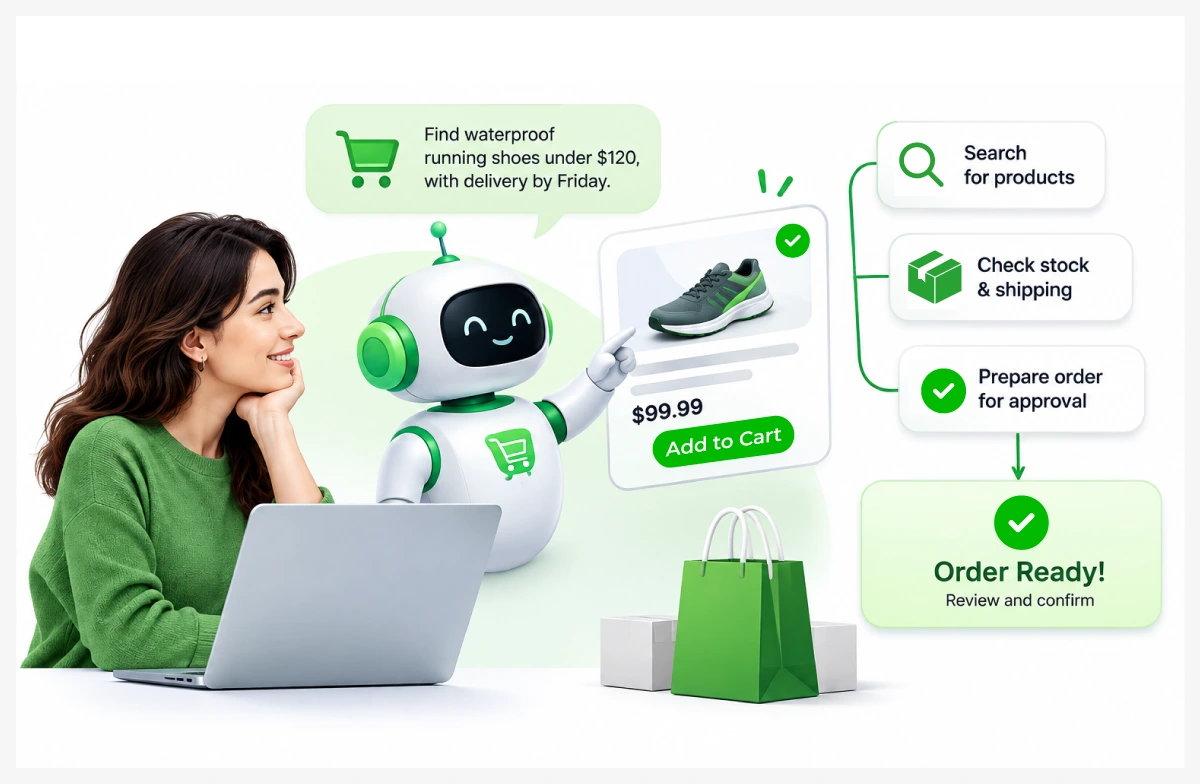
For example, a shopper could ask an agent to find waterproof running shoes under $120, in their size, with delivery by Friday. The agent may compare suitable products, check stock and shipping options, and prepare an order for approval. What autonomous shopping can complete depends on its permissions and the platform.
What Are the Types of Agentic Commerce?
- Shopper-side agents: Help customers discover, compare, and purchase products according to their preferences and budget.
- Merchant-side agents: Support retailers with tasks such as updating listings, monitoring inventory, or assisting customers.
- Agent-to-agent commerce: An emerging model where a shopper’s agent interacts with a merchant’s agent to exchange product or transaction information.
How Does Agentic Commerce Work?
The process connects a shopper’s request with product data, decision-making tools, and checkout systems. A typical journey includes five stages:
- Understand the request. The agent identifies the product, price limit, preferences, and delivery requirements.
- Find suitable products. It reads available listings, product attributes, prices, and stock information.
- Compare options. It evaluates relevant choices against the shopper’s stated priorities.
- Confirm and transact. Where supported, it presents the purchase for authorization and passes checkout details securely.
- Complete fulfillment. The merchant validates the order, processes payment, and handles delivery and returns.
Not every AI shopping agent supports all five stages. Some stop at product recommendations or send shoppers to the retailer’s checkout.
Why Does Agentic Commerce Matter for Ecommerce?
For shoppers, agents can reduce repetitive searching and make complex comparisons easier. For retailers, they create another route to product discovery and potentially faster purchases. However, visibility is not guaranteed, and merchants may have less insight into how an agent selected their products.
Accurate product information becomes especially important. Outdated prices, missing specifications, and unclear delivery policies can prevent an agent from presenting an otherwise suitable item.
What Are the Common Applications of Agentic Commerce?
- Shopper-side agents: Help customers discover, compare, and purchase products according to their preferences and budget.
- Merchant-side agents: Help retailers respond to shopping requests, verify product availability, and complete authorized transactions.
- Agent-to-agent commerce: An emerging model where a shopper’s agent interacts with a merchant’s agent to exchange product or transaction information.
How Can Ecommerce Stores Prepare?
Start with a reliable catalog. Complete product titles, clear attributes, current prices, stock levels, and shipping and return policies. Well-maintained listings, such as an essential part of ecommerce marketplace management, also help agents evaluate products consistently.
Next, review store integrations and checkout readiness. The technical options depend on the selling platform. Protect customer information, require appropriate purchase authorization, and check which AI channels your platform actually supports.
Frequently Asked Questions
Is agentic commerce the same as AI shopping?
Not exactly. AI shopping may only recommend items. Agentic commerce also involves AI agents taking permitted actions, potentially including checkout.
Can an AI agent buy products without approval?
That depends on the service and its permissions. Some systems require explicit purchase approval; merchants and shoppers should set clear authorization limits.
Does every ecommerce store need an AI agent?
No. Stores can first improve catalog quality, inventory accuracy, and compatible integrations. Building a custom agent is not a universal requirement.
How can retailers track agentic commerce results?
Monitor AI-referred visits where identifiable, completed orders, conversion rates, and product-data errors. Attribution may be incomplete across AI platforms.