Black Friday Email Marketing Strategy for Ecommerce
Plan a profitable Black Friday email marketing campaign with smart segmentation, clear offers, timely automation, mobile-friendly design, and measurable KPIs to increase ecommerce revenue and build lasting customer relationships effectively.
As an ecommerce store owner, target Black Friday to boost revenue. But just like you, there are many other store owners who target these holidays or events to grab the attention of customers with offers and promos. Adobe reported that US online spending reached $11.8 billion on Black Friday 2025 and $14.25 billion on Cyber Monday.
Customers get tons of emails from stores they've visited or bought from during these events. In those crowded inboxes, making your offers stand out is the key challenge. The opportunity is substantial.
We manage tons of Black Friday email marketing campaigns for our clients. The core of our workflow is to reach the right customer with a useful and personalized message at the moment they’re likely to take action. You don’t need to send tons of offers in different emails. You should plan in a way that protects margin, deliverability, and the customer relationship.
Today, we will show how you should plan for Black Friday 2026. We’ll explain how our email marketing experts handle list preparation and segmentation to creative automation, measurement, and after-sale retention. Alongside, we’ll also share campaign examples and ready-to-adapt email templates from our previous work.
Let’s begin.
Your BFCM Plan at a Glance
You need to answer these 6 questions before designing your promo banners:
Who should receive the offer?
What should they receive?
When should it arrive?
Why should they believe it?
What should happen after they click?
How will you judge the result?
Stage
Recommended timing
Main job
Useful measures
Foundation
4–6 weeks before
Audit the list, authenticate the domain, set goals, and confirm inventory
Deliverability, active audience size, margin target
Warm-up
2–3 weeks before
Grow the list, collect preferences, and tease the event
New subscribers, clicks, product interest
Early access
3–7 days before
Reward high-value and highly engaged subscribers
Conversion rate, revenue per recipient
Main event
Black Friday weekend
Launch, remind, and adjust based on behavior
Revenue, conversion, margin, unsubscribes
Cyber Monday
Monday
Refresh the angle or feature a distinct offer
Incremental revenue, new conversions
Retention
1–30 days after
Welcome new buyers and encourage the next purchase
Repeat purchase, returns, support volume
This is a basic planning frame our team often follows. A specialty store with a modest list may need four focused campaign emails. A large catalog with several active segments may justify more sends, provided engagement and suppression rules remain healthy.
Step 1: Build a Profitable Black Friday Email Strategy
You need to start with the commercial decision rather than the subject line. Email can amplify a good offer, but it can’t rescue weak economics. At first, review last year’s orders, discount depth, margin, average order value (AOV), returns, stockouts, and the customer segments that produced repeat purchases.
But if 2026 BFCM is the first season of your ecommerce business, use recent promotion data. Understand which products attract first-time buyers, which bundles lift order value, and where discounts create sales without cheating excessive returns or customer service pressure.
Set One Primary Goal
Revenue is an outcome, but it is rarely a precise campaign goal. Decide what this event should do for the business. You might want to acquire first-time customers, reactivate lapsed buyers, move seasonal inventory, increase order value, or reward loyal customers.
The goal changes the offer. A blanket discount may suit inventory clearance. A gift-with-purchase can protect margin. A threshold offer can lift basket size. Early access can make loyal customers feel recognized without training everyone to wait for a deeper discount.
Choose an Offer Customers Can Understand Quickly
Someone scanning a crowded inbox should understand the value within seconds. Strong offers usually have one dominant idea, such as 20% off selected collections, a tiered saving, a limited bundle, or a useful gift above a spending threshold.
Run the numbers before approving the creative. You need to include product margin, fulfilment, paid acquisition, returns, payment fees, and any free gift or shipping cost. If the order looks unprofitable before returns, a busier campaign will only make the problem larger.
For stores that need the promotion to work across channels, connect the email plan to the wider ecommerce marketing strategy. Customers may discover the offer through social, search, SMS, or paid media before email closes the sale.
Step 2: Prepare Your List and Sending Infrastructure
Black Friday is the worst time to discover that your emails land in spam. Start list and infrastructure work four to six weeks before the event, while there is still time to correct authentication, remove risky contacts, and rebuild engagement.
Make sure that SPF and DKIM pass for the domain you use to send. Bulk senders to personal Gmail accounts should also have DMARC, easy one-click unsubscribe, and low spam complaint rates. Google's current email sender guidelines set specific requirements for senders who cross its bulk threshold.
Do not suddenly mail every address you have collected. You have to suppress hard bounces, repeated non-openers with no other engagement, unsubscribed contacts, and addresses with uncertain permission. Remember, a smaller responsive audience is more valuable than a large list that damages sender reputation.
Grow the List Without Buying One
Now, use a clear on-site form that explains what the subscriber will receive. Early access, a gift guide, back-in-stock alerts, or a first look at bundles can be more credible than a vague promise of “exclusive updates.”
Buying or scraping addresses creates legal, deliverability, and trust problems. It also fills the list with people who never asked to hear from the brand. That is not growth. It is a borrowed reach with an expensive downside.
Keep Consent and Unsubscribe Rules Visible
In the United States, commercial messages need accurate sender information, a non-deceptive subject, a valid postal address, and a working opt-out process. The FTC's CAN-SPAM compliance guide explains the requirements and makes clear that business-to-business email is not automatically exempt.
For UK recipients, review the ICO's current PECR guidance, including consent, the soft opt-in, sender identification, and unsubscribe rules. Laws vary by market, so treat this section as a planning reminder rather than legal advice.
Step 3: Segment by Intent, Value, and Engagement
Segmentation does not require dozens of tiny groups. It requires meaningful differences in message or offer. If two segments will receive the same email at the same time, you’ve to separate them to add reporting complexity without improving the customer experience.
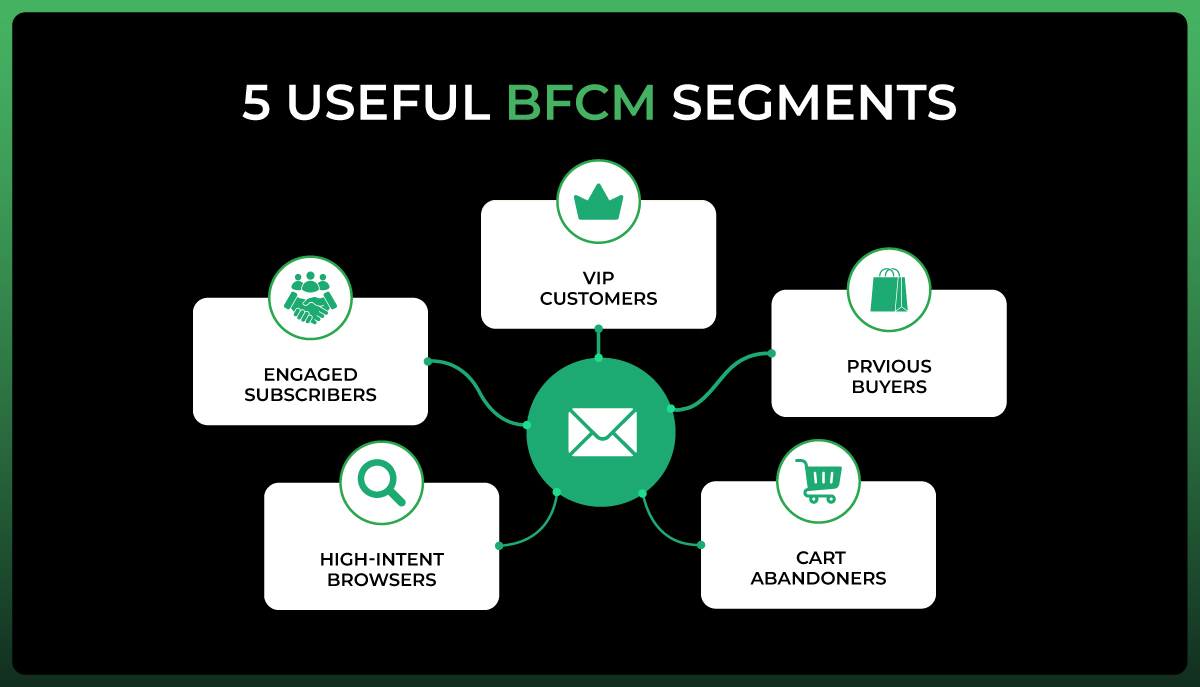
Start with five practical groups:
VIP customers: Give loyal or high-value buyers early access, a reserved bundle, or a benefit that feels earned.
Recently engaged subscribers: Send the core campaign to people who have opened, clicked, browsed, or purchased recently.
Previous BFCM buyers: Reference relevant categories or replenishment timing, not merely the fact that they bought last November.
High-intent browsers: Feature products or categories they viewed, when your data and consent setup allow that personalization.
Cart and checkout abandoners: Keep automated reminders active, but suppress overlapping promotional messages when they would create confusion.
Also create suppression groups for recent purchasers, unengaged subscribers, contacts at frequency limits, and customers who should not see an offer they can no longer use. Someone who paid full price ten minutes ago should not immediately receive a discount for the same product.
Here’s a crucial fact: Personalization should help a person decide, not prove how much data you have. A relevant category, size restock, replenishment cue, or loyalty status can be helpful. Overly specific behavioral references can feel intrusive and distract from the offer.
Step 4: Map the Campaign Timeline
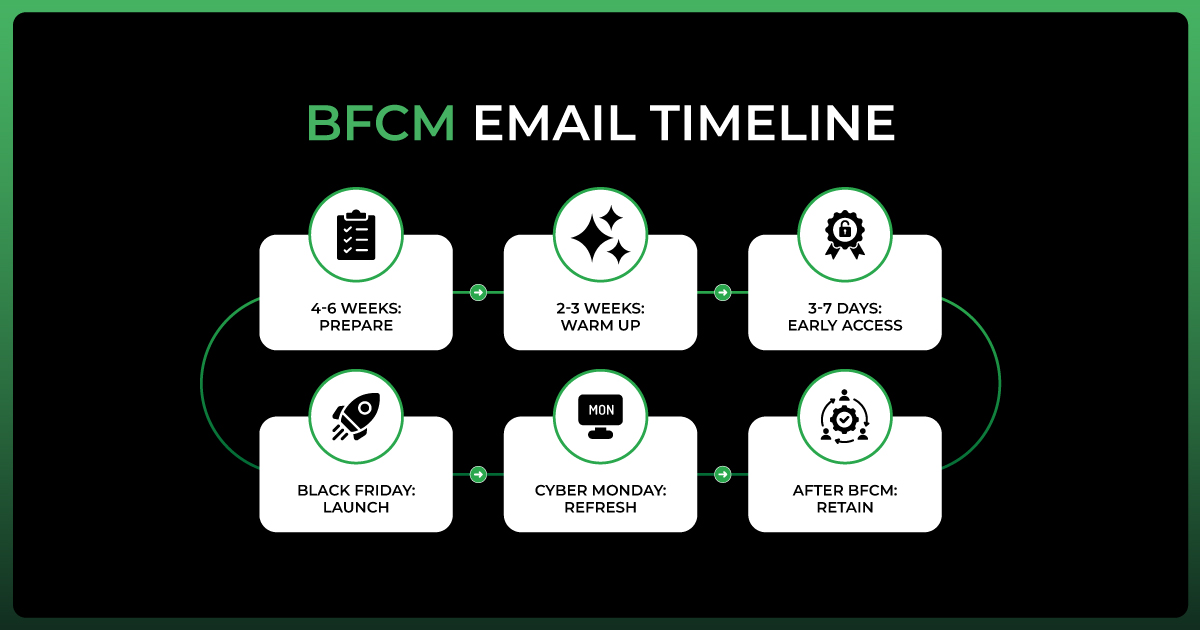
The best timeline gives customers time to notice the event without exhausting them before Friday arrives. Therefore, plan the full sequence in advance, then use live behavior to decide who needs the next message.
Four to Six Weeks Before: Build the Foundation
Confirm goals, offers, stock, landing pages, tracking, sending domains, segments, creative requirements, and customer service answers. This is also the time to test forms and update preference data.
You should introduce the event without revealing every detail. Invite subscribers to choose categories, join early access, save a date, or build a wishlist. These clicks provide useful intent signals for later segmentation.
Always avoid artificial mystery, no matter what. “Something huge is coming” becomes background noise when every brand says it. Give the teaser a practical reason to exist, such as priority access, a limited bundle, or help choosing the right product.
Three to Seven Days Before: Open Early Access
Send VIP and highly engaged groups a clear early-access email. State the benefit, deadline, eligible products, and any exclusions. If codes are limited or stock is genuinely constrained, explain that plainly.
Black Friday: Launch and React
Send the main offer when your customers are likely to shop, not merely when a generic playbook says midnight. A second message can reach non-openers or non-clickers with a different subject or product angle. Avoid resending the identical email to everyone.
Weekend: Help Undecided Shoppers
Shift from announcement to decision support. Feature best sellers, giftable products, reviews, bundles, shipping information, or answers to common questions. A reminder earns its place when it adds something useful.
Cyber Monday: Refresh the Reason to Act
Cyber Monday should not feel like a mislabeled copy of Friday. You need to change the featured category, add a digital bonus, introduce a bundle, or frame the deadline more clearly. Keep the visual system familiar so customers recognize the same event.
After the Event: Close the Loop
At first, confirm that the promotion ended. Then move new buyers into onboarding, education, replenishment, and review flows based on what they purchased. Because continuing “last chance” messages after the deadline weakens trust.
Step 5: Use Campaign Ideas That Serve a Purpose
Good BFCM email marketing ideas are not isolated design tricks. Each email should solve a job in the sequence. These six concepts cover the most useful jobs without forcing the campaign into unnecessary daily sends.
1. Preference-Led Teaser
First, ask subscribers what they want to see: gifts, essentials, premium products, or a particular collection. The click builds anticipation and gives you a signal for the launch email. Keep the choices broad enough that each segment will be useful.
2. VIP Early Access
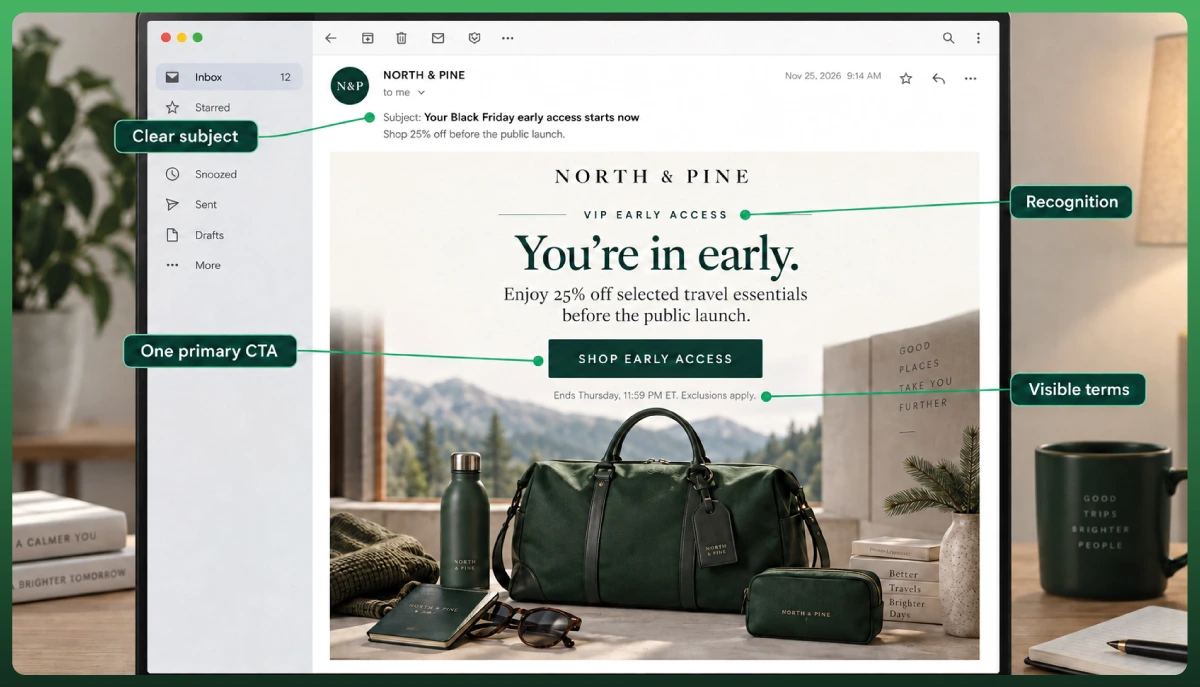
Don’t forget to frame early access as recognition, not pressure. A calm message with a private link, clear duration, and selected product grid can outperform a loud sitewide announcement for customers who already trust the brand.
3. Main Offer With One Visual Hierarchy
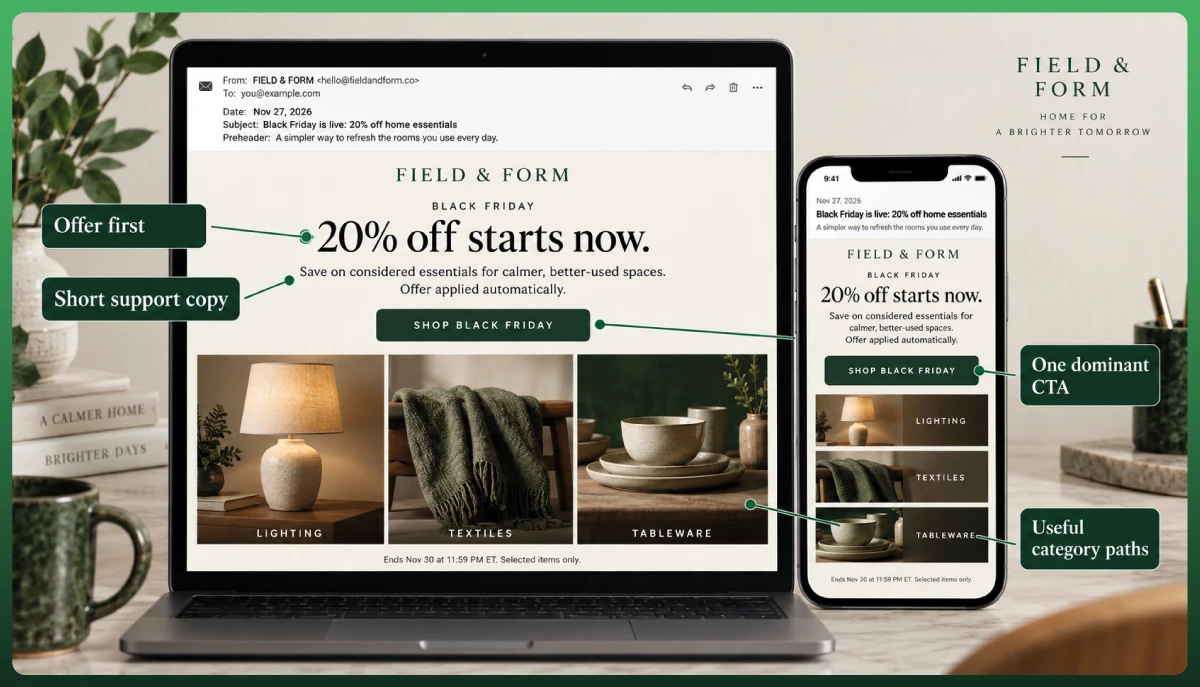
Lead with the offer, support it with one short sentence, and place the primary call to action above the first major product block; this is how things should go. This is the most dependable format among Black Friday email marketing examples because it reduces the work required to understand the promotion.
4. Product-Led Gift Guide
Organize products by recipient, problem, price, or use case. “Gifts under $50” is easier to scan than a random catalog. Use this when product choice, rather than awareness of the discount, is the main obstacle.
5. Values-Led Alternative
Not every brand should compete on discount depth. A repair program, donation, durability story, or limited charitable partnership may fit the brand better. Your commitment must be specific and verifiable. A vague cause message can look opportunistic during a sales event.
6. Final Reminder With New Information
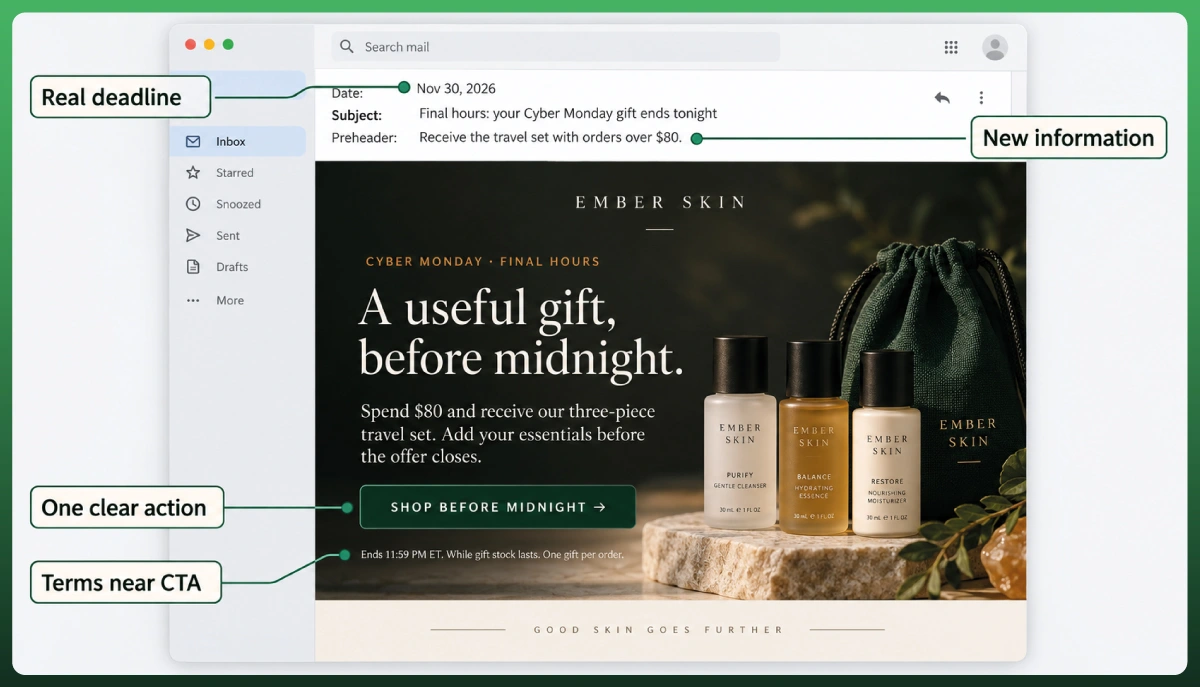
Your last reminder should clarify the deadline, shipping cutoff, remaining stock, or products still available. Genuine urgency is useful. Fabricated countdown resets, false scarcity, and endless extensions teach customers not to believe future deadlines.
Step 6: Adapt These Black Friday Email Templates
Templates are starting points. We are sharing some of the templates our outreach experts use. To use them, replace the bracketed details, match the language to your brand, and remove claims you cannot support. The goal here is to reduce production time without making every message sound interchangeable.
Template 1: Early-Access Email
Subject: Your Black Friday early access starts now
Preheader: Shop [offer] before the public launch.
Headline: You are in early
Body: As one of our [VIP members/most loyal customers], you can shop [offer] before it opens to everyone. Early access ends [day and time], and selected products may sell out.
CTA: Shop early access
Terms: [Eligibility, exclusions, time zone, code, and return conditions]
Template 2: Main Launch Email
Subject: Black Friday is live: [clear offer]
Preheader: Save on [category or benefit] through [deadline].
Headline: [Offer] starts now
Body: For a limited time, get [offer] on [eligible range]. Start with our most-shopped [category], or browse the full event before it ends [deadline and time zone].
CTA: Shop Black Friday
Support line: Free shipping over [threshold] | Easy returns | [Relevant proof]
Template 3: Category or Gift-Guide Email
Subject: Black Friday picks for [recipient or need]
Preheader: A shorter path to the right gift.
Headline: Gifts they will actually use
Body: Skip the endless scroll. We grouped the event into [three useful categories] so you can find the right option faster. The Black Friday offer applies automatically at checkout.
CTA: Explore the gift guide
Template 4: Final-Hours Email
Subject: Final hours: [offer] ends tonight
Preheader: Last call before prices return to normal.
Headline: Ends at [time and time zone]
Body: This is the final reminder for [offer]. If [specific product benefit] has been on your list, complete your order before [deadline]. No extension is planned.
CTA: Shop before it ends
Template 5: Cyber Monday Pivot
Subject: Cyber Monday: [new angle or benefit]
Preheader: One day, one focused offer.
Headline: A new reason to shop Monday
Body: Today only, [explain the distinct offer]. It is available on [eligible products] until [deadline]. If you purchased over the weekend, [explain whether the offer applies or provide a support route].
CTA: Shop Cyber Monday
Step 7: Design for Mobile Decisions
A polished desktop design can still fail on the device where customers read it. Build the email for a narrow screen first. Use readable type, strong contrast, generous spacing, descriptive links, and buttons that are easy to tap.
You need to keep the essential message in live text whenever possible. Image-only emails can be difficult to read, inaccessible to some customers, and unclear when images are blocked. Add meaningful alt text to product and campaign images, but leave decorative images with empty alt text.
The golden rule is: one email should have one primary action. Secondary links are fine when they help shoppers browse, but the dominant button should match the main promise. If the email says “Shop gifts under $50,” the landing page should open to that exact selection.
Maintain the same offer, wording, pricing, and deadline across the email and destination page. For stores on Shopify, coordinated Shopify design and development can help remove the visual and functional gaps between the message and checkout.
Before launch, test common mobile and desktop clients, dark mode, image blocking, link destinations, discount behavior, personalization fallbacks, and the plain-text version. Also check that the footer and unsubscribe route remain easy to find.
Step 8: Coordinate Campaigns With Automated Flows
Broadcast campaigns create the event, and automated flows respond to behavior. They should work together, but they should not talk over one another. A shopper who has just entered the checkout needs a different message from a subscriber who has not visited the store in six months.
Review these flows before BFCM:
Welcome: Update the promise if new subscribers join for early access, and do not send an ordinary welcome discount that conflicts with the event.
Browse abandonment: Feature the viewed product and current valid offer without pretending the shopper placed it in a cart.
Cart and checkout abandonment: Preserve product details, explain the promotion accurately, and suppress unrelated campaign reminders for a sensible period.
Back in stock: Check whether the product is included in the sale and whether the alert could create frustration if inventory is extremely limited.
Post-purchase: Thank the buyer, set delivery expectations, and delay cross-sell messages until they are useful.
Use a contact-level campaign calendar or frequency rule so the same person does not receive a teaser, cart reminder, welcome email, and flash promotion within a few hours. The exact cap should reflect normal engagement, purchase intent, and the urgency of the event.
Large catalogs and higher-volume stores may also need tighter coordination between merchandising, customer support, email operations, and storefront teams. A structured Shopify store management service can help keep pricing, inventory, content, and campaign execution aligned.
Step 9: Test, Monitor, and Measure What Matters
You don’t have to wait until Friday morning to send the first proof. Make sure to test the complete customer journey: inbox, email, landing page, cart, discount, checkout, confirmation, and post-purchase message. Nonetheless, include at least one real mobile device and one purchase in the test plan.
Test One Meaningful Variable at a Time
Useful subject-line tests compare clear approaches, such as offer-led versus benefit-led. Design tests might compare a product grid with a category-led layout. If you change the subject, offer, audience, and spend time together, the result will not tell you what caused the difference.
Do not overread tiny samples. When an audience is small, use tests to catch obvious weaknesses and learn directionally. A winning result is more useful when it repeats across multiple sends or aligns with on-site behavior.
Look Beyond Opens
Apple's Mail Privacy Protection makes open activity less dependable for individual-level decisions. Treat open rate as a directional delivery and creative signal. Give more weight to clicks, sessions, conversion, revenue per recipient, average order value, margin, unsubscribes, complaints, and return rate.
The most useful dashboard connects email behavior to business health:
Deliverability: Delivery rate, bounce rate, spam complaints, and unsubscribe rate.
Engagement: Unique clicks, click-to-open trend, and landing-page sessions.
Commerce: Conversion rate, revenue per recipient, average order value, and gross margin after discounts.
Customer quality: First-time buyers, repeat purchase, return rate, support contacts, and cohort value after the event.
Compare performance by audience and message purpose. A VIP launch and a reactivation email should not share the same benchmark. The right comparison is usually the segment's past performance, the equivalent campaign last year, and the economics required by this year's plan.
Teams that also run paid search and social should use consistent naming and attribution windows. Ecomgiantz's ecommerce marketing service supports coordinated measurement across the channels that contribute to the sale.
Step 10: Turn BFCM Buyers Into Repeat Customers
The sale is not finished when the order is placed. First-time BFCM buyers often arrive with different expectations from full-price customers. Your post-purchase experience needs to confirm the value of the product without immediately pushing another discount.
Start with accurate order and delivery communication. High volume, split shipments, preorders, and holiday cutoffs create anxiety when they are not explained. A proactive update can prevent a support ticket and protect trust.
Then tailor education to the product. Show setup, sizing, care, storage, replenishment, or complementary use cases. Ask for a review after the customer has had enough time to form an opinion, not on an arbitrary schedule that suits the platform.
For the second purchase, choose the next logical step. That might be a refill reminder, a companion product, loyalty invitation, or content that helps the buyer get more value from the first order. Constant coupons make the relationship depend on another sale.
If your operation needs help beyond campaign execution, connect retention work with broader ecommerce management. Inventory, fulfillment, customer service, merchandising, and lifecycle messaging all shape whether a Black Friday customer returns.
Common Black Friday Email Campaign Mistakes
Even strong creativity can be undermined by a few predictable decisions. Check for these problems before approving the final schedule:
Starting too late: Authentication, segmentation, creative, landing pages, and testing become rushed when planning begins in November.
Sending the same message to everyone: Relevance drops, frequency rises, and loyal customers receive no meaningful recognition.
Using a discount the business cannot afford: Top-line revenue looks impressive while margin, returns, and fulfilment erase the gain.
Creating false urgency: Resetting timers and extending every deadline trains subscribers to ignore the next one.
Changing the promise after the click: Different prices, exclusions, or deadlines between email and landing page create abandonment and support work.
Trusting open rate alone: Privacy features and image loading make opens an incomplete measure of buying intent.
Forgetting recent purchasers: Customers receive a promotion they just missed or a reminder for something they already bought.
Ending at checkout: New customers receive no useful onboarding, education, or reason to return.
Black Friday Email Campaign Checklist
Use this final review before scheduling:
The commercial goal and margin guardrails are documented.
Inventory, exclusions, codes, deadlines, and time zones are confirmed.
SPF, DKIM, DMARC, unsubscribe, and tracking are tested.
Engaged audiences and suppression groups are defined.
Every email has a clear job and one primary call to action.
Mobile, dark mode, alt text, and image blocking are checked.
The email promise matches the landing page and checkout.
Campaigns and automated flows have collision rules.
Customer service has the offer details and approved answers.
Reporting covers revenue, margin, deliverability, and retention.
Post-purchase messages are ready before the first order arrives.
Frequently Asked Questions
When should I start planning for Black Friday?
Begin planning four to six weeks before Black Friday. Warm the audience two to three weeks ahead, then launch early access several days before the main event.
How many Black Friday emails should I send?
Many stores can cover the event with four to seven focused campaigns. Adjust by engagement, purchase behavior, and frequency rules rather than copying a universal number.
What makes the best Black Friday emails effective?
The best Black Friday emails combine a clear offer, relevant audience, honest deadline, mobile-friendly design, matching landing page, and useful reason to click now.
Should I discount every product?
No. Selected categories, bundles, gifts, tiered offers, or loyalty benefits can protect margin and give customers a clearer choice than a storewide discount.
Should Black Friday campaigns replace automated flows?
No. Keep useful flows active, but update conflicting discounts and add suppression or frequency rules so automated and scheduled messages do not collide.
Which metrics matter most during BFCM?
Track clicks, conversion, revenue per recipient, margin, average order value, complaints, unsubscribes, returns, and repeat purchases. Use opens as a directional signal.
Final Thoughts
Strong Black Friday email campaigns do not depend on louder subject lines or more frequent reminders. They depend on preparation, a profitable offer, relevant segmentation, honest urgency, a smooth buying path, and a useful experience after checkout.
Build the calendar early, give each message a clear job, and let customer behavior decide who receives the next send. That is how black friday email marketing becomes a sustainable revenue program instead of a four-day scramble.
Ready To Boost Your Black Friday Sales?
Get Expert Ecommerce Email Marketing Services From Ecomgiantz.
Ecomgiantz Team consists of our in-house experts who share their hands-on experience in ecommerce businesses, websites, marketplaces, etc. We also share the latest updates, insights, and market trends that can be helpful for your online business.
Most Related Posts
No related posts found.
Ecomgiantz’s Development Expertise Across Leading Ecommerce Platforms