Shopify vs Etsy: Which One Should You Actually Sell On?
Compare Shopify vs Etsy to find the right ecommerce platform for your business. Explore costs, customization, SEO, traffic, marketing, product types, scalability, and customer ownership to make an informed choice.
Are you new to ecommerce industry? Looking for the right platform or model to launch your store online? Well, many will suggest either Shopify or Etsy for beginners. However, the Shopify vs Etsy comparison is not as simple as it seems. It’s not like comparing two different CMSs or SaaS. These two offer highly different models that you need to understand before making a choice.
Etsy is an online marketplace. You're renting a stall inside someone else's mall, and millions of shoppers already walk past that mall every day. On the other hand, Shopify is a top-choice ecommerce platform for building your own neat-looking online store from scratch, your own address, your own rules, and the traffic is entirely on you to bring in.
Neither choice is wrong. But picking the wrong platform for your situation can cost you months of wasted effort. Today, we will compare both platforms and help you pick the right model for your online store.
Quick Verdict
If you're...
Better fit
Why
Brand new with zero experience and a small budget
Etsy
Live in a matter of minutes, no site to build
Selling handmade or vintage products
Etsy
Built-in shoppers already searching for that
Selling digital products or templates at volume
Shopify
Better margins once sales climb, full control
Ready to build a brand people remember
Shopify
Your own domain, your own customer list
An Etsy seller whose fees are eating your profit
Shopify
Fixed monthly cost beats rising transaction fees
What Is Shopify?
Shopify is a SaaS ecommerce platform that lets you build your own neat, good-looking website without touching a line of code. As a platform for business owners moving beyond brick-and-mortar shops, or a brand-new Etsy shop that's ready for its own home, you pick a theme, add your products, connect a payment option, and you have a real online business with your own domain name.
Shopify: The Upside
Full ownership of your brand, your store, and your customer list
Unlimited product listings on every plan
Deep customization through themes and apps
Room to grow into a genuinely large ecommerce business
Shopify: The Trade-offs
No built-in traffic, you bring every visitor yourself
Monthly costs, whether you make a sale or not
A slightly steeper learning curve for total beginners
What Is Etsy?
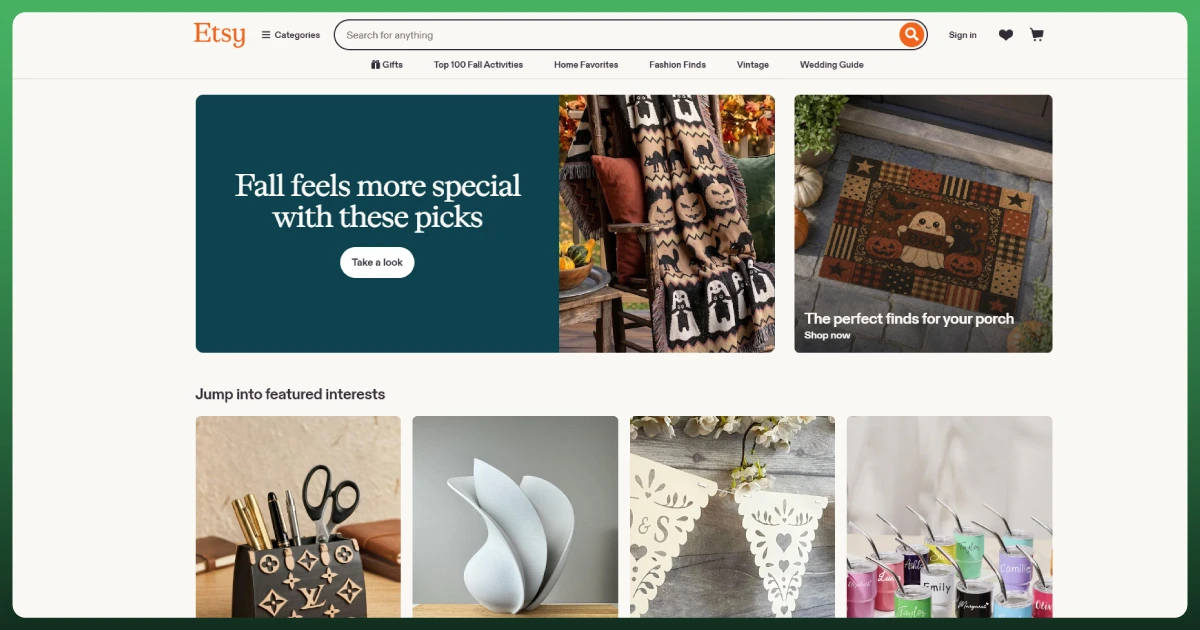
Etsy is an online marketplace built for handmade goods, vintage products, and craft supplies. Its whole appeal rests on simplicity: you open a shop inside Etsy's existing website, list your seller items, and shoppers already searching Etsy's marketplace can discover you almost immediately, without you managing separate hosting accounts or technical setup.
Etsy: The Upside
Millions of potential customers browsing on day one
No monthly plan required, you mostly pay as you sell
You can be live and taking orders within the slightest experience of ecommerce
Etsy: The Trade-offs
Limited customizability options for your shop's look
Etsy owns the customer relationship, not you
Fees stack up fast once your sales volume grows
Shopify vs Etsy: Full Comparison Chart
Factor
Shopify
Etsy
What it is
Standalone ecommerce platform
Online marketplace
Monthly cost
From $5, Basic at $39
No monthly fee required
Transaction fees
0% with Shopify Payments
6.5% per sale
Setup time
A few hours
A matter of minutes
Customization
Full design freedom
Limited personalization options
Built-in traffic
None, you drive your own
Millions of active shoppers
Customer data
Yours to keep
Etsy owns the relationship
Best for
Brands, digital products, scaling sellers
Handmade, vintage, testing an idea
Real Cost of Selling: Shopify vs Etsy Pricing Breakdown
This is where most beginners get surprised. The sticker price is never the full story. Let's break every expense down honestly, because expenses are the one thing that will make or break your first year.
Cost
Shopify
Etsy
Monthly platform fee
$5 to $39+
None
Listing fee
None
$0.20 per item, every 4 months
Transaction fee
0% (Shopify Payments)
6.5% of order total
Payment processing
2.9% + $0.30
3% + $0.25 (varies by region)
Apps
$0 to $100+/month
Limited third-party options
Themes
$0 to $350 one-time
Etsy Pattern, $15/month
Domain
~$9 to $15/year
Included in your shop URL
Marketing
Ads, email, SEO tools
Etsy Ads, Offsite Ads (12-15%)
Here's the real-world math. On a $50 sale with $5 shipping, Etsy's cut runs roughly $3.58 in transaction and payment processing fees, before you even count the 20 cents in listing fees due again once that item resells (per Printify's fee breakdown). On Shopify's Basic plan, that same $55 sale costs about $1.90 in payment processing, plus your flat monthly payments regardless of volume, so a slow month never turns into an outright loss the way stacked marketplace fees sometimes can.
The breakeven point most sellers hit sits around $600 to $800 in monthly sales. Below that, Etsy's pay-as-you-go model is usually the cheaper choice. Above it, Shopify's fixed monthly costs start winning by a wide margin, and the gap only grows as your sales climb.
Getting Started: Setup Time and Learning Curve
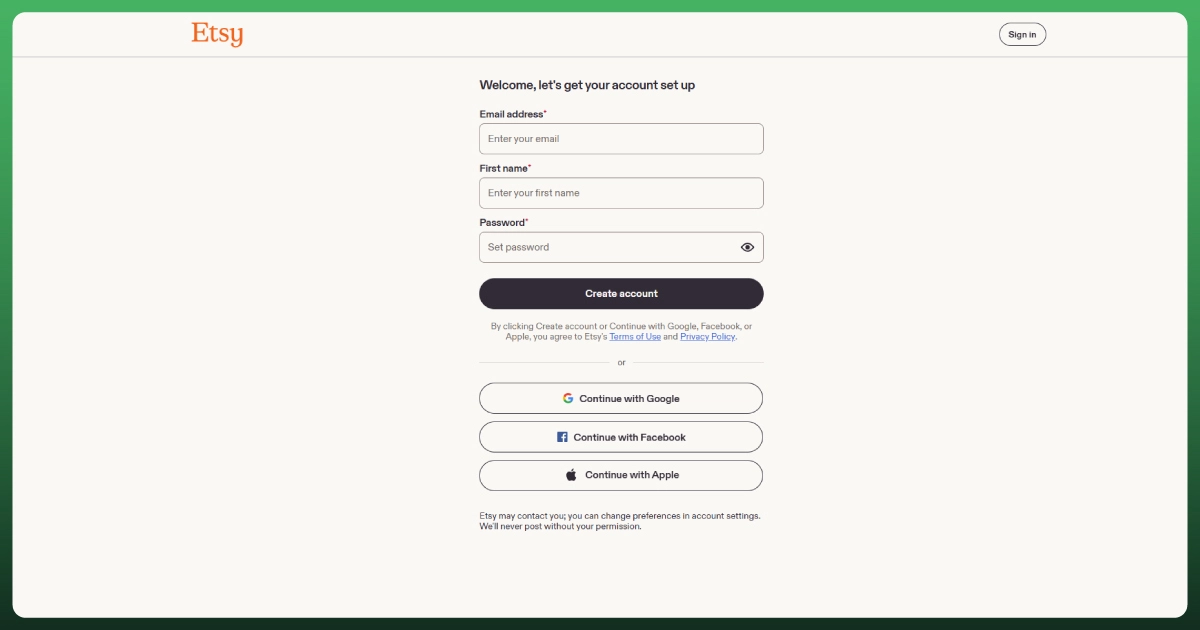
Etsy wins this round without much of a fight. Create an account, upload photos, write two honest paragraphs about your shop, and you're selling. No design decisions, no themes, no plugins. It genuinely takes a matter of minutes for a simple shop, which is exactly why the Shopify vs Etsy for beginners debate usually starts here.
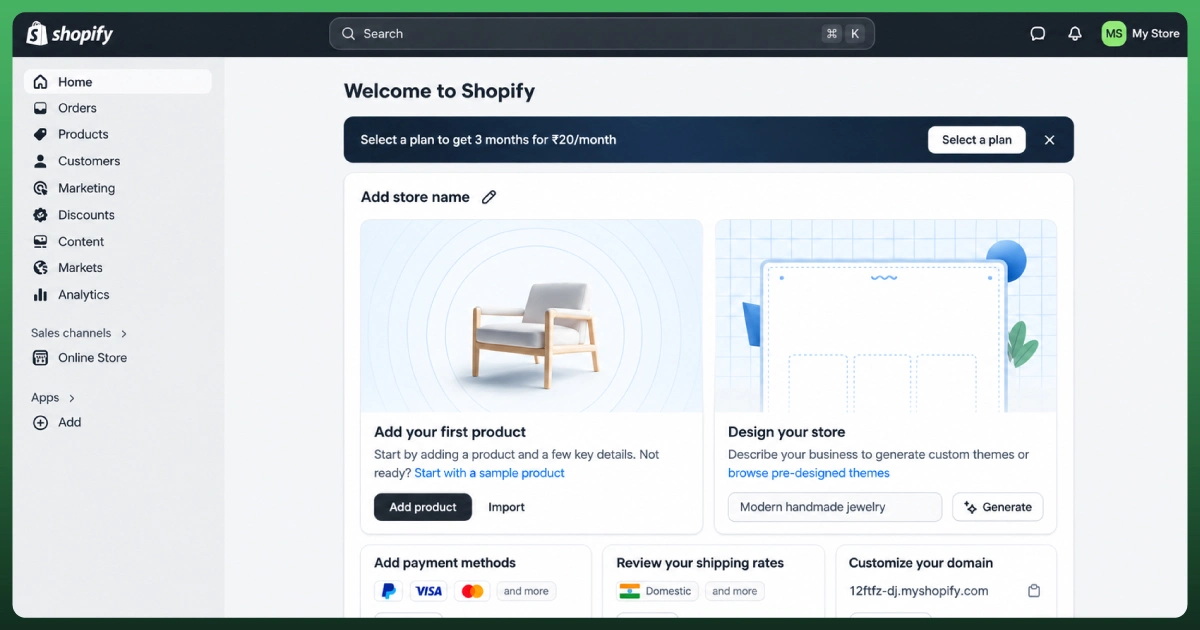
Shopify asks a bit more of you upfront. You'll pick a theme, set up payment gateways, configure shipping, and organize your product listing before you publish. It's still beginner-friendly, and Shopify's step-by-step instructions and setup wizard carry you through it, but budget a few real hours rather than a coffee break.
Here's the honest note: that extra setup time on Shopify isn't wasted effort. It's you building an asset instead of a rental. Keep that in mind as we get to the next section, because it's the single biggest difference between these two platforms.
Who Owns Your Customer Relationship?
On Etsy, you're building Etsy's business. On Shopify, you're building your own asset. That single sentence explains almost every other difference on this page.
Etsy restricts you from contacting buyers directly unless it relates to their specific order. No email list, no newsletters, no remarketing to people who already loved your products. Your customer's loyalty belongs to Etsy, the marketplace, not to your shop specifically.
Shopify flips that entirely. Every customer who buys from you becomes part of your own database. You can email them, send coupons, run a loyalty program, and market to customers through email for as long as you own that relationship. Tools like our own email marketing service exist specifically because repeat customers, not one-time buyers, are what make an ecommerce business genuinely profitable long-term.
If long-term selling and real brand recognition matter to you, this is the section to reread twice. Customer lifetime value compounds. A rented audience does not.
Branding and Store Customization
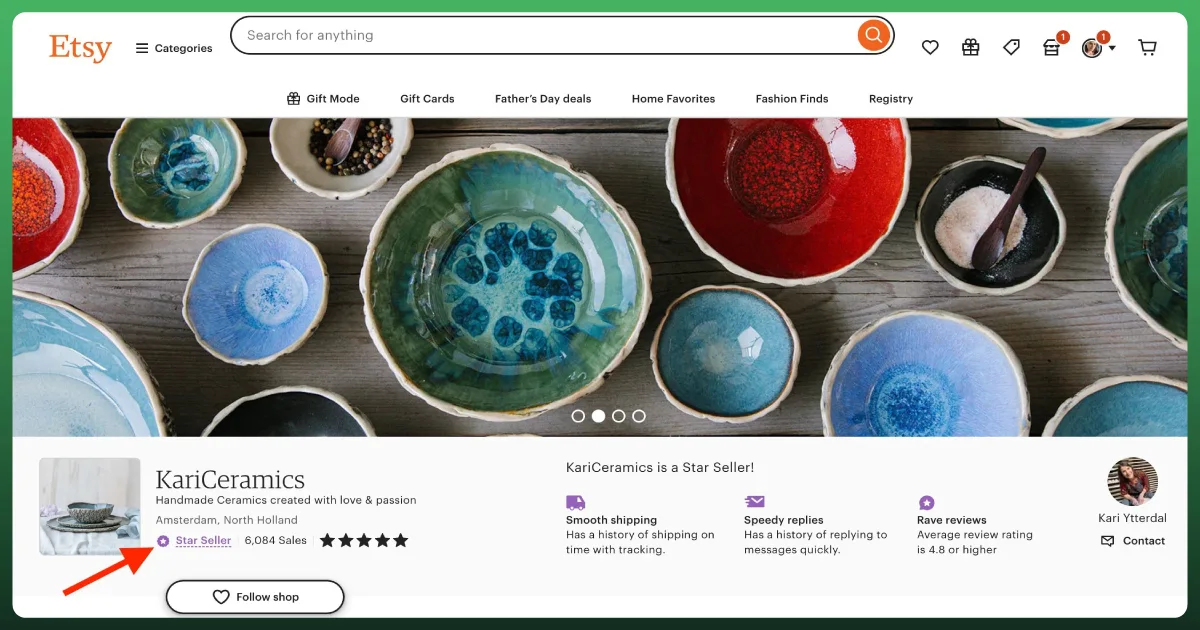
Every Etsy shop follows the same basic layout: banner, profile photo, a grid of listings, and an About section. You can add your own logo and a bit of personality to your shop story, but the overall structure of every Etsy shop looks the same.
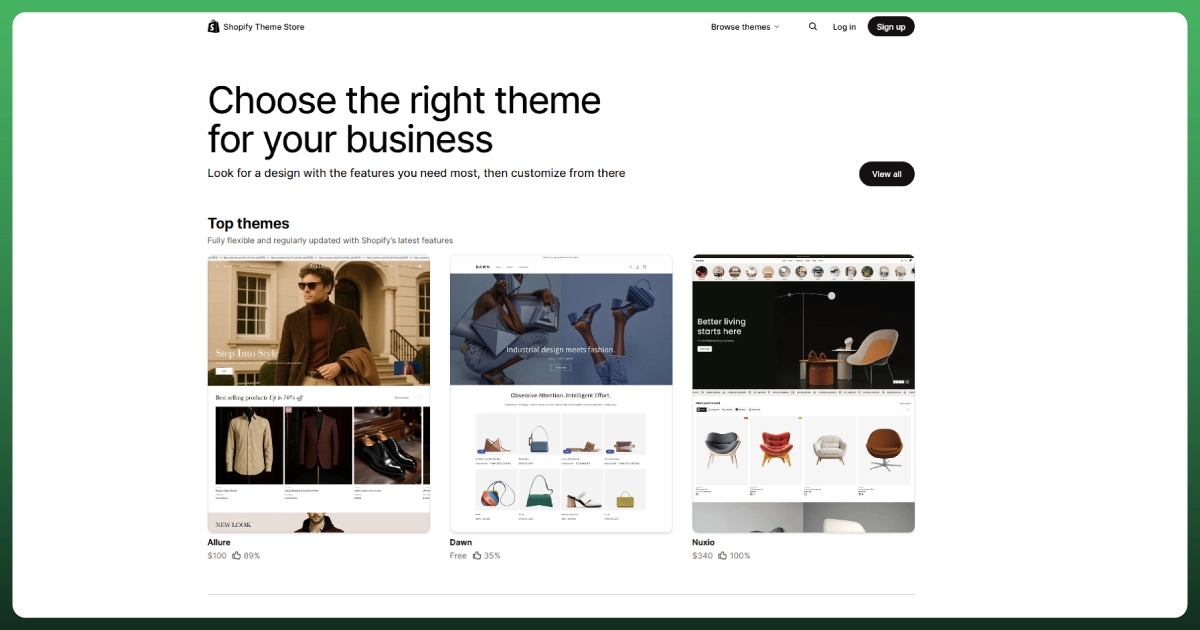
Shopify hands you real freedom. Hundreds of themes, full color and font customization, and the ability to build a neat-looking online store that actually reflects your brand's uniqueness. You can go well beyond basic images as well, with product 3D videos and rich media on higher-tier themes. Your URL is yourbrand.com, not etsy.com/shop/yourbrand, and that difference matters more than it sounds.
For a lot of sellers, that limited customizability on Etsy is fine at first. But once you've got repeat buyers and a bit of recognition building, the lack of a distinct brand identity starts to feel like a ceiling rather than a convenience.
Built-In Audience vs Building Your Own Traffic
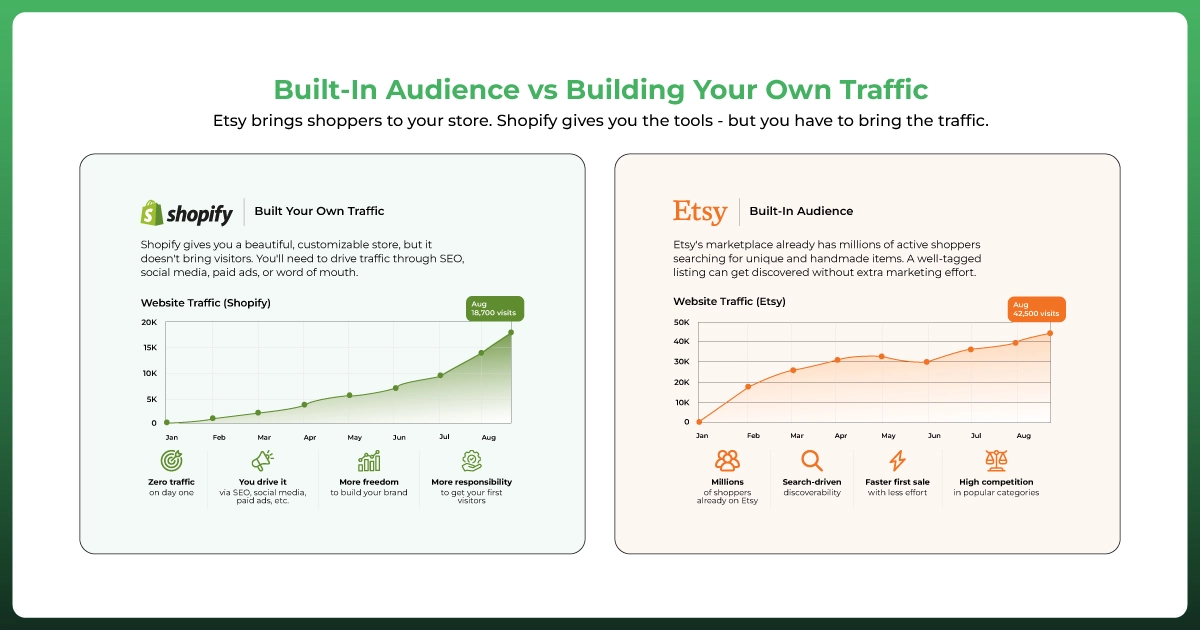
Etsy's biggest gift to new sellers is traffic. Millions of shoppers are already searching Etsy's marketplace daily for one-of-a-kind items, so a well-tagged product listing can get discovered without you lifting a marketing finger.
Shopify gives you zero traffic on day one. None. Every single visitor has to come from somewhere you point them: search engines, social media platforms, paid ads, or word of mouth. That's real freedom, but it's also real responsibility.
Here's the trade-off in plain terms: Etsy's wonderful traffic flow is a real gift when you're starting out and don't have a marketing plan yet, and it gives brand-new sellers a genuine chance at their first sale fast. But you're one fish in a very big pond, competing against thousands of similar shops, much like competing for attention on Amazon or eBay, for the same shoppers. The difficulty only grows as more sellers join the same crowded categories.
Shopify SEO vs Etsy SEO: How Discovery Actually Works
These are genuinely two different games, and understanding the difference will save you months of guessing.
Can Your Etsy Shop Rank on Google?
Yes, individual Etsy listings can and do show up in Google search results, largely because Etsy.com itself carries enormous domain authority. But you're not optimizing for Google directly; you're optimizing for Etsy's internal search algorithm, which weighs your titles, tags, photos, and shop performance (Search Engine Journal).
Serious Etsy sellers use third-party keyword tools like eRank or eVerBee because Etsy's own analytics only tell you so much about which tags are driving your online sales versus your competitors'.
Can a Shopify Blog Actually Rank?
Absolutely, but it's a slower build. Shopify auto-generates a sitemap and lets you edit meta titles, URLs, and product schema, all of which help Google understand your pages. Unlike a shop page on Etsy's domain, your Shopify store starts with zero built-in domain authority and has to earn it through backlinks, content, and time.
The short version: Etsy SEO is about winning inside one marketplace's search box. Shopify SEO is about winning across the entire open web, on Google, on AI answer engines, everywhere your potential customers actually search.
Marketing and Customer Acquisition Tools
A successful marketing strategy looks completely different depending on which platform you're on, so let's separate the effective marketing tools each one actually gives you.
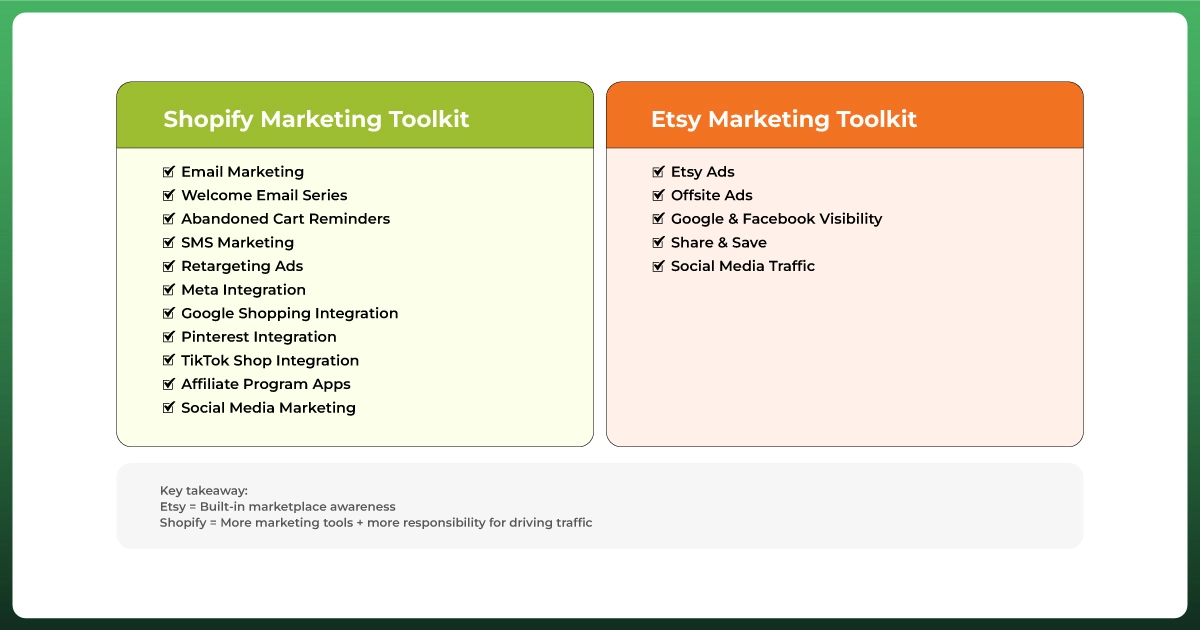
Shopify's toolkit is enormous: built-in email marketing with every form of marketing email you'd need, from welcome series to abandoned cart reminders, SMS, retargeting ads, Meta and Google Shopping integrations, Pinterest and TikTok Shop connections, and affiliate program apps. Pairing that with a real social media marketing push is usually how Shopify sellers build genuine traffic momentum over time.
Etsy's marketing toolkit is narrower but still useful: Etsy Ads for on-platform visibility, Offsite Ads that show your products on Google and Facebook (at a 12-15% fee if they lead to a sale), and a Share & Save feature that refunds part of your fee when your own social links drive a sale.
What you're actually selling changes this whole decision more than almost anything else. Shopify vs Etsy selling looks completely different depending on your product category, so let's go through it one type at a time.
The takeaway: Etsy gives you a head start through marketplace awareness. Shopify gives you the tools to build a real, sustainable marketing engine, but you have to be the one operating it.
Selling Different Types of Products
Handmade Products
Etsy was practically built for this category, and product demand for genuinely handmade, one-of-a-kind items is strong there. Etsy does require handmade verification and lets you disclose production partners if you use help to make your goods, but pure mass-produced items and vintage products (over 20 years old, per Etsy's policy) both have their own rules worth reading before you list.
Print-on-Demand
This is genuinely one of the biggest audiences for this exact comparison. Both platforms support print-on-demand well through partners like Printful, Printify, and Gelato, letting you sell everything from tote bags to apparel with zero inventory. Etsy gives POD sellers instant traffic to test designs; Shopify gives POD sellers a real brand once a design proves itself.
Digital Products
Digital products, templates, printables, and downloadable files, sell well on both platforms, and this is where margins matter most since there's no shipping cost eating into your profit. Etsy caps how creative your delivery experience can be; Shopify lets you build a genuinely pleasant customer shopping experience around instant digital delivery, from custom thank-you pages to upsell offers.
Dropshipping
Here's a hard line worth knowing before you build a business plan around it: dropshipping is explicitly banned on Etsy, since every item must be designed or made by the seller. It's a common and fully supported business model on Shopify, so if dropshipping is your plan, this decision more or less makes itself.
Shipping, Fulfillment, and Payment Processing
Etsy bakes shipping into the seller experience with built-in labels for USPS, UPS, and Royal Mail, pre-filled customs forms for international orders, and calculated or flat-rate options you set per listing.
Shopify's shipping tools go further once you scale: real-time carrier rates, discounted shipping labels, inventory tracking across up to ten locations on standard plans, and fulfillment apps that let you manage a growing product assortment and inventory with ease behind the scenes.
On payments, both platforms support major credit cards, PayPal, Apple Pay, and Google Pay. The difference is who's processing it. Etsy Payments handles everything centrally; Shopify Payments does the same, but you can also plug in dozens of alternative payment processors if you want more control.
Selling Internationally
If shoppers outside your home country are part of the plan, both platforms can handle it, just differently. Etsy automatically converts prices into a shopper's local currency and lets you set domestic versus global pricing to absorb higher international shipping costs.
Shopify Markets goes deeper: localized storefronts, multiple languages, automatic currency conversion, and duty and tax calculations at checkout for specific countries. If you're serious about a global customer base rather than the occasional international order, Shopify's tools are built for that scale.
Security and Data Protection
This one matters more than most beginners think about upfront, and it's a genuine YMYL concern since you're handling real customer payment data either way.
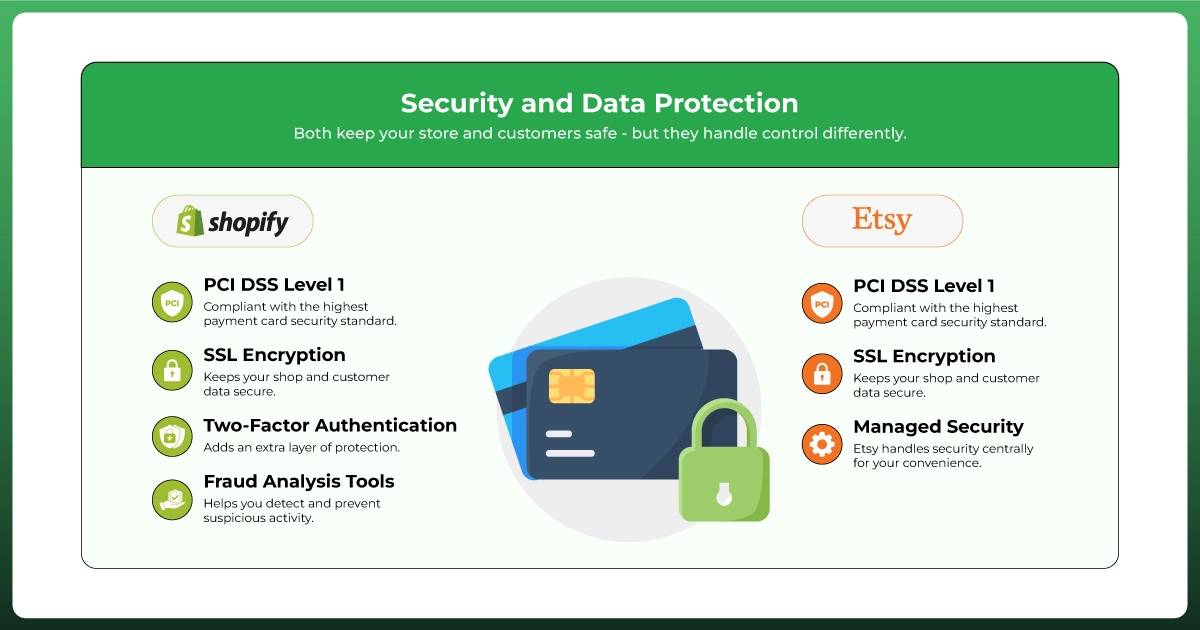
Both platforms meet PCI DSS Level 1 compliance, the highest tier of payment card security (PCI Security Standards Council), and both provide SSL encryption on every shop and store automatically. Shopify adds two-factor authentication and fraud analysis tools you control directly.
Etsy manages security centrally on your behalf, which is genuinely convenient, but it also means you have less visibility and control if something goes wrong. Shopify puts more of that control in your hands, along with more responsibility to use it well.
Apps, Integrations, and Automation
Shopify's app ecosystem is enormous, with thousands of neat tools covering everything from upsells to accounting to customer support chatbots, plus the ability to access performance analytics and a real insight option for every corner of your store. Etsy's integrations are far more limited, mostly API connections for accounting or inventory tools, with no true app store, and updates to what's possible arrive far less often.
A Quick Note on AI Tools in 2026
Both platforms have leaned into AI this year. Shopify Magic generates product descriptions, email copy, and edited images for free on every plan, while Sidekick acts as a conversational assistant inside your store admin (Shopify). Etsy introduced its own AI Shop Assistant in early 2026, aimed at helping sellers manage listings with less manual busywork.
Neither tool replaces good product photos or an honest description written in your own voice. Treat them as a time-saver, not a strategy.
Account Risk and Business Basics
What Happens If Etsy Suspends Your Shop
This is a real risk worth knowing upfront, not a scare tactic. Etsy sellers have reported shop suspensions with little warning, sometimes after years of clean selling history, over policy violations or account reviews that can take weeks to resolve. Your shop, your listings, and your reviews all live on Etsy's terms, not yours.
A Shopify store carries a different kind of risk, mainly around your own security practices, but you're never at the mercy of another company's account review process for your core storefront.
Do You Need an LLC or Business License?
Neither platform requires a business license to open a shop. But once you're making consistent money, most experts recommend registering your business for legal and tax protection.
Customer and Merchant Support Compared
Shopify offers 24/7 live chat and email support on every plan, backed by a large Help Center, an active merchant community, and Shopify Academy for beginners who want structured, helpful tips rather than trial and error.
Etsy's support leans more on self-service: a detailed guide called the Seller Handbook, community forums, and email or callback support during business hours rather than round-the-clock live chat. For a beginner who wants fast answers at 11 pm, that difference is worth knowing.
Using Both Platforms: The Playbook Sellers Actually Use
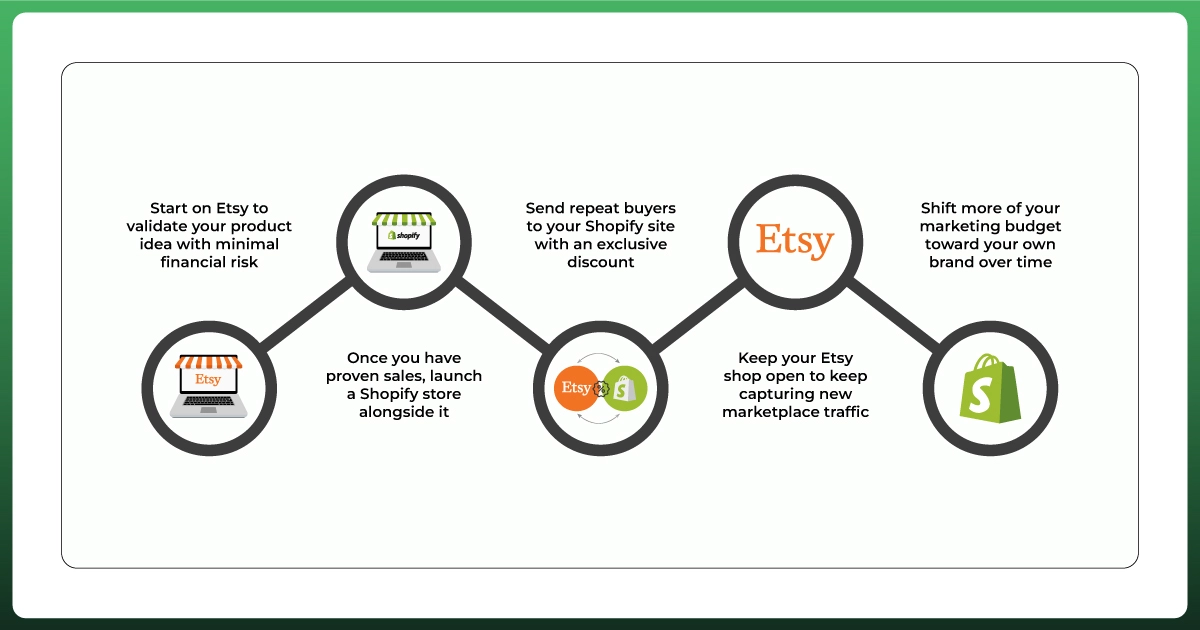
Here's a crazy idea that isn't actually crazy at all: you don't have to choose just one. Plenty of successful sellers run both, and honestly, it's often the smartest option for someone brand-new to the ecommerce field.
Start on Etsy to validate your product idea with minimal financial risk
Once you have proven sales, launch a Shopify store alongside it
Send repeat buyers to your Shopify site with an exclusive discount
Keep your Etsy shop open to keep capturing new marketplace traffic
Shift more of your marketing budget toward your own brand over time
Shopify even makes this easier through its multichannel selling tools, letting you sync inventory across Etsy, Amazon, and Shopify from one dashboard instead of juggling separate systems by hand.
Etsy Sellers Planning to Scale
If you're already selling on Etsy and reading this, here's how to know it's time. Rising fees are eating a bigger slice of your margin every month. You're struggling to stand out against nearly identical shops. You want subscriptions, wholesale, or a loyalty program Etsy simply doesn't offer.
When that moment comes, Shopify's conversion tools become genuinely useful: product upsells and bundles, abandoned cart recovery emails, and a checkout flow that consistently converts better than the industry average. These are the tools that turn a side hustle into a business with real long-term benefits.
Feeling that Etsy ceiling already? We help established Etsy sellers move to a Shopify store the smart way, without losing momentum. Talk to our store management team.
Decision Matrix by Seller Type
Ratings below reflect how well each platform fits that specific seller situation in this Shopify vs Etsy breakdown, with five stars being the strongest match.
Seller type
Etsy
Shopify
Handmade goods
★★★★★
★★★★
Print-on-demand
★★★
★★★★★
Digital products
★★★★
★★★★★
Vintage products
★★★★★
★★
Dropshipping
Not allowed
★★★★★
Subscription business
★
★★★★★
Local or established brand
★★
★★★★
Final Thought
Here's our honest closing advice for this article, the same thing I'd tell a friend over coffee: start where the risk is lowest for your specific situation, and don't be afraid to outgrow that starting point. The practicality of daily customer interaction, order by order, teaches you more than any guide ever will.
We've walked plenty of sellers through exactly these situations, and you can see how those journeys played out in our case studies. For more like this, our blog covers plenty of previous articles on getting an ecommerce business off the ground. If you want a second opinion on your specific situation, reach out to our team, and we'll help you map the smartest first step.
Frequently Asked Questions
Is Shopify better than Etsy?
Neither is universally better. Shopify is stronger for building a long-term brand with full ownership and better margins at scale. Etsy is stronger for immediate traffic and testing a product idea with minimal risk. The right answer depends on your product, budget, and how much control you want.
Is Etsy saturated in 2026?
Competition is real, with well over 100 million listings on the marketplace, but demand is still strong for genuinely unique or well-photographed products. Saturation affects generic categories more than distinctive, well-tagged shops with a clear target audience.
Is Shopify worth it for beginners with no experience?
Yes, for anyone planning long-term selling rather than a quick test. The monthly cost is a real commitment compared to Etsy's pay-as-you-go model, but you're building an asset you fully own instead of renting space in someone else's marketplace.
Can I sell on Etsy and Shopify at the same time?
Yes, and many sellers do exactly that. Etsy brings in marketplace shoppers while Shopify builds your own customer base and brand. Shopify's multichannel tools can even sync your inventory across both platforms from a single dashboard.
Can I migrate my Etsy shop to Shopify later?
Yes. Product listings, photos, and descriptions can be exported and rebuilt on Shopify, though your reviews and shop history stay with Etsy. Most sellers migrate gradually, keeping the Etsy shop open while the Shopify store grows.
Choosing Etsy For Your Business?
Let Our Experts Help You Launch And Grow Your Etsy Store.
Ecomgiantz Team consists of our in-house experts who share their hands-on experience in ecommerce businesses, websites, marketplaces, etc. We also share the latest updates, insights, and market trends that can be helpful for your online business.