BigCommerce vs Shopify 2026: Which Platform Actually Fits Your Store
Choosing between BigCommerce and Shopify in 2026 comes down to total cost of ownership, catalog scale, and native features. Discover which platform aligns with your store's growth strategy.
BigCommerce and Shopify are two of the most promising ecommerce platforms that will host your online stores and help you scale efficiently without bothering about core technical concerns. To create a solid D2C platform or a multichannel ecommerce business, Shopify is the best option you have. But when your business model is mainly B2B wholesale and retail altogether, you should deploy your store on BigCommerce.
In the BigCommerce vs Shopify battle, the winner depends on your business model and size, specific requirements, and the amount of flexibility you need in customization. Both platforms have different SaaS models. So, it’s not possible to declare a sole winner.
After working with hundreds of Shopify and BigCommerce store owners, we’ve gained a deep understanding of both platforms. Today, we will break down all the features and setbacks of Shopify and BigCommerce. We’ll also explain the ideal choices of functions and features based on store types.
Let’s compare these ecommerce website builders.
BigCommerce vs Shopify: Quick Comparison
If you are...
Go with
Why
Launching your first store or a lean DTC brand
Shopify
Faster setup, bigger app ecosystem, best checkout
Running heavy B2B or wholesale alongside retail
BigCommerce
Native B2B depth and multi-storefront without enterprise pricing plans
Selling a large catalog with complex variants
BigCommerce
Cleaner native handling of variants and faceted filtering
Focused on conversion and social commerce
Shopify
Shop Pay, Shop app, and deeper native channel selling
Wanting no forced upgrades as revenue grows
Shopify
No GMV caps, unlike BigCommerce's revenue-tied plans
Creating a multichannel ecommerce business
Shopify
Acts as a centralized platform to run operations
As said earlier, neither wins outright. Shopify leads on ecosystem and ease; BigCommerce leads on built-in features and technical control. The right pick depends on your model, and 2026 changed some of the old rules, as you will see.
BigCommerce started in 2009 when Eddie Machalaani and Mitch Harper, two Australians who'd met years earlier in an online chatroom, decided the ecommerce tools of the time weren't good enough and built their own. That engineering-first culture still shows in the product: BigCommerce brands itself as Open SaaS, fully hosted like Shopify, but built with more native functionality and a more open API layer underneath. Today it runs stores for well over 90,000 merchants across 120+ countries, including brands like Burrow and Uplift Desk, and trades publicly on the Nasdaq.
What BigCommerce Does Well
More features ship natively, so you lean on fewer paid apps
No forced move to an enterprise tier just to unlock B2B tools
Higher API ceilings, useful once integrations start piling up
Multi-storefront comes standard well before the top pricing tier
What It Costs You
A smaller theme and agency pool than Shopify's
Annual sales caps that can force a plan upgrade uninvited
A steeper admin to learn than Shopify's more guided setup
What Is Shopify?
Shopify's origin story is well known in ecommerce circles: Tobias Lutke couldn't find decent software to sell snowboards online back in 2004, so he built his own, and that side project became Shopify by 2006. Two decades later, it's a publicly traded company on the NYSE, running one of the most recognizable storefront experiences in commerce. Where BigCommerce leans on an open architecture, Shopify leans on a closed, curated one: you work inside its themes, its app store, and its checkout, and in exchange, you get a system that rarely needs your attention.
What Shopify Does Well
A guided setup that gets a first-time founder selling fast
The largest theme and app ecosystem in ecommerce, by a wide margin
Shop Pay's one-tap checkout, a genuine edge at the register
One of the largest pools of agencies and freelance developers to hire from
Where It Holds You Back
Native features often mean an app subscription instead
Deep customization tends to point you toward Shopify Plus
You're building inside Shopify's rules, not your own
The Core Difference: Open SaaS vs Closed SaaS Platform
This explains most of the differences below. Shopify is a closed, curated SaaS platform. BigCommerce calls itself Open SaaS. Both are fully hosted, but they draw the line between simplicity and control in very different places.
Shopify optimizes for speed and polish. You trade some flexibility for a system that just works, backed by over 15,000 apps and the easiest admin in ecommerce. Most stores under $5M in sales run faster on Shopify because there is less to configure.
BigCommerce optimizes for built-in depth and open access. More features come natively, its APIs are more open, and it gives developers deeper access to platform internals without extra apps. For brands scaling past $10M, that flexibility often justifies the steeper learning curve.
Think of it this way: Shopify hands you a finished, well-run shop. BigCommerce hands you a bigger toolbox and more control over how the shop runs. Both are valid; the fit depends on how much control your business actually needs. Keep that split in mind as we will now compare BigCommerce vs Shopify feature by feature.
Total Cost of Ownership: What You Actually Pay After Three Years
Sticker price is the wrong number to compare. Real cost includes plan fees, transaction fees, apps, themes, and developer time over two to three years. When you add it all up, the two platforms diverge in ways the pricing pages hide.
Base plans look similar, both starting around $29 to $39 a month, but they scale differently. Plans range from roughly $29 to $2,300+ a month on each, before you add the stack around them.
Plan Tiers and the GMV Cap Trap
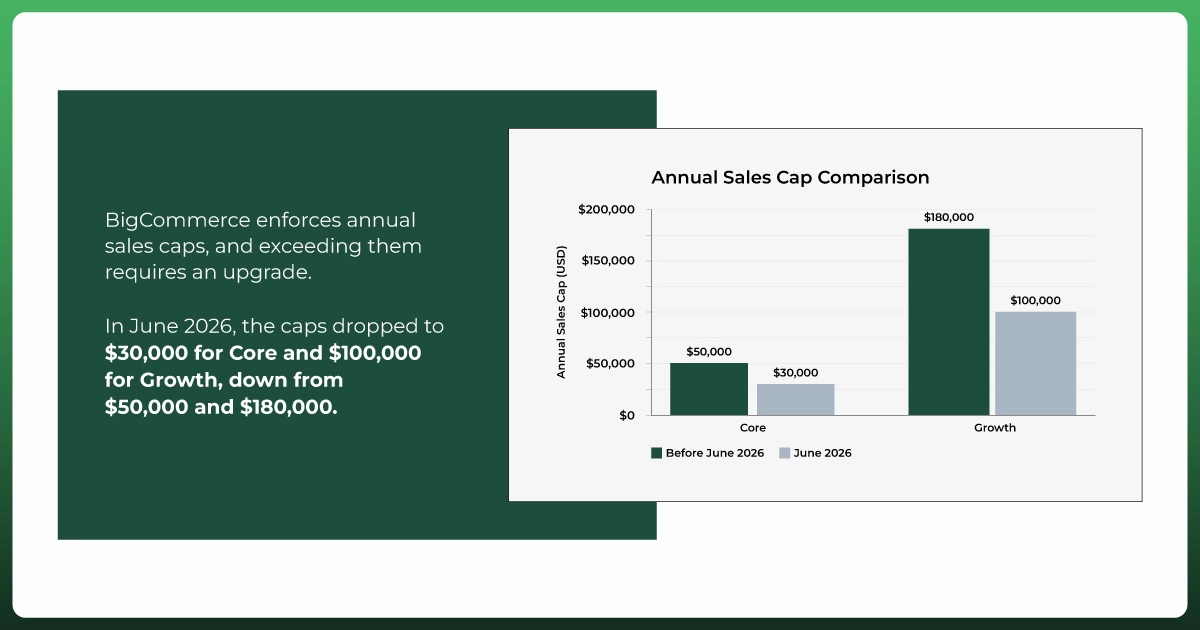
Here is a real difference. BigCommerce ties each plan to an annual sales cap, and crossing it forces an upgrade whether you want new features or not. In June 2026, those caps dropped: Core now caps at $30,000 a year and Growth at $100,000, down from $50,000 and $180,000.
Shopify has no such caps. You stay on your chosen plan at any revenue and upgrade only when you want better rates or features. For a fast-growing store, predictability matters, since a BigCommerce upgrade can arrive right when cash flow is tightest.
Transaction Fees and the June 2026 BigCommerce Fee Change
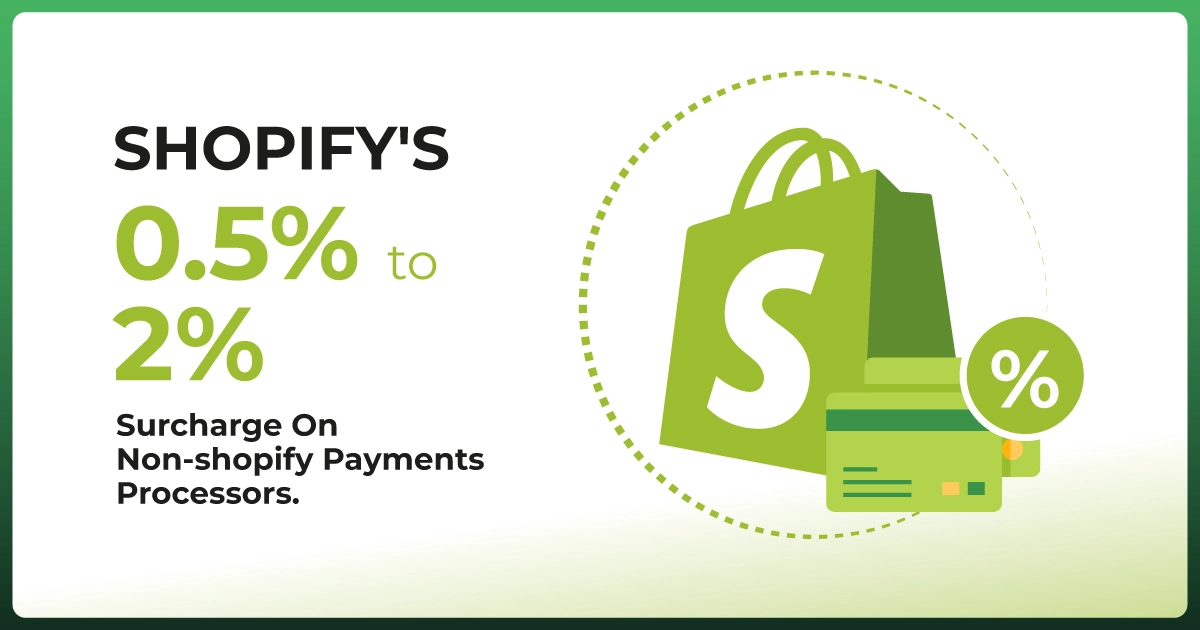
For years, BigCommerce's headline pitch was zero platform transaction fees on any gateway, a real edge over Shopify's 0.5% to 2% surcharge on non-Shopify Payments processors. That gap saved high-volume sellers real money.
That pitch weakened in 2026. Starting June 1, BigCommerce introduced an Open Payment Provider Fee on self-service plans. The math still favors BigCommerce for some third-party gateway users, but the zero-fees-forever story is no longer strictly true, and any current comparison needs to say so.
The Real Stack Cost: Apps, Themes, and Developers
Apps are where Shopify costs creep up. Most Shopify Plus stores spend $500 to $1,000+ a month on apps, because features like advanced filtering or customer groups often need paid add-ons. BigCommerce stores usually spend less here since more is built in.
Themes and development run similarly on both, roughly $100 to $500 for a premium theme and $150 to $250 an hour for experienced developers. The honest takeaway: Shopify can cost more in monthly apps, while BigCommerce can cost more through forced plan upgrades. Model both against your real numbers.
Want that math done for your store? We will map your true 3-year cost before you commit. Talk to our ecommerce team.
Design, Themes, and Ease of Use
Both platforms are hosted and beginner-friendly, but the day-to-day feel differs. One holds your hand; the other gives you more levers and expects you to know how to pull them.
Shopify's Editor and Liquid Templating
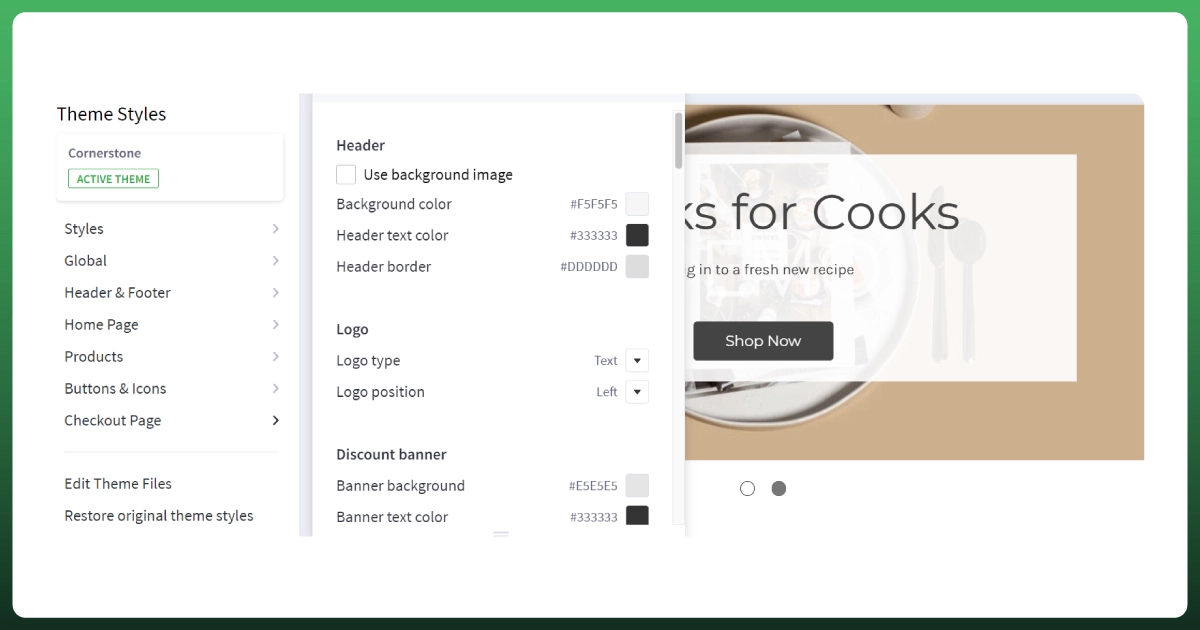
Shopify is the easiest admin in ecommerce. Setup takes under an hour with drag-and-drop themes, and its Liquid templating language has extensive documentation and a large agency pool behind it. The trade-off is that big changes still live inside Shopify's rules.
BigCommerce's Stencil Framework and Setup Curve
BigCommerce uses the Stencil framework, which gives developers more direct access to platform internals but carries a steeper learning curve that narrows the developer pool. You can easily scale the user experience of your website in BigCommerce. However, both platforms give full access to your HTML and CSS, so custom design is possible on either.
The practical read: if your team is non-technical and wants to launch fast, Shopify wins on ease. If you have developers who want open control over the theme layer, BigCommerce rewards them. Design ceilings are high on both; the effort to reach them differs.
Built-In Features vs App Dependency
This is the heart of the Open SaaS pitch. BigCommerce bakes in features that Shopify often asks you to add through apps. That changes both your monthly cost and how much you maintain.
Where BigCommerce Wins Out of the Box
Features you often add by app on Shopify, like native product filtering, product reviews, wishlists, persistent shopping cart, and customer group pricing, come native on BigCommerce. Fewer apps means fewer subscriptions and fewer moving parts to break after updates.
Shopify's App Store and Ecosystem Advantage
Shopify counters with sheer ecosystem scale: over 8,000 to 15,000+ apps in their app marketplace covering virtually every use case, plus the largest pool of agencies, developers, and tutorials in ecommerce. BigCommerce's marketplace holds around 1,200 integrations by comparison. However, Shopify’s integrated system is already ensures a smooth customer experience without too many apps.
So the choice is native depth versus ecosystem breadth. BigCommerce reduces the workarounds you buy; Shopify gives you a plug-and-play answer for almost anything, at a monthly cost. For lean teams that hate maintaining app stacks, native features are a quiet win.
Product Variants, Catalogs, and Native Product Filtering
If you sell complex products, this section may decide everything. Catalog architecture shapes your page speed, your filtering, and how many workarounds your team maintains. And 2026 reset the scoreboard here.
For years, BigCommerce won this outright in product management. It natively handled up to 600 variants per product, while Shopify capped at 100 variants and 3 options, pushing complex catalogs toward apps or workarounds. BigCommerce also has its own inventory management systems as well.
That changed in the Winter 2026 Renaissance update, when Shopify raised its native limit to 2,048 variants per product, removing what had been BigCommerce's single biggest technical selling point.
BigCommerce still leads on native product filtering, giving cleaner faceted navigation out of the box, though this sits on its higher-tier plan. The verdict now: the variant gap has closed, but BigCommerce keeps an edge on native filtering and faceted-URL control for very large catalogs.
SEO Features: Which Platform Drives More Organic Growth
For any brand betting on organic traffic, this is the section that matters most. Both platforms can rank well when the work is done right, but they hand you different levels of technical control. The gaps show up at catalog scale.
URL Structure, Canonicals, Sitemaps, and Redirects
Both cover the basics: SSL, auto XML sitemaps, 301 redirects, and canonical tags. The difference is control. BigCommerce allows URL customization and direct robots.txt editing, while Shopify enforces rigid /products/ and /collections/ paths and restricts robots.txt to theme-level code.
Shopify's dual /products/ and /collections/ paths can create a known duplicate-content issue that needs careful canonical management, whereas BigCommerce canonicalizes faceted navigation to base category pages by default. For deep catalogs, that saves real crawl-budget cleanup.
Blogging and Content Marketing Tools
Neither platform has a blogging engine as strong as WordPress, but both include one. If content marketing is central to your acquisition, plan to invest in structure and internal linking regardless of platform, since the built-in blogs are functional rather than powerful.
Core Web Vitals, Site Speed, and Schema
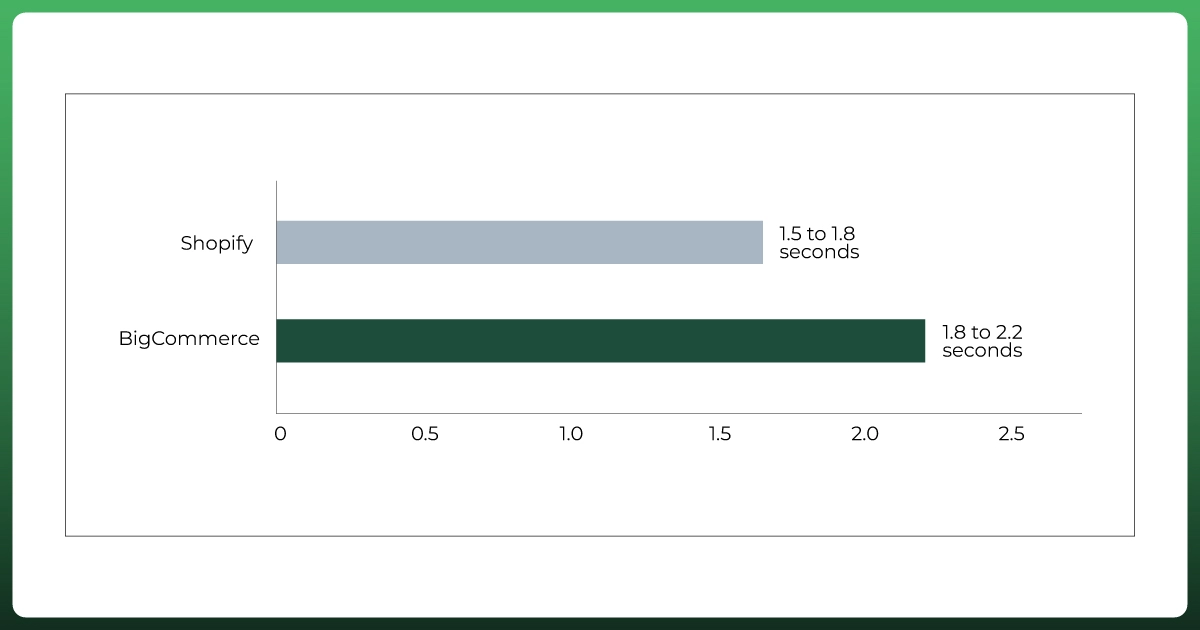
On page speed, fully optimized 2026 LCP benchmarks land around 1.5 to 1.8 seconds for Shopify and 1.8 to 2.2 seconds for BigCommerce. Shopify gives strong baseline speed with less effort, but its app JavaScript can push LCP past 4 seconds if the stack is not pruned quarterly.
On structured data, BigCommerce embeds basic product schema natively, while Shopify's native schema is minimal and usually needs apps or theme edits for full Product, Review, and FAQ markup. Schema now also feeds AI Overviews, so it matters more than ever.
The honest summary: most stores under $5M rank fine and run faster on Shopify. Merchants with large catalogs and serious technical SEO ambitions often hit a higher ceiling on BigCommerce, if they invest in the implementation.
B2B Ecommerce Features: The Gap That Narrowed in 2026
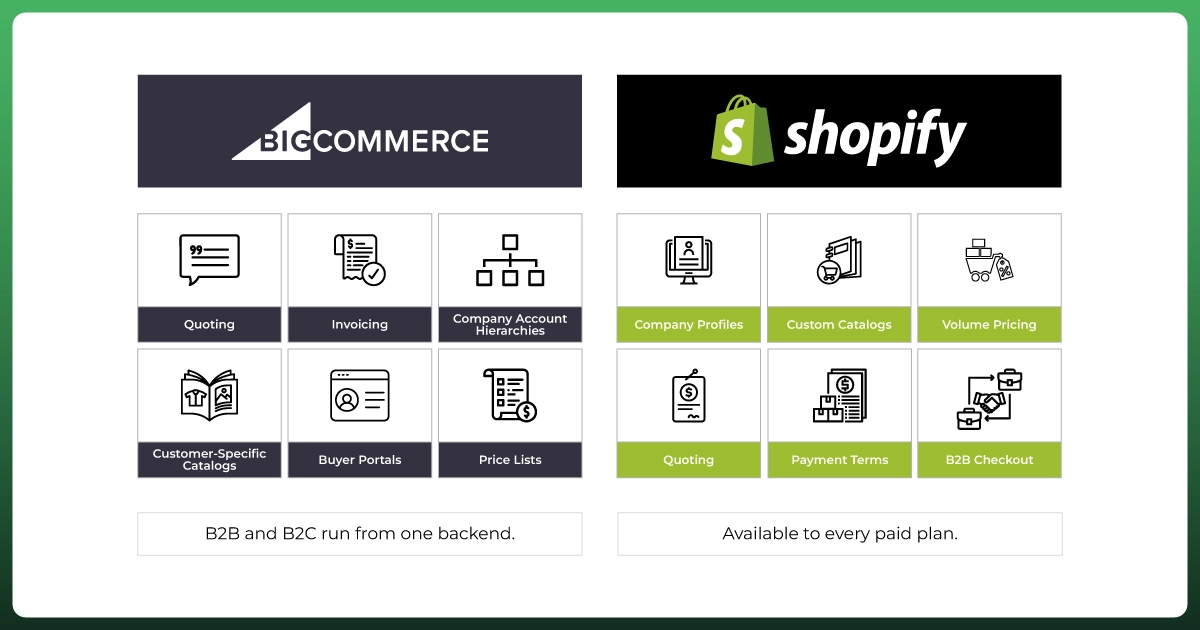
BigCommerce has long owned the B2B story. Its B2B Edition includes quoting, invoicing, company account hierarchies, customer-specific catalogs, buyer portals, and price lists, with B2B and B2C run from one backend.
Then Shopify moved. In April 2026, it opened core B2B features, company profiles, custom catalogs, volume pricing, and payment terms to every paid plan, not just Plus. That closed most of the everyday B2B gap.
So where does that leave you? For standard wholesale, both now handle company accounts and tiered pricing well. For deep, complex B2B with quoting, approval workflows, and hybrid B2B/B2C from one system, BigCommerce still holds an edge in native depth. The gap is real but smaller than a year ago.
Scaling, Multi-Storefront, and Developer Experience
As you grow, two things start to bite: how many storefronts you can run and how much your APIs can handle. This is where the Open SaaS design shows its value for technical teams.
Multi-Storefront Architecture and International Selling
BigCommerce offers native multi-storefront from lower tiers, letting you run several branded storefronts on one backend, which also cleans up international SEO with separate metadata per region. Shopify's equivalent expansion stores are gated behind Shopify Plus.
For international selling, Shopify Markets plus Plus expansion stores handle multi-currency and multi-language cleanly, and BigCommerce's multi-storefront plus Catalyst is also strong. Both work; BigCommerce simply reaches multi-storefront at a lower price point, which matters for mid-market brands.
API Rate Limits, Headless, and SaaS Ecommerce Scalability
BigCommerce's open architecture gives more generous API limits, even on mid-tier plans, while Shopify throttles harder on lower tiers, which can pinch high-traffic or headless builds.
For headless, Shopify offers Hydrogen and Oxygen as an integrated React stack, while BigCommerce is framework-agnostic and pairs with Catalyst on Next.js, avoiding front-end lock-in. Both scale well; the choice is integrated-and-guided versus open-and-flexible, matching each platform's core philosophy.
Checkout Extensibility and Payment Gateways
Checkout is where conversions live, so how much you can customize it and how you get paid deserves a close look. The two platforms take opposite routes here.
Checkout Customization: Shopify Functions vs BigCommerce Checkout SDK
BigCommerce gives open access to its checkout on every plan through the Checkout SDK, so you can rework steps and logic freely, at the cost of owning the maintenance forever. Shopify keeps deep checkout customization on Plus through Checkout Extensibility.
Shopify's advantage is safety: its Functions framework lets you customize checkout logic and discounts at code level across all plans, and changes run in a sandbox that survives updates without breaking PCI compliance. For most brands, upgrade-safe beats unlimited but fragile. The conversion rate of Shopify’s checkout system is comparatively high.
Third-Party Payment Gateway Support
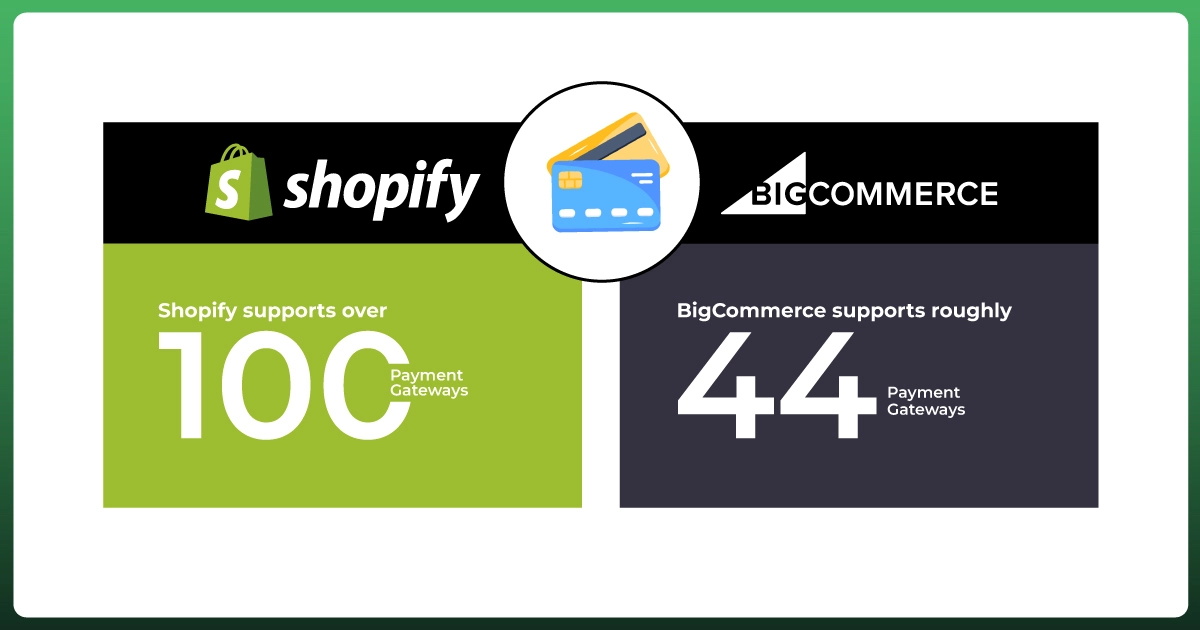
Shopify supports over 100 payment gateways to BigCommerce's roughly 44, so it wins on raw choice. But remember the fee structure: Shopify surcharges non-Shopify Payments gateways, while BigCommerce's new 2026 fee narrowed its old no-surcharge advantage.
Marketing, Social Commerce, and Multi-Channel Selling
Your store is only one sales surface. How each platform connects to marketplaces and social channels shapes how far your reach extends without extra tools.
Both connect natively to the major channels: Amazon, eBay, Meta (Facebook and Instagram), TikTok, and Google Shopping, and both include POS systems for in-person selling. On paper, they are close.
Shopify's edge is its own acquisition surface. Shop Pay and the Shop app give merchants a free customer-facing channel BigCommerce cannot match, and Shop Pay's accelerated checkout lifts conversion out of the box. For DTC brands chasing conversion, that matters.
If your growth runs through marketplaces, the platform is only half the job. Listing strategy and account management on Amazon, Walmart, or social media carry the rest, which is where a specialist team earns its keep.
AI Features and Store Automation
AI integration moved from novelty to daily workflow in 2026, and here Shopify has pulled ahead in native tooling. This is worth weighing if you want automation baked into the platform rather than bolted on.
Shopify bundles Shopify Magic for AI product descriptions, email copy, and image editing, plus Sidekick, an AI assistant that can now perform back-office actions like running a sale and updating the homepage from a text command.
BigCommerce leans on its open, API-first architecture and Catalyst headless stack to integrate AI tools, rather than a single bundled assistant. It is capable, but the AI is more assembled than built in.
The read for 2026: if native, ready-to-use AI matters to you, Shopify is ahead today. If you prefer to wire your own AI stack through open APIs, BigCommerce gives you the freedom to do it. For most teams, bundled beats assembled.
Security, Hosting, and Maintenance
Because both are fully hosted SaaS platforms, this is one area where they are genuinely close, and where both beat self-hosted options. Still, the details are worth knowing before you trust either with payment data.
Both include managed hosting, SSL on every store, PCI DSS compliance, security patching, and CDN-delivered assets. You do not manage servers, apply security updates, or handle PCI paperwork on either platform. That is the core SaaS benefit.
The practical difference is small. Shopify's fully closed stack means slightly less for you to break; BigCommerce's more open access gives you more control but a bit more responsibility over what you configure. For most owners, both remove security as a daily worry, which is the point.
Customer Support and Learning Resources
When something breaks mid-sale, support stops being abstract. Here both platforms are strong, which is a real advantage over open-source alternatives that leave you to fend for yourself.
Both offer 24/7 support through live chat, email, and phone, backed by deep documentation, help centers, and academies. Shopify adds the larger partner ecosystem, so finding a Shopify developer or agency is easier in most markets than finding a BigCommerce specialist.
The takeaway: support quality is comparable, but Shopify's bigger talent pool means faster access to outside help when you need custom work. BigCommerce support is solid; its specialist community is simply smaller.
Migration: Moving Between Shopify and BigCommerce
Plenty of brands switch platforms, usually toward a simpler operational model or toward more built-in features. Whichever direction you go, the process follows the same shape, and one step carries most of the risk.
A clean migration moves your products, variants, customers, orders, and content, then rebuilds the storefront in the new theme since themes do not port across. The single biggest risk is SEO: every indexed URL needs a 301 redirect to its new equivalent before launch.
Skip the redirect mapping, and you can lose years of rankings in the week you launch. Done right, you keep your organic traffic intact. This is the step most teams underestimate, and the one worth planning first, not last.
Shopify Plus vs BigCommerce Enterprise
At the top tier, the comparison sharpens. Both target high-volume brands, but they optimize for different strengths, which makes the Shopify Plus vs BigCommerce Enterprise choice a genuine fork.
Shopify Plus wins on ecosystem, checkout conversion, brand recognition, and developer availability, and includes 10 expansion stores. BigCommerce Enterprise wins on native features, more generous API limits, native B2B functionalities, and freedom from platform transaction fees, typically with 5 storefronts.
The rule of thumb: choose Shopify Plus if you want the richest app ecosystem and the best checkout with managed simplicity. Choose BigCommerce Enterprise if you want maximum native features, open flexibility, and lower transaction costs at high volume, and you have the technical team to use them.
Decision Matrix: Which Platform Fits Your Business Model
Strip away the features, and it comes down to a trade. Shopify trades some control for ecosystem and ease. BigCommerce trades some ease for native depth and open control. To close this BigCommerce vs Shopify comparison, here is how to place yourself.
When Shopify Is the Right Call
Choose Shopify if you are launching your first store, run a conversion-focused DTC brand, want the largest app ecosystem, value Shop Pay and social commerce, need native AI tools today, or want no forced upgrades as your revenue climbs.
When BigCommerce Is the Right Call
Choose BigCommerce if you run heavy B2B or wholesale, manage a large catalog needing native filtering, want multi-storefront without enterprise pricing, prefer built-in features over app stacks, or need zero platform transaction fees on a specific third-party gateway.
Factor
Shopify
BigCommerce
Best for
Ease, ecosystem, conversion
Native features, B2B, control
Setup
Under an hour
Steeper learning curve
Pricing model
No revenue caps
GMV caps trigger upgrades
Transaction fees
0.5-2% off Shopify Payments
New 2026 open payment fee
Product variants
Up to 2,048 (2026)
Up to 600 native
Native filtering
Often needs apps
Built-in (higher tier)
B2B
Native on all paid plans (2026)
Deeper native B2B Edition
Multi-storefront
Plus only
Native from lower tiers
App ecosystem
15,000+ apps
~1,200 integrations
Native AI
Magic + Sidekick
API-first, assembled
Wrapping Up: What Actually Decides the Choice from Our Experience
After building on both, the platform debate usually resolves faster than people expect once you name your real constraints. In practice, the decision comes down to a short list of questions:
Do you have developers, or do you need it to just work?
Is B2B or complex wholesale central, or a side channel?
Will your catalog have products with hundreds of variants and filters?
Do you need a specific local payment gateway without extra fees?
Is conversion and social commerce your top growth lever?
Answer those honestly, and the platform usually picks itself. If you want a second opinion mapped to your numbers and roadmap, our ecommerce team can scope it before you commit.
Frequently Asked Questions
Which is cheaper, BigCommerce or Shopify?
It depends on your model. Base plans are similar, around $29 to $39 a month. Shopify can cost more in monthly apps; BigCommerce can cost more through forced plan upgrades tied to your annual sales. Model the full 3-year stack, not the sticker price.
Does BigCommerce still have no transaction fees in 2026?
Not entirely. BigCommerce long charged zero platform transaction fees on any gateway. Starting June 1, 2026, it introduced an Open Payment Provider Fee on self-service plans. It can still be cheaper than Shopify's surcharge for some gateways, but the no-fees pitch weakened.
What is the product variant limit on each platform?
As of the Winter 2026 update, Shopify supports up to 2,048 variants per product, up from its old 100 limit. BigCommerce natively supports up to 600. Shopify's jump removed BigCommerce's biggest technical edge, though BigCommerce still leads on native filtering.
Which platform is better for B2B ecommerce?
BigCommerce still has deeper native B2B, including quoting, invoicing, and account hierarchies. But in April 2026 Shopify opened company profiles, custom catalogs, and payment terms to all paid plans. For standard wholesale, both work; for complex B2B, BigCommerce keeps an edge.
Which is better for SEO, BigCommerce or Shopify?
Both rank well when optimized. BigCommerce gives more native technical control, editable robots.txt, flexible URLs, and cleaner faceted-navigation canonicals, which helps large catalogs. Shopify is faster to run and rank for smaller stores but enforces rigid URL paths. Control versus simplicity.
How do API rate limits compare?
BigCommerce's open architecture offers more generous API limits, even on mid-tier plans, which suits high-traffic and headless builds. Shopify throttles harder on lower tiers, easing as you move up to Plus. For API-heavy integrations, BigCommerce has more headroom at a lower price point.
Shopify Plus vs BigCommerce Enterprise: which should I pick?
Pick Shopify Plus for the richest app ecosystem, best-converting checkout, and easier access to developers. Pick BigCommerce Enterprise for maximum native features, more open flexibility, generous API limits, and no platform transaction fees at high volume, if you have the technical team.
Need Help Choosing Your Ecommerce Platform?
Get Expert Shopify & BigCommerce Solutions From Ecomgiantz.
Ecomgiantz Team consists of our in-house experts who share their hands-on experience in ecommerce businesses, websites, marketplaces, etc. We also share the latest updates, insights, and market trends that can be helpful for your online business.