Adobe Commerce Vs Shopify: Which One Should You Pick
The Adobe Commerce vs Shopify debate has one key trade-off: control versus convenience. You get the open-source freedom in Adobe Commerce. You shape every part of the store.

The Adobe Commerce vs Shopify debate has one key trade-off: control versus convenience. You get the open-source freedom in Adobe Commerce. You shape every part of the store.


In 2026, you no longer worry about technical or development work while launching your new ecommerce website. Shopify and Adobe Commerce (now known as Magento) are two of the most reliable ecommerce platforms to launch your online store. But each one comes with some unique benefits and setbacks. So, which one should you choose?
The Adobe Commerce vs Shopify debate has one key trade-off: control versus convenience. You get the open-source freedom in Adobe Commerce. You shape every part of the store in your own way. But the cost and upkeep are up to you. On the other hand, Shopify Plus (not the beginner plans) comes with a fully managed platform. You can efficiently scale here without any maintenance hassle.
| Quick Verdict: For most enterprise stores or D2C brands, Shopify Plus is the perfect choice for speed, net spend, and saving time. However, Adobe Commerce is the right choice when deep B2B work, complex catalog, and control over hosting and coding matter most. |
Now, let’s compare the features, benefits, and drawbacks to help you find the new home for your online store.
At first, let’s show you a quick side-by-side comparison. If you’re not in the mood to read a detailed article, this table might help you pick the right option.
| Dimension | Adobe Commerce | Shopify Plus |
| Hosting model | Self-hosted or Adobe-managed cloud | Fully hosted SaaS |
| Pricing model | Quote-based, tied to GMV and AOV | Flat fee, then revenue share at scale |
| Platform and transaction fees | License fee, no forced gateway fee | 0.20% third-party gateway fee on Plus |
| B2B depth | Native B2B Edition, deep by default | Native B2B, strong and improving |
| Headless | PWA Studio, GraphQL, Edge Delivery | Hydrogen and Storefront API |
| API rate limits | You control throughput via your infra | Vendor-capped, deeper bucket on Plus |
| Implementation timeline | Around 4 to 12 months | Around 8 to 16 weeks |
| Best for | Complex B2B, custom catalogs, full control | Speed, unified B2B and DTC, lower TCO |
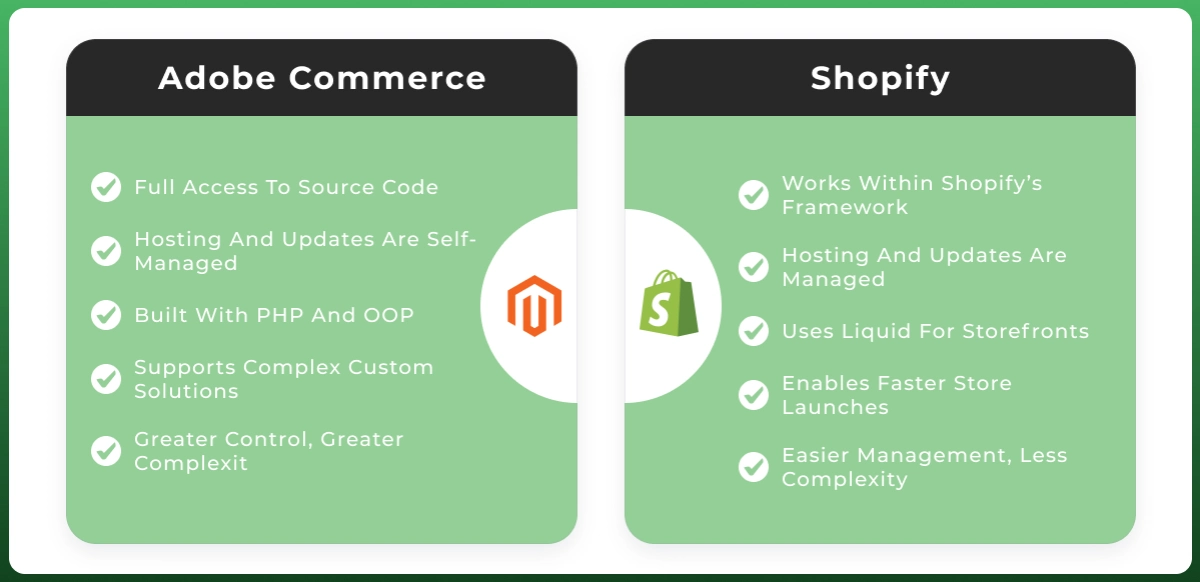
At first, you need to understand the core structure of both ecommerce platforms. Adobe Commerce is an open-source platform, whereas Shopify comes with closed SaaS functions.
In other words, Adobe Commerce is built on PHP and object-oriented programming. You get the code here to customize accordingly. But Shopify is a SaaS that runs on its own server and uses the Liquid theme on the frontend.
If you want freedom of design and features, Adobe Commerce is there for you. But for a secure and scalable solution, Shopify comes first.
Adobe Commerce gives you full access to the application code and extensive customization capabilities. But remember, the underlying infrastructure depends on your deployment model. That freedom is real, and so is the responsibility. You handle hosting, patches, and upgrades yourself, which is why serious builds usually need a dedicated web design and development team behind them.
Adobe Commerce comes in a few versions. Knowing them clears up most buyer confusion. Here, Magento Open Source is the free, self-hosted base. Whereas Adobe Commerce adds the enterprise features.
That is also where the Adobe Commerce Cloud vs Shopify question really lives. Both are managed and cloud-hosted, so the contest is not hosting anymore. It is how much control you keep and how much complexity you are willing to run.
Shopify manages hosting, security patching, and platform updates to ease your job. You spend more time selling instead of managing websites. You can easily launch your online platform faster than with Magento.
Shopify Plus takes the infrastructure off your plate. Hosting, security patching, and platform upgrades ship automatically. Most brands can stand up a store far faster this way, which is why a Shopify design service is often the quicker path to launch. You can create an uninterrupted customer experience with Shopify.
However, the system comes with limitations as well. You can only work within Shopify’s framework. Even the deep backend changes won’t allow you to change the core logic. Even so, small to medium-sized store owners don’t bother about limited customization. Only larger brands looking for a completely personalized solution won’t be happy with it.
Monthly subscription fees aren’t the whole scenario here. You need to calculate the total cost of ownership (TCO). It includes the amount you spend on license, platform fees, build, apps, maintenance, hosting, etc. TCO will unveil how much each platform might cost for a business.
According to the recent pricing, Shopify Plus starts around $2,300 per month. Once your ecommerce store passes roughly $800,000 in monthly sales, billing shifts to a revenue share of about 0.25% of GMV, capped at $40,000 per month. Third-party payment gateways add a 0.20% fee, but you can avoid it with Shopify Payments.
You won’t find any specific packages mentioned on the official site of Adobe Commerce. Here, licensing is quote-based and tied to your GMV and average order value. But according to our research, industry benchmarks put the license near $22,000 to $125,000 a year on-premise, and roughly $40,000 to $190,000 for Adobe Commerce Cloud. Platform fees will scale as you grow.
The license or subscription is only the beginning. On Adobe Commerce, full TCO usually runs two to three times the license when you add hosting, development, extensions, and maintenance. This costs many online enterprise stores between $122,000 and $450,000 a year. On Shopify Plus, apps and custom development typically add a few thousand dollars a month.
Shopify's own commissioned TCO research claims its total cost of ownership is about 29% lower than Adobe Commerce on average. But it's not the standard. For some businesses with high GMV and complex B2B requirements, Magento Commerce's native capabilities may offset its higher licensing costs. Below that, Shopify Plus usually wins on total cost.
If you run an ERP, a PIM, or a busy product feed, API rate limits decide whether your data syncs cleanly or stalls at the worst moment. This is the area almost no comparison quantifies, so here are the real numbers.
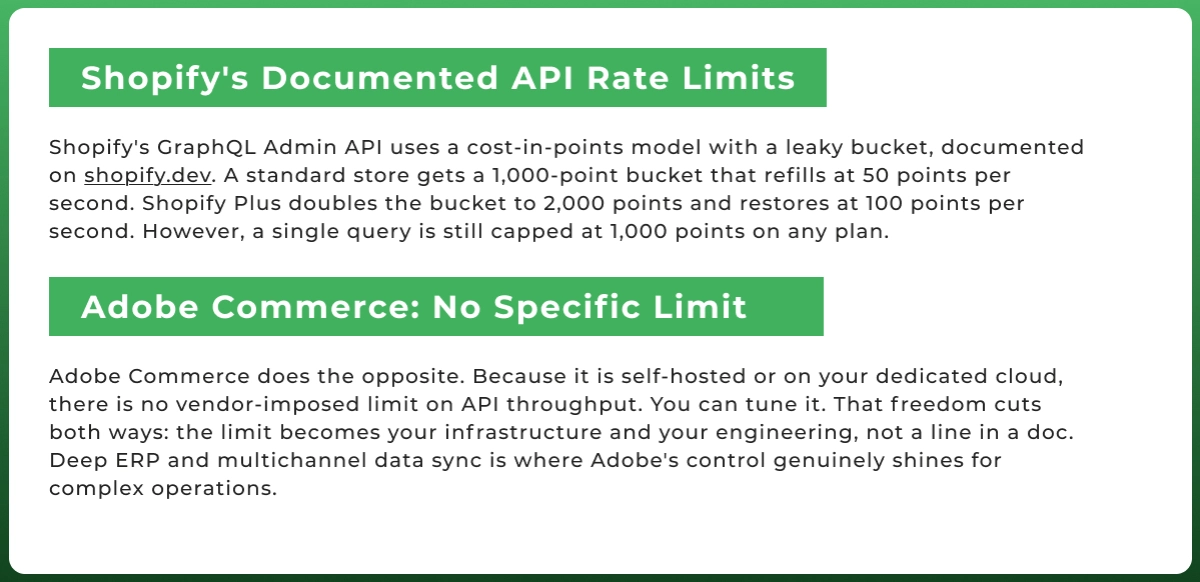
Shopify's GraphQL Admin API uses a cost-in-points model with a leaky bucket, documented on shopify.dev. A standard store gets a 1,000-point bucket that refills at 50 points per second. Shopify Plus doubles the bucket to 2,000 points and restores at 100 points per second. However, a single query is still capped at 1,000 points on any plan.
The older REST Admin API became legacy in October 2024 and runs at about two requests per second, doubled for Plus. For large exports, the Bulk Operations API sidesteps live limits entirely.
Practical takeaway: Plus buys you a deeper bucket and headroom, not unlimited calls, so heavy syncs still need queueing and backoff.
Adobe Commerce does the opposite. Because it is self-hosted or on your dedicated cloud, there is no vendor-imposed limit on API throughput. You can tune it. That freedom cuts both ways: the limit becomes your infrastructure and your engineering, not a line in a doc. Deep ERP and multichannel data sync is where Adobe's control genuinely shines for complex operations.
For wholesale, distribution, and manufacturing, B2B depth determines the right platform. Both Magento and Shopify are user-friendly platforms for B2B operations. But they have different features to offer.
Adobe Commerce ships a full B2B Edition with shared catalogs, customer-group pricing, and tiered volume discounts out of the box. You can show different catalogs and prices to different buyers without bolting on extensions.
On the other hand, Shopify now offers native B2B on Plus that covers most standard wholesale needs cleanly.
Adobe Commerce handles negotiable quotes, requisition lists, company accounts, and multi-step purchase approvals natively. A buyer requests a quote, a sales rep responds, and the order routes through an approval chain.
Shopify covers the core of this on the Plus plan only, and closes the remaining gaps with apps found in the store. That's why Adobe still leads for the most demanding B2B workflows.
An ecommerce platform with strong Core Web Vitals and responsiveness can actually convert and retain customers. A platform that lets you make your store SEO-friendly and mobile-first is the ideal choice for your business. Both Adobe and Shopify will let you optimize your website and manage the buyers’ journey.

Shopify's checkout is famously high-converting and handles enormous traffic spikes. But you can customize it within guardrails using Checkout Extensibility and Shopify Functions. The built-in functions are good enough to encourage buyers to confirm purchases.
On the other side, Adobe Commerce gives you full control of the checkout code and layout. If you need bespoke payment flows or verification steps, Adobe's openness wins.
But we’d recommend Shopify if you’re too afraid of cart abandonment. Those who don’t know how to create a better buyer’s journey should avoid Adobe Commerce.
Both platforms go headless, just with different toolkits. Shopify offers Hydrogen, its Oxygen hosting, and the Storefront API for custom front ends. Adobe Commerce counters with PWA Studio, a GraphQL storefront, and Edge Delivery Services for fast, decoupled builds.
On technical SEO, Adobe hands teams more levers. You control URL structure without forced subfolders, edit metadata and title tags freely at the product and category level, and use a built-in schema markup editor for rich results. Canonical tags and 301 redirects are fully yours to manage.
Shopify keeps SEO simpler but stricter. It locks you into /collections/ and /products/ URLs, caps title tags at around 70 characters, and needs an app for custom schema, though it auto-generates canonicals and redirects. Neither blocks strong rankings; Adobe just gives SEO specialists deeper control with multiple SEO tools.
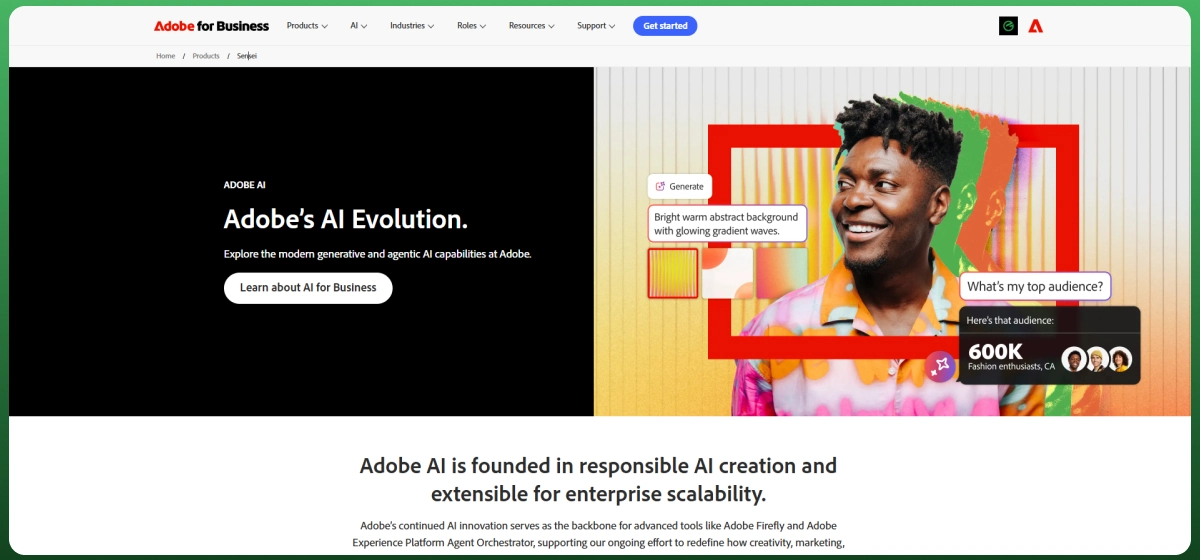
AI is now a real part of the Adobe Commerce vs Shopify decision. Adobe Commerce offers Adobe Sensei for smart product recommendations, live search, and automated merchandising. It goes deeper into data-driven merchandising.
And Shopify counters with Shopify Magic for content and Sidekick, its merchant-facing AI assistant, plus fast native search. This system is a broader solution for everyday ease for both customers and owners.
For a money topic, security is not a footnote. Shopify is PCI DSS Level 1 compliant across every store and manages patching for you, so compliance is largely handled.
Adobe Commerce is a certified PCI Level 1 solution provider too, but under a shared responsibility model: you still own patching, extensions, and hardening of your own code.
If you look at the industry, regulated industries often prefer that control; leaner teams prefer Shopify carrying the load.
Technical errors can happen anytime during your peak online selling time. Getting instant support from the platform’s officials will keep your business operational without any latency.
Shopify includes round-the-clock support through live chat on all plans. But in the Plus plan, you’ll also get support over phone calls. Not only that, but Plus members also get a dedicated Merchant Success Manager and priority response. So, any urgent issues are always addressed in due time.
Adobe Commerce works differently. Magento Open Source ships with no official support, so you lean on community forums, documentation, and your development partner. Paid Adobe Commerce includes official support, and Adobe Managed Services adds a designated Customer Success Engineer, though response times track your package tier.
| Facing trouble managing your store? Get ongoing store management service from us. |
As said earlier, you can’t find a single winner in Adobe Commerce vs Shopify. But what we can do is tell you which platform fits right for your model, budget, and custom requirements.
Choose Adobe Commerce if:
Choose Shopify Plus if:
If you are weighing the Shopify vs Magento decision for a specific store, the smartest move is to model your own three-year TCO and B2B needs. But don’t copy someone else's verdict. Talk to our team and we will map the right platform to your catalog, GMV, and timeline, with no pressure to switch.